
|
Dirty barrel. |
Post Reply 
|
Page <1234> |
| Author | |
britrifles 
Senior Member 

Joined: February 03 2018 Location: Georgia, USA Status: Offline Points: 8404 |
 Post Options Post Options
 Thanks(0) Thanks(0)
 Quote Reply Quote Reply
 Posted: January 07 2024 at 1:13pm Posted: January 07 2024 at 1:13pm |
|
^^^^ this is what the Outers Foul Out system does, and it removes copper and rust. But, not carbon, that has to be cleaned out another way.
|
|
 |
|
|
Mayhem
Senior Member
Joined: February 06 2016 Location: Australia Status: Offline Points: 335 |
Post Options
Thanks(0)
Quote Reply
Posted: January 07 2024 at 3:36pm |
|
@Shamu: I believe that there is a typo in their article, as their picture clearly shows positive to the anode and negative to the part.
However, I agree with Britrifles words of caution regarding damaging the barrel. Whilst I have not seen evidence of anything other than rust being removed (i.e., no damage to non-rusted material), I really only use this method on things that are manky to begin with. My primary concern was the blackening of the base metal where the rust has been removed, as shown in the pictures shown in my previous posts. This is why I suggest testings some pieces first. My other concern was placing the anode inside the barrel without shorting it. |
|
|
.303 - Helping Englishmen express their feelings since 1889
|
|
|
|
|
Zed
Special Member 

Donating Member Joined: May 01 2012 Location: France Status: Offline Points: 6460 |
Post Options
Thanks(0)
Quote Reply
Posted: January 08 2024 at 11:46am |
|
Shamu, interesting that on that site; the diagram shows the Negative to the rusted component; and the text states the Positive!
I tested using the negative on the rusted object; but I was using a different solution (ammonia, white vinegar and water). Two 12 minute sessions of 15 volts at 0.5 amp max. Here's the test piece.  First results, obvious reduction of surface rust on the test piece (left). But could be better; possible with extra sessions.  I will do some more testing with Sodium Carbonate soon. (I will make my own from Sodium bicarbonate)
|
|
|
It's nice to be important, but it's more important to be nice!
|
|
|
|
|
Shamu
Admin Group

Logo Designer / Donating Member Joined: April 25 2007 Location: MD, USA. Status: Offline Points: 20510 |
Post Options
Thanks(0)
Quote Reply
Posted: January 08 2024 at 1:49pm |
|
I think you have the right idea with so much conflicting info. IIRC its a slow process, so try overnight maybe? For test you might want to "go over" just to check it doesn't start eating the steel as well as the rust. Ideally you'd like it to eat all the oxide, but none of the metal.
|
|
|
Don't shoot till you see the whites of their thighs. (Unofficial motto of the Royal Air Force)
|
|
|
|
|
Mayhem
Senior Member
Joined: February 06 2016 Location: Australia Status: Offline Points: 335 |
Post Options
Thanks(0)
Quote Reply
Posted: January 08 2024 at 3:19pm |
|
With my method, I take the part out and scrub it under running how water and then return it. As Shamu has stated, it is a slow process.
|
|
|
.303 - Helping Englishmen express their feelings since 1889
|
|
|
|
|
Zed
Special Member
Donating Member Joined: May 01 2012 Location: France Status: Offline Points: 6460 |
Post Options
Thanks(0)
Quote Reply
Posted: January 08 2024 at 10:31pm |
|
With the ammonia and vinegar, the bubbling reaction slows after about 10 minutes. Possibly because of the small quantities of product in the test piece.
I will test with Sodium carbonate.
|
|
|
It's nice to be important, but it's more important to be nice!
|
|
|
|
|
britrifles
Senior Member
Joined: February 03 2018 Location: Georgia, USA Status: Offline Points: 8404 |
Post Options
Thanks(0)
Quote Reply
Posted: January 09 2024 at 3:29am |
|
What does the rod look like, is there a coating of red oxide?
|
|
|
|
|
Zed
Special Member
Donating Member Joined: May 01 2012 Location: France Status: Offline Points: 6460 |
Post Options
Thanks(0)
Quote Reply
Posted: January 09 2024 at 3:43am |
|
The rod was just wet with rusty solution; it wiped straight off.
I will be doing more tests before attempting to clean the barrel.
|
|
|
It's nice to be important, but it's more important to be nice!
|
|
|
|
|
britrifles
Senior Member
Joined: February 03 2018 Location: Georgia, USA Status: Offline Points: 8404 |
Post Options
Thanks(0)
Quote Reply
Posted: January 09 2024 at 4:07am |
|
Doesn’t seem to be working the way the Foul Out system worked. The rust accumulated on the rod like plating, had to be sanded off. I thing the polarity is wrong here…
|
|
|
|
|
Mayhem
Senior Member
Joined: February 06 2016 Location: Australia Status: Offline Points: 335 |
Post Options
Thanks(0)
Quote Reply
Posted: January 09 2024 at 4:39am |
|
I've have only ever used sodium carbonate, so I cannot comment on the polarity for the vinegar and ammonia solution. It isn't going to damage anything to reverse the polarity and see what happens, given that you are testing on scrap.
|
|
|
.303 - Helping Englishmen express their feelings since 1889
|
|
|
|
|
shiloh
Senior Member

Joined: January 08 2019 Location: Ontario, Canada Status: Offline Points: 3049 |
Post Options
Thanks(0)
Quote Reply
Posted: January 09 2024 at 5:49am |
|
Just my 2C`s worth of wizzdom, I`d be Leary about electro eroding the barrel and what I`ve done with a few rusty bores is to fill them with vinegar, plug the breech fill, let sit over night. empty scrub, repeat as needed. Use 5% vinegar as its less aggressive but works just fine. In some case it will ever start to resolve copper fouling.
|
|
|
|
|
britrifles
Senior Member
Joined: February 03 2018 Location: Georgia, USA Status: Offline Points: 8404 |
Post Options
Thanks(0)
Quote Reply
Posted: January 09 2024 at 6:04am |
|
This is all getting a bit risky in my humble opinion. Last thing you want to do is ruin a barrel, even one that is not in that great of shape.
Vinegar is an acid, a weak one, but still acidic. Ammonia is a weak base, so these two perhaps cancel each other out to some degree and may not pit the barrel if not left in too long. Ammonia will certainly attack the copper that is in there. Perhaps give it a good soak in Kroil for a few days and brush with a bronze brush. I bet that takes out all the rust. |
|
|
|
|
Zed
Special Member
Donating Member Joined: May 01 2012 Location: France Status: Offline Points: 6460 |
Post Options
Thanks(0)
Quote Reply
Posted: January 15 2024 at 1:23pm |
|
So I tried the Sodium Carbonate solution at the weekend. I made this by cooking Sodium Bicarbonate; (230°C for 60 minutes).
Two 15 minute sessions. The positive rod requires cleaning after 15 minutes, due to the build up of rust on the positive steel rod. Wipe out the tube with a rag between sessions. 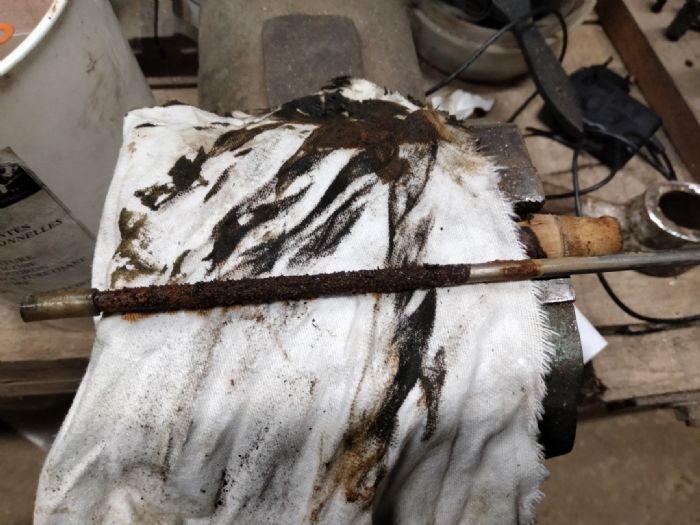  |
|
|
It's nice to be important, but it's more important to be nice!
|
|
|
|
|
Mayhem
Senior Member
Joined: February 06 2016 Location: Australia Status: Offline Points: 335 |
Post Options
Thanks(0)
Quote Reply
Posted: January 15 2024 at 2:57pm |
|
These are the same results that I get. Note the black colour of the inside of the pipe. This is why I suggested a test piece, as I am not sure that you want the inside of your barrel to look like that. Regardless, this is a very useful method for rust removal and one I use frequently (on selected items).
|
|
|
.303 - Helping Englishmen express their feelings since 1889
|
|
|
|
|
britrifles
Senior Member
Joined: February 03 2018 Location: Georgia, USA Status: Offline Points: 8404 |
Post Options
Thanks(0)
Quote Reply
Posted: January 15 2024 at 3:24pm |
|
Wonder if you reversed polarity now the rust would no back to the pipe? Or is that rust being generated by this process? Was the pipe covered in rust before you started this? Clearly, a different polarity is used to remove copper rather than rust.
Still, would make me nervous doing this on a barrel. Unless you plan on changing it regardless and just want to experiment.
|
|
|
|
|
Shamu
Admin Group
Logo Designer / Donating Member Joined: April 25 2007 Location: MD, USA. Status: Offline Points: 20510 |
Post Options
Thanks(0)
Quote Reply
Posted: January 16 2024 at 2:17pm |
|
The black coloration is very common with rust removal chemistry to varying degrees. The process, called "Chelation" draws carbon from inside the steel's structure to the surface as part of it. It can vary from mild grey to jet black. All the gruesome details:
|
|
|
Don't shoot till you see the whites of their thighs. (Unofficial motto of the Royal Air Force)
|
|
|
|
|
Post Reply
|
Page <1234> |
| Tweet |
| Forum Jump | Forum Permissions You cannot post new topics in this forum You cannot reply to topics in this forum You cannot delete your posts in this forum You cannot edit your posts in this forum You cannot create polls in this forum You cannot vote in polls in this forum |


 Topic Options