
|
Effect of Canting the Rifle on Accuracy |
Post Reply 
|
Page 12> |
| Author | |
britrifles 
Senior Member 

Joined: February 03 2018 Location: Georgia, USA Status: Offline Points: 8404 |
 Post Options Post Options
 Thanks(0) Thanks(0)
 Quote Reply Quote Reply
 Topic: Effect of Canting the Rifle on Accuracy Topic: Effect of Canting the Rifle on AccuracyPosted: January 01 2025 at 9:11am |
|
Strangely Brown (Mick) and I have been emailing on the subject of errors in point of aim induced by canting the rifle. That is a rotation of the rifle down the axis of the bore.
With a scoped rifle, it’s fairly easy to hold the rifle reasonably “level” using the horizontal reticle line as a horizon reference. Not so easy with iron sights. Some simple math shows the lateral error in direction the barrel is pointing becomes quite significant at high rear sight elevations. For most shooters, this would mean 600 yds and beyond. The reason I went down this rabbit hole was to understand the source of my fairly wide lateral dispersions at 800 and 1000 yards with the No. 4. This of course applies to any rifle, scoped or metallic sights. But the calculations of error depend on elevation setting which is different for different bullet trajectories. What I thought to be missed wind strength and direction calls at 1000 yds was probably variations in the angle of cant in holding the rifle. To give a bit of perspective, if my No. 4 7.62 conversion firing my Long Range load (which requires much less elevation of the rear sight compared to .303 Mk 7 ball) is rotated about the bore axis by 5 degrees, that results in a lateral shift of the bullet point of impact of 3.5 minutes (35 inches at 1000 yards). It is considerably less at 800 yards, about 2.25 MOA (18 inches at 800 yds, half the amount at 1000 yds). At 600 yds, it’s down to 1.5 MOA (9 inches at 600 yds, or one quarter of what it is at 1000 yds). So, how much is 5 degrees? Well, looking at an analog clock, 1 minute movement of the long hand equates to 6 degrees. I’d think looking thru an aperture sight, it would be tough to judge less than a 6 degree cant. In any typical 10 shot group, there will be deviations in the angle of cant. Unless you are using some sort of leveling device, such as a spirit level attached to the rifle, it’s difficult to hold this error to less than 5 degrees (meaning +/- 2.5 deg). These errors are enough to move the bullet out of the 10 ring at 600 yards and out of the 7 ring at 1000 yards approaching a complete miss of the target. If you shoot competition, that’s a big deal. This prompted me to try and quantify the deviations in angle of cant in my prone shooting position. Based on my results at the target, I doubted it was as much as +/- 2.5 degrees. To measure this, I fitted the MantisX training device to the muzzle of the No. 4 and did some dry firing. This records movement of the rifle just prior to and just after trigger release and plots the information in the vertical plane on a target overlay. It also displays the angle of Cant at the moment of trigger release. The deviation (max - min) in angle of cant for the 10 rounds of dry fire was 2.8 deg. I think a 3 degree cant deviation would be reasonable to expect during actual firing, and sometimes probably more. A 3 degree deviation results in just over 2 MOA lateral point of impact change at 1000 yds. This seems to explain why I’m getting more than 4 MOA lateral spread on average at 1000 yard 10 shot groups. It’s not all because of missed wind calls. Errors sometimes add, sometimes cancel out. If my aiming error is 2 MOA, angle of cant is 2 MOA and missed wind shifts is 2 MOA, that could sometimes mean a group that is 6 MOA wide, The diameter of the 7 ring on the Long Range Target. But, sometimes the errors cancel, and you get what I had last time with 4 consecutive shots within less than 1 MOA. If anyone has made it this far, you’re a shooter for sure!  MantisX installed on No. 4 DCRA below: 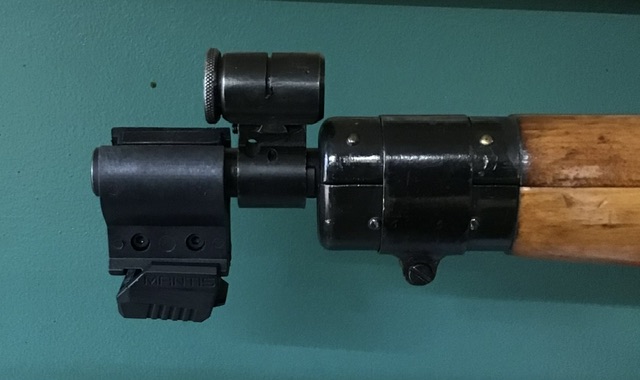 MantisX display showing muzzle movement: Blue line - during the hold just prior to striker release Yellow line - movement during striker release Red line - after striker release. Angle of cant shows in the upper right box, it is 4.4 degrees. The zig-zag line shape I believe is due to my pulse. This is a useful training aid to show you how much rifle movement occurs at the time of striker release. This image is zoomed way in to the inner “X” ring on the target overlay. Movement is much more in the standing position. 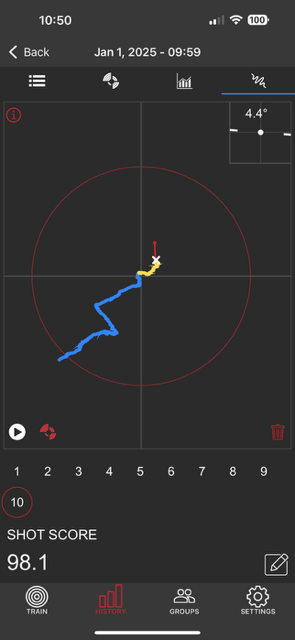 |
|
 |
|
|
Zed
Special Member 

Donating Member Joined: May 01 2012 Location: France Status: Offline Points: 6460 |
Post Options
Thanks(0)
Quote Reply
Posted: January 01 2025 at 9:18am |
|
That's very interesting! A useful piece of kit for long distance shooting, and indeed any target shooting.
|
|
|
It's nice to be important, but it's more important to be nice!
|
|
|
|
|
Strangely Brown
Senior Member

Joined: April 05 2022 Location: Wiltshire Status: Offline Points: 645 |
Post Options
Thanks(0)
Quote Reply
Posted: January 01 2025 at 9:48am |
|
"Spirit levels: It is permitted to attach spirit levels or other level indicators to
the rifle".
Just found this snippet in the 2004 Bisley Bible Geoff; I seem to recall such items were banned in Target Rifle in the past but not Match Rifle where anything (scopes, Gallien sights etc.) goes.
|
|
|
Mick
|
|
|
|
|
britrifles
Senior Member
Joined: February 03 2018 Location: Georgia, USA Status: Offline Points: 8404 |
Post Options
Thanks(1)
Quote Reply
Posted: January 01 2025 at 10:26am |
|
Certainly banned here for Service Rifle shooting Mick, but I can’t find any reference to allowing the use of a spirit level (or scope that gives a level indication) in the rules for Match Rifle and F-Class Rifle.
I ran another dry fire test, this time breaking position for each shot (taking rifle down off the shoulder, working action, then back up on the shoulder and “fire”). This time I really concentrated on holding the rifle as level as possible based on the vertical front ring supporting strips. That got the canting angle deviation (max - min) down to 1.6 degrees (1.12 MOA lateral spread at 1000 yds). That’s much better. I never really thought about this or paying particular attention to trying to hold the rifle consistently level. Now curious to see if I get any improvement next time I shoot the rifle at 800 and 1000 yds. |
|
|
|
|
Strangely Brown
Senior Member
Joined: April 05 2022 Location: Wiltshire Status: Offline Points: 645 |
Post Options
Thanks(0)
Quote Reply
Posted: January 01 2025 at 10:31am |
Me neither Geoff; I'm at 600 & 900 at Bisley on the 14th; I hadn't planned to shoot my No.4 but you've roused my curiosity!
|
|
|
Mick
|
|
|
|
|
britrifles
Senior Member
Joined: February 03 2018 Location: Georgia, USA Status: Offline Points: 8404 |
Post Options
Thanks(0)
Quote Reply
Posted: January 01 2025 at 11:06am |
|
Just to prove out the theory, I’m going to deliberately take some shots with the rifle notably canted left and right and plot the target hits. I should be able to do this with the MantisX fitted so I know what the cant angle was. I’ll cant the rifle to what I think would be quite evident looking thru the sights taking that as a “maximum”. Cant go too far as it could easily create a miss at 1000x.
The only time I pay any particular attention in shot to shot angle of cant is at the 600 yd prone slow fire stage with the AR Service Rifle looking thru the scope. I also check my initial position during the 200 yard sitting rapid fire stage as I deliberately cant the rifle about 15 degrees to the right so I could get good head position on the stock and eye alignment to see thru the scope. I “index” the angle of cant by looking at the horizontal reticle line position on the two adjacent targets such that it is at the top edge on the target to the left and bottom edge on the target to the right. This amount of cant causes a significant shift of the bullet POI at 200 yards and the sight elevation and windage settings adjusted accordingly. It’s all about shot to shot consistency. Mick, I actually think it was you that got me thinking of this some months back! But I put it in the back of my mind until I saw the results of last Mondays 1000 yard shoot. |
|
|
|
|
Shamu
Admin Group

Logo Designer / Donating Member Joined: April 25 2007 Location: MD, USA. Status: Offline Points: 20510 |
Post Options
Thanks(0)
Quote Reply
Posted: January 01 2025 at 11:30am |
|
I have a tendency to cant to the right. Always the right no matter
what rifle! Its just something i instinctively do, just not a good
instinct! With the FAL I used the magazine as a guide! if it was not just touching the inside of the left forearm I was canting right!  For that reason & the fact there's precious
little "Square, Vertical, or Horizontal" places on a No4 I found &
added this little bubble level to the scope mounting rail! It was just a few bucks on E-Bay. Its
reasonably well sheltered from knocks or anything & mounts to the
dovetails in the mount so it IS square! You can see it simply by
opening the left eye & glancing slightly downwards. I
originally intended it to be a temporary "training aid" to break the
habit, but its become a fixture since I don't compete formally any more  |
|
|
Don't shoot till you see the whites of their thighs. (Unofficial motto of the Royal Air Force)
|
|
|
|
|
Doco Overboard
Senior Member
Joined: January 26 2020 Location: USA Status: Offline Points: 279 |
Post Options
Thanks(0)
Quote Reply
Posted: January 01 2025 at 11:42am |
|
My copy of the textbook of small arms p64 has a bit on the effect of canting the rifle during the act of aiming. It would be interesting based on the determination of two accomplished shooters and with use of some of the technology as described above to see what else can be learned by what they actually experience. Because I cant shoot well enough to any great distance I personally cannot say. Or really I should probably say that Im not dedicated or squared away enough to make an accurate distinction based on my own application of marksmanship principles. Anyway, I have often read to where others express (even argue) that there is no effect of canting the rifle to which I don't believe based on my own humble experience.
|
|
|
|
|
Shamu
Admin Group
Logo Designer / Donating Member Joined: April 25 2007 Location: MD, USA. Status: Offline Points: 20510 |
Post Options
Thanks(0)
Quote Reply
Posted: January 01 2025 at 11:45am |
|
Hey, nice to see you posting. Ask those same shooters if they square their scope reticle or just get it close & see what they say!
 |
|
|
Don't shoot till you see the whites of their thighs. (Unofficial motto of the Royal Air Force)
|
|
|
|
|
britrifles
Senior Member
Joined: February 03 2018 Location: Georgia, USA Status: Offline Points: 8404 |
Post Options
Thanks(0)
Quote Reply
Posted: January 01 2025 at 12:37pm |
|
There is a mathematical certainty that canting any small arm will have an effect on moving the bullet POI, but that effect is proportional to the amount of elevation put on the rear sight. At short ranges (say out to 200 yds), the effect is probably not noticeable unless the cant angles are large.
It has been proven experimentally as well. Here, I’ve attempted to quantify the amount of shot to shot variance in the cant angle by use of the MantisX training aid. I’ve read in a few places that the best marksman can hold to an angle of 3 degrees or less. That seems to be true based on my own measurements. Canting does also affect elevation POI, but this is not significant for relatively small angles (6 degrees and less) out to 1000 yards, here is an example: For a 40 MOA rear sight elevation required for 1000 yards (typical .308 with a 168-175 grain high BC long range bullet at a MV of 2600 to 2650 fps): 5 deg of cant gives 0.15 MOA reduced elevation POI and 3.5 MOA lateral POI deviation. 10 deg of cant gives 0.61 MOA reduced elevation POI and 6.95 MOA lateral POI deviation. 10 degrees is very excessive and would be obvious to any level of shooter I would think. For a serious Service Rifle competitor, anything over 1 MOA deviation is worth trying to correct or minimize. Guys shooting long range PRS, Bench Rest or F-Class definitely worry about this and do what they can to minimize it. If you’re shooting at 100 yards, you can ignore this entirely, but you would see an impact if you shoot gangster style laying the rifle over on its side like in the movies! |
|
|
|
|
Shamu
Admin Group
Logo Designer / Donating Member Joined: April 25 2007 Location: MD, USA. Status: Offline Points: 20510 |
Post Options
Thanks(0)
Quote Reply
Posted: January 01 2025 at 6:20pm |
|
If you read the installation instructions for most of the old Target sights they are big on "squaring them" which is a (kind of) reverse cant! Literally shims, heating & bending mount adopters a so on are all mentioned as essential. My "Central" sight for the SMLE actually has a neat double screw coaxial adjustment built in for doing this without heating, bashing or bending the plate.
|
|
|
Don't shoot till you see the whites of their thighs. (Unofficial motto of the Royal Air Force)
|
|
|
|
|
britrifles
Senior Member
Joined: February 03 2018 Location: Georgia, USA Status: Offline Points: 8404 |
Post Options
Thanks(0)
Quote Reply
Posted: January 02 2025 at 5:45am |
|
Yes, having a backsight or scope not leveled to the rifle will cause this same error, it would move the bullet impact point laterally with increasing elevation setting. You can test for this using a zeroing target placed at close range (71 feet) and shoot three shot groups with increasing elevation settings to see if bullet impact tracks vertically or is leaning to one side. 71 feet 7 inches is convenient as at that distance, 1/4 inch represents 1 MOA, bullet holes should be touching at that distance and a small size target can be used.
In setting up the scope on the T, great care was taken by H&H to culminate and true the scope to the individual rifle. I can’t detect any change in lateral POI in my T between 100 and 600 yard scope settings as long as I hold the horizontal graticule line in the scope level.
Canting the rifle then introduces further error, particularly when each shot is canted at a different angle. Good groups however can be made with sights or scopes not truly aligned to the bore axis by making adjustments to windage and holding the same degree of cant. But, you would want to avoid the need to dial in windage adjustments for each different range (an indication that the backsight or scope is not aligned to the bore). |
|
|
|
|
Bear43
Special Member

Donating Member Joined: August 11 2010 Location: Doland, SD Status: Offline Points: 3500 |
Post Options
Thanks(0)
Quote Reply
Posted: January 02 2025 at 7:59am |
|
This is very interesting. I never had any idea that canting the rifle had that dramatic of an effect on point of impact.
|
|
|
|
|
Canuck
Special Member

Donating Member Joined: January 17 2012 Location: Cochrane, AB Status: Offline Points: 4021 |
Post Options
Thanks(0)
Quote Reply
Posted: January 02 2025 at 8:27am |
|
Gentlemen, these technical posts are amazing! Thank you for sharing your valuable information with the rest of us!
|
|
|
Castles made of sand slip into the sea.....eventually
|
|
|
|
|
A square 10
Special Member

Donating Member Joined: December 12 2006 Location: MN , USA Status: Offline Points: 16998 |
Post Options
Thanks(0)
Quote Reply
Posted: January 02 2025 at 9:38pm |
|
i have that level on my M14 type rifle - its also got my best scope on it and my best bipod and shooting sling , i rely on it when i feel im less than perfect in my setup ,
im putting one on my kimber bench rest rifle as well ,
|
|
|
|
|
DarioPirovano
Senior Member
Joined: May 20 2023 Location: Italy Status: Offline Points: 219 |
Post Options
Thanks(0)
Quote Reply
Posted: January 03 2025 at 4:53am |
|
Great topic.
|
|
|
|
|
Post Reply
|
Page 12> |
| Tweet |
| Forum Jump | Forum Permissions You cannot post new topics in this forum You cannot reply to topics in this forum You cannot delete your posts in this forum You cannot edit your posts in this forum You cannot create polls in this forum You cannot vote in polls in this forum |


 Topic Options
 britrifles wrote: