
|
Getting Best Results From Your .303 British Cases |
Post Reply 
|
Page 12> |
| Author | ||||||
Rick 
Groupie 
Joined: April 24 2025 Location: NW MT/SE BC Status: Offline Points: 83 |
 Post Options Post Options
 Thanks(0) Thanks(0)
 Quote Reply Quote Reply
 Topic: Getting Best Results From Your .303 British Cases Topic: Getting Best Results From Your .303 British CasesPosted: September 07 2025 at 10:44am |
|||||
|
A frequently heard complaint is that "Lee Enfields all have excess headspace" and "Lee Enfield brass only lasts a couple of reloadings". Urban Legend BullSchiff. The reality is that the "Lee Enfield excess headspace problem" primarily only exists between the ears of unknowledgeable American gun writers and reloaders. You don't hear the same whining and whinging from Commonwealth nation competitors reloading for Service Rifle competition i.e. the Canadians, Brits, Aussies, etc. And some of the better of that lot, once handloading became legal, have been running very stiff loads through their rifles, whether the usual .303 British or rifles like the Canadian DCRA conversions that are rechambered to 7.62 This is a .303 British handloading topic where there is a lot of supporting background detail and corporate knowledge available to throw out there to discuss and opine about. Much as I enjoy that sharing and discussion, for the sake of this being a basic primer, I will try to avoid going into the nuances and context of that in this post as much as possible. For best results, whether just case life and/or best grouping results during load development, this is the basic workflow to achieve that objective. It is a one time process only done prior to first firing of your new brass to minimize and control the stretching of the brass on first firing. It does not have to ever be repeated again with that brass:
That's the basic outline of how to select and prepare your .303 British brass for best case life and performance. You can do something similar with "the O-ring trick". That technique for case prep prior to first firing does indeed hold the rim back against the bolt face. But everything forward of that is drooping down, unsupported anywhere in the Lee Enfield's large chamber, left to expand wherever it wants on first firing. There is no guarantee you will see noticeable differences by forming a false shoulder for case preparation versus the O-ring technique. But the addition of centering the case in the longitudinal access of the chamber by supporting it at the front cannot possibly hurt. One final thought: case neck annealing also offers the potential to improve both case life and grouping potential. Hardened case necks cracking is another source of cases failing and being scrapped, and inconsistent neck tension due to work hardened necks is detrimental to consistency and grouping. While there is no benefit to doing it as I do, anneal after every firing as part of the process of inspecting and depriming fired brass, it takes very little time to do this per case. Most shooters other than those in the benchrest type extreme accuracy disciplines feel annealing about every five firings is sufficient. I do not have an annealing machine, the best (and most expensive) option. I do it as the benchrest competitor and metallurgist described in an article of Precision Shooting: I hold the case by the base between my fingers while turning the neck and shoulder in the flame of a lab alcohol lamp. When the base gets too hot to continue holding in your fingers (only a few seconds), drop it on a cloth and continue with the next case. The alcohol lamps and 99% pure alcohol for fuel are only a few dollars on Amazon and elsewhere, and using 99% alcohol instead of an even less expensive candle results in very little smoke and soot on your cases needing cleaning. This is not the very best way to get the very best annealing results, but it close enough that what it lacks isn't going to detract from the results while handloading for the .303 British. For your information and consideration... |
||||||
 |
||||||
|
britrifles
Senior Member 

Joined: February 03 2018 Location: Georgia, USA Status: Offline Points: 8404 |
Post Options
Thanks(0)
Quote Reply
Posted: September 07 2025 at 1:10pm |
|||||
|
Good write up Rick.
I like the idea of expanding the neck to get the cartridge case to headspace on the shoulder at first firing. How may reloads have you got from your brass with this method?
Totally agree on neck sizing to the maximum extent, then a partial length resize to bump back the shoulder just enough to lock the bolt. That’s the approach I’ve been using since I started reloading .303. I’ve used a Lee Collet die for many years, and typically get 30 to 40 (perhaps even more) reloads before the case web cracks. A PL resize is needed after about 10 reloads, sometimes I’ll get more. If loads are stiff, you will get less number of neck sizing between PL resizing. There is no question though, that .303 British case life is very short if the cases are FL sized (even if they are PL sized). The rear locking lugs do result in more axial deflection of the bolt and receiver resulting in more case stretch than a Mauser action. I’ve lost count how many reloads I’ve done on the .30-06 brass for my M1 rifles which are FL resized every time. For years I rarely annealed the case necks, but I’m now a believer and do it every reload. |
||||||
|
||||||
|
Shamu
Admin Group 

Logo Designer / Donating Member Joined: April 25 2007 Location: MD, USA. Status: Offline Points: 20510 |
Post Options
Thanks(0)
Quote Reply
Posted: September 07 2025 at 1:42pm |
|||||
|
A part of the problem is people conlfating rimmed & rimless head-spacing. Then, add to that the old hoary 'Generous Chamber" & the fact the rifle & case were never designed to be reloaded, we're off to the races again.  A while back I posted down in the reloading section on the value of "Smoke Smudging" & "Partial full-length resizing". You might find a peek there interesting. Its an old post & for some reason has not "stickied" so its maybe lost though.  a HUGE help in extending brass life is to keep each rifles brass segregated to that rifle as well. I have many cases on the 6th & 7th reloading cycle with zero signs of case stretching to the point of incipient failure.
|
||||||
|
Don't shoot till you see the whites of their thighs. (Unofficial motto of the Royal Air Force)
|
||||||
|
||||||
|
britrifles
Senior Member
Joined: February 03 2018 Location: Georgia, USA Status: Offline Points: 8404 |
Post Options
Thanks(0)
Quote Reply
Posted: September 07 2025 at 2:16pm |
|||||
|
It takes a lot more than 7 reloads to get thinning of the case web, unless you PL resize every time. If you full length sized every time, probably only get 2 or 3 reloads before the case head separated.
Definitely helps segregating brass for each rifle. In my reloading notebook, I record the case "headspace" length (from head to the shoulder datum) using a Hornady Headspace Gage for each No. 4 rifle I have. Ideally, I'd have a sizing die set up for each rifle so I don't have to fiddle with it when I change to sizing cases for a different rifle. This is where a micrometer type adjustment of the lock ring would be very helpful, I've put index marks on the die body which gets it close.
By minimizing the number of PL resizes, you can get military brass cases up to around 40 reloads. If anyone gets more than that, let me know how you do it. One way would be to shoot cast lead bullets T much lower pressures. I calculated the amount of bolt compression at the 19.5 tons breech pressure and it’s significant, even assuming the case takes 30% of the axial load via friction in the chamber. It's this compression of the bolt body that stretches the case. By neck sizing only, it certainly helps extend brass life, but case web cracking above the head has always been the failure mode I've experienced with the .303. Next time I break out a new batch of PPU cases, I’ll try this method of expanding the necks to get the case to headspace on the "new" formed shoulder at first firing, I think this approach has merit. |
||||||
|
||||||
|
clancey1849
Groupie
Joined: August 27 2025 Location: USA Status: Offline Points: 23 |
Post Options
Thanks(0)
Quote Reply
Posted: September 08 2025 at 6:53am |
|||||
|
Forgive my ignorance, but what exactly is "PL" resizing? I am not familiar with that abbreviation.
|
||||||
|
||||||
|
britrifles
Senior Member
Joined: February 03 2018 Location: Georgia, USA Status: Offline Points: 8404 |
Post Options
Thanks(0)
Quote Reply
Posted: September 08 2025 at 11:56am |
|||||
Partial Length resizing. That is a term given to the method of adjusting the die in the press by unscrewing it slightly such that the case shoulder is “bumped” back by a few thousandths of an inch. In Full Length sizing, the die is usually screwed all the way down until it contacts the she!! holder with the press ram fully up. |
||||||
|
||||||
|
Shamu
Admin Group
Logo Designer / Donating Member Joined: April 25 2007 Location: MD, USA. Status: Offline Points: 20510 |
Post Options
Thanks(0)
Quote Reply
Posted: September 08 2025 at 2:33pm |
|||||
|
I can't find the original post, sorry I searched without success. I'll go find the original article & post then sticky it this time.
|
||||||
|
Don't shoot till you see the whites of their thighs. (Unofficial motto of the Royal Air Force)
|
||||||
|
||||||
|
Rick
Groupie
Joined: April 24 2025 Location: NW MT/SE BC Status: Offline Points: 83 |
Post Options
Thanks(0)
Quote Reply
Posted: September 08 2025 at 9:46pm |
|||||
What you're actually doing is converting your loads (and rifle I suppose) to being the same as a rimless cartridge: after doing this you're headspacing on a shoulder datum, NOT the rim as with ball and commercial ammunition. Whatever the size of the chamber your rifle has when you purchased it, you can't change that (other than to set back and recut the chamber). But by doing this, it is child's play to convert your brass headspacing on the shoulder rather than the rim. Number of rounds I get? Can't say; I purchased 400 - 500 PP cases when they first became available and I began realizing that we wouldn't always have HXP and similar to purchase in bulk. And the HXP empties weren't going to last forever, either. I don't have a specific plan, but I set a hundred aside and they are for best quality service rifle loads. Using small numbers in each lot I set aside, I don't lose track on how often each case is fired with full power loads. After about 25 times, they get sidelined into use with my cast bullet loads from that point onward. I still have some of that original lot of formed brass that has not yet been put into service. I probably fire 50 cast bullet rounds for every round of ball Service Rifle loads, and at about 2,000 fps as my fun walk 'n shoot loading, I have yet to get to where I am losing cases with either loading.
|
||||||
|
||||||
|
britrifles
Senior Member
Joined: February 03 2018 Location: Georgia, USA Status: Offline Points: 8404 |
Post Options
Thanks(0)
Quote Reply
Posted: September 09 2025 at 3:36am |
|||||
|
The concept of getting the .303 to headspace on the shoulder is not new of course. I've been doing that for 25 years now; but what I had not done is get that to happen on first firing. About that time, I read Steve Redgwell's book on reloading the .303 British and that's where I got the idea along with using the Lee Collet Neck Sizer. I wasn't able to find the Lyman .338 Win M Die yesterday on-line, but I did see .337 neck expanding mandrels for my LE Wilson Expanding die and will try that. On my recent barrel replacements, I have not done a final chamber ream as this only lengthens the depth to the shoulder making the situation worse. The CBI and LW barrels are supposed to come 0.010" short chambered, but 0.01 short on a SAAMI chamber reamer is still too long compared to commercial and military brass. I'm also setting headspace on the tight side, a bit under 0.064" such that the bolt is just short of fully closing on the 0.064 GO gage. This seems to be helping, although I suspect preventing the large strain in the case web area at the first firing will make a significant difference to case life. The Hornady Case Headspace Comparator is very useful for setting up the sizing die for when you need to do a partial length sizing. It's especially useful if you have more than one .303 rifle! A big debate over the years on lubing cases for the first firing. I think that would also work, if you significantly reduce loads. I would not do this will a full power military ball load. |
||||||
|
||||||
|
clancey1849
Groupie
Joined: August 27 2025 Location: USA Status: Offline Points: 23 |
Post Options
Thanks(0)
Quote Reply
Posted: September 09 2025 at 7:02am |
|||||
|
I bought a set of neck sizing RCBS dies for my reloading. My HXP 75 ammo is boxer primed, so I am reloading it using those. Got a bunch of the Hornady 174 gr Boattails to load in it and they are supposed to be here today. Looking at BL (C)-2 and Varget for load development and am going to try to mimic the 2440 fps velocity of the ball ammo. I also got a radar chronometer to clock it with from Athlon.
I did notice in three different sources for reloading data that there is a wide variation in starting and max load amounts listed. All used different components also, of course.
|
||||||
|
||||||
|
Shamu
Admin Group
Logo Designer / Donating Member Joined: April 25 2007 Location: MD, USA. Status: Offline Points: 20510 |
Post Options
Thanks(0)
Quote Reply
Posted: September 09 2025 at 10:33am |
|||||
|
And different barrels & actions. If the data source lists it (& good ones should) it will say what the tests were done in.
|
||||||
|
Don't shoot till you see the whites of their thighs. (Unofficial motto of the Royal Air Force)
|
||||||
|
||||||
|
Rick
Groupie
Joined: April 24 2025 Location: NW MT/SE BC Status: Offline Points: 83 |
Post Options
Thanks(0)
Quote Reply
Posted: September 09 2025 at 3:06pm |
|||||
No, it's not. Nor is the idea of setting up ideal headspacing via creating a false shoulder prior to first firing. Owners of obsolete cartridges and handloaders have been using and documenting this process from before I started reloading in the early 1970's. Rocky Gibbs of the Gibbs wildcats, Art Mashburn of the Mashburn magnums, etc were doing this and writing about it in the 1940's. I got into it because when I found my prized .35 Newton hunting rifle in the 1970's, I had exactly 20 empty virgin unfired cases that came with it. Ammunition for Newton's awesome magnums invented in the early 1900s has been out of production since the early 1950s. The chances of getting more cases was exactly zero, so read every book, babied every one of those cases, prepared them as perfectly as possible before first firing. There was no "Google it" in 1974, which is partially why I have so many earlier books on reloading, wildcatting, etc. That's how I learned about this process. And in doing so, discovered the world of shooters who were out there busily preparing rare cases for the obsolete chamberings that they were still shooting. There is a lot of corporate knowledge that still exists in the shooting/handloading world, and yet many of today's reloaders are completely unaware of its' existence. At our gun show last weekend, I walked past many copies of books written by George Nonte, Townsend Whelen, etc that the vendors couldn't sell even with a "$10" price tag on them. (I also walked by two tables that each had an Ishapore 7.62 that appeared to be in good shape, with price tags of $700 dangling from them... but I have zero interest in those rifles and have no idea if that was a good price and if they sold)
Redgwell did a great job of taking the community corporate knowledge regarding the Lee-Enfield, compiling it, and then selling it. I remember him from his earliest days of showing up on the forums right after the WWW became a thing around 1994. Can't say whether I remember him from the earlier FidoNet days. He's gone beyond that to selling shooting products... a fine example of capitalism at work.
Most would be surprised if it didn't i.e. why WOULDN'T lower working pressures on each firing lengthen the working life of your cartridges? Not all shoot cast at reduced velocities. Most do so because those reduced velocities give them all they're looking for without all the fiddling and F'ing around that is needed when you load to higher velocities (without resorting to paper patching your bullets). Especially The Gravel Pit Tin Can Killers... not a lot of precision required for that flavour of fun. 1600 fps i.e. "The Load" will deliver that with very little fumbling or fooling around to develop casting technique and knowledge. Cheap fun... Others do try to find loads where they still have the grouping they find acceptable along with higher velocities. This is of particular interest to those bullet casters that are into precision casting i.e. cast bullet benchrest matches, as well as cast bullet hunters that want maximum range and terminal performance WITHOUT leading their bore from front to back. Both of those groups (and experimenters) have found the right combination of alloy, Bn hardness, bullet mould, and so on to get both good grouping and center fire velocities. Ken Mollohan who mentored me in my early days of precision bullet casting had competition benchrest .30 caliber loads that chronographed around 3,000 fps he took to matches on windy days (he wrote articles for some of Lyman's bullet casting manuals). Tom Gray is another. (for those interested in cast bullets in their Lee Enfields, there's a lot of corporate knowledge over on the CBA's website and forum) To get those kinds of results, as Ken, Tom, and others in the cast bullet benchrest crowd have taught for decades, you have to pay a lot of attention to matching the Bn hardness of your cast bullets to your load's pressures in order to stay within their tensile strength at the pressures they are being launched at. Those doing that put a LOT of work into finding how to do that with every rifle and every barrel they attempt it with. I'm not one of them willing to put so much work into succeeding in that... There's a formula regarding that which some metallurgists from that crowd have developed over the years, along with the process of how to heat treat your alloy to get the Bn hardness you desire. If anyone can't find that for themselves and is interested, I'll dig through my stuff and post it up here. Might even be in one of Lyman's cast bullet handbooks. While developing cast bullets for my latest (and probably last) custom rifle, a Mannlicher stocked Husqvarna action chambered in .35 Whelen, with careful fitting, sizing, and bullet design, I have a 225 grain WFN design that will stay inside an honest MOA at 100 and still around 1.5 MOA at 200. Not too shabby when it's chronographing 2500 fps... only about 150 fps slower than the fastest jacketed loads.   For my Lee Enfield, the design I put together and had Tom at Accurate
Moulds cut to fit my chamber will group with my HXP ball ammo while
being launched at 2270 fps. 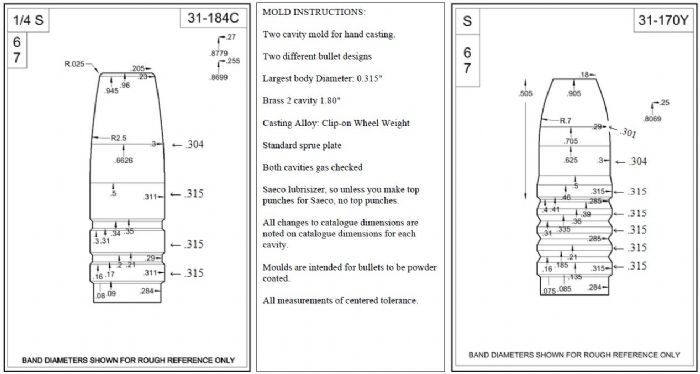 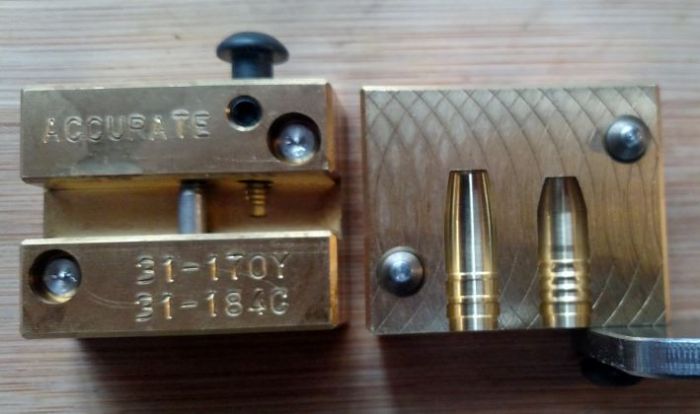 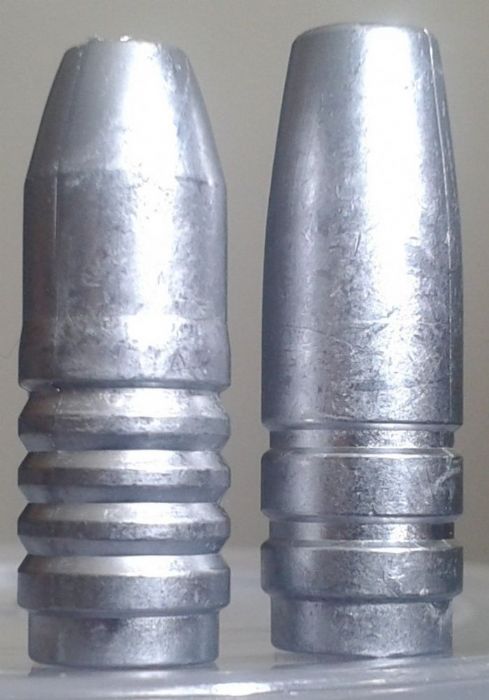  Interestingly enough (and perhaps not surprisingly, considering the dominance of the wadcutter design in handgun PPC and Bullseye competition), it is the WFN design that delivers the most accuracy, not the other design I had cut into that mould block thinking it might deliver a grouping edge due to being kind of a Loverin design (i.e. tapered). Once you get it figured out, casting 500 bullets for practicing your offhand shooting at 100 yards is a LOT less expensive than launching Sierra MatchKings or other jacketed designs. I'm a pretty deliberate bullet caster and I kick out about 150 good bullets for every hour of casting. Not a bad time investment. And for the vast majority of offhand Service Rifle shooters, I don't think the decreased MV will make the slightest difference while practicing with the far less expensive cast.
That will definitely work. Lyman doesn't call or label it ".338 Win". Or they didn't in the past. Just as they don't label the M die for .303 British that way (I think it's labeled "30L" or something like that. Anyways, I was mildly surprised to see The Usual Suspects in their online catalogues are all 'out of stock' for both the 8mm M die and 33 M die as well Lyman's website is more of the same. I had use a Lee universal neck expander (or whatever they call it) to add a little flare to the case mouth so the neck expander would enter the neck instead of collapsing it in on itself. I suppose I should chuck the mandrel in a drill press or whatever and put a bit of an angle on the end so it enters case necks just as it is. But it's a once in a decade operation, so I've never bothered actually doing it.
I imagine it is. I would think that barrel companies catering to the Lee Enfield crowd would know how detrimental using SAAMI specifications are and listen to the serious shooters and gunsmiths working on those replacement LE barrels. Apparently not... I'm nowhere near considering a replacement barrel. If and when I get there I will ask my tame gunsmith (and flyfishing/motorcycling partner and decades long Service Rifle competitor) what he thinks of having one of the better companies drill out the bore of the original barrel and install a liner. And perhaps whatever other trickery he might suggest to keep the fit in the draws exactly as it is now.
I follow that a bit when it pops back up, mostly out of curiosity given how adamant those on both sides of the isle are about it. My take is simply this: why bother with lubed cases when there's no agreement on what is going on when those oiled cases are fired? And you KNOW that by using the false shoulder technique, you aren't dealing with what the pressures could be with oiled cases, the load it puts on the cases and action, etc!
|
||||||
|
||||||
|
Shamu
Admin Group
Logo Designer / Donating Member Joined: April 25 2007 Location: MD, USA. Status: Offline Points: 20510 |
Post Options
Thanks(0)
Quote Reply
Posted: September 09 2025 at 4:00pm |
|||||
|
I found the smoking & smudging file. Its too big to upload, which is why I couldn't find it. I'll try redcing the image sizes to see how much I can shrink file size without making it gibberish. Give me a few days.
|
||||||
|
Don't shoot till you see the whites of their thighs. (Unofficial motto of the Royal Air Force)
|
||||||
|
||||||
|
Sapper740
Senior Member

Joined: July 15 2021 Location: Texas Status: Offline Points: 1737 |
Post Options
Thanks(0)
Quote Reply
Posted: September 10 2025 at 5:00am |
|||||
|
"The reality is that the "Lee Enfield excess headspace problem" primarily only exists between the ears of unknowledgeable American gun writers and reloaders."
There's those darn Americans 'whinging' again! The truth of the matter is every myth and old wive's tale I ever heard regarding anything to do with shooting sports was on a B.C. rifle range somewhere. Too bad you had to mar an otherwise excellent post with an uncalled for dig against Americans.
|
||||||
|
||||||
|
Rick
Groupie
Joined: April 24 2025 Location: NW MT/SE BC Status: Offline Points: 83 |
Post Options
Thanks(0)
Quote Reply
Posted: September 10 2025 at 8:58am |
|||||
Every single myth and old wives tale you've ever heard was on a BC rifle range??? Not even a single one while living in Texas? How many years have you been living in Texas and frequenting gun ranges in Texas by now that you've never heard a single myth or old wive's tale about "shooting sports"? And did you just accidentally refer to "shooting sports" instead of "Lee Enfields" - the specific topic I was writing about? Or you just missed the specific topic of the post and zeroed in on what offended you? Too bad you haven't noticed previously that I immigrated to Montana from BC after 30 years in the Canadian infantry by choice - which is similar to what I suspect (given your username here) you did to end up in Texas. Odd choice for me to make, given the years and thousands of dollars it cost to do that legally and obtain naturalization citizenship - all that so I could choose to live among people you claim I want to take digs at! So... you self-identifying from having some familiarity with BC's rifle ranges (while a combat engineer in 1 CER back in the CFB Chilliwack days, perhaps?) around the Lower Mainland, as well as membership in more than one, which specific ones should I have heard this urban legend endlessly repeated? Like you, I also owned memberships in some of those ranges from Victoria on the Island, all the way out to Chilliwack; so which ones? The ones hosting DCRA matches I attended (like the Barnet Rifle Club that you must remember)? Lots of Lee Enfields around to be talked about at those matches! And because context and nuance are important: assuming you actually frequent online forums other than this one over the last 30 years, read print and online offerings from gun writers, etc - did you only hear about the urban legend "Lee Enfield headspace problem" during your time spent on BC rifle ranges? Or perhaps instead: you saw it in print or online, all posted by gunwriters and opinion writers living in BC (or somewhere else in Canada) and were members of of those BC rifle ranges you frequented? This BS about "excess headspace" didn't begin and spread in Canada, Australia, NZ, etc. And those spreading it aren't overwhelmingly Canadian, Australia, NZ, etc writers in print and online. And it was around in print long before Fidonet and then the WWW arrived to spread both information and BS 30 years ago. If that reality offends you now that you're down in Texas, I'm sorry... I guess. BTW, Canadian firearms enthusiasts aren't immune to parroting what they see and hear in print and online - just to assure you they don't get a pass. Just as American firearms enthusiasts at the ranges I belong to here regularly tell me Canadians aren't allowed to own guns. I don't just nod my head up and down to that least I offend my fellow gun club members. Would you prefer instead that I apologize to you for hurting you right in the feels this morning?
|
||||||
|
||||||
|
Shamu
Admin Group
Logo Designer / Donating Member Joined: April 25 2007 Location: MD, USA. Status: Offline Points: 20510 |
Post Options
Thanks(0)
Quote Reply
Posted: September 10 2025 at 10:07am |
|||||
|
A Gentle rules reminder. No sl*gging! Disagree as much as you wish that's fine, but no attacks by group or name. Keep it civilized, please.
|
||||||
|
Don't shoot till you see the whites of their thighs. (Unofficial motto of the Royal Air Force)
|
||||||
|
||||||
|
Post Reply
|
Page 12> |
| Tweet |
| Forum Jump | Forum Permissions You cannot post new topics in this forum You cannot reply to topics in this forum You cannot delete your posts in this forum You cannot edit your posts in this forum You cannot create polls in this forum You cannot vote in polls in this forum |


 Topic Options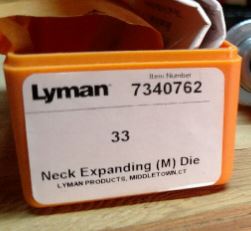
 clancey1849 wrote: