No. 4 Conversion to 7.62
Printed From: Enfield-Rifles.com
Category: Enfields
Forum Name: 7.62 Enfield
Forum Description: All things to do with the 7.62 Enfield
URL: http://www.enfield-rifles.com/forum_posts.asp?TID=12404
Printed Date: March 26 2026 at 6:57pm
Software Version: Web Wiz Forums 12.07 - https://www.webwizforums.com
Topic: No. 4 Conversion to 7.62
Posted By: britrifles
Subject: No. 4 Conversion to 7.62
Date Posted: December 07 2022 at 5:25pm
|
A number of members have asked about conversions of the No. 4 .303 to fire the 7.62 NATO cartridge. Early trials in Canada by the DCRA were done by modifying a .303 barrel to chamber the 7.62 with good results. The following photos are of a January 1961 Canadian Marksman article written by Dave Reynolds of the DCRA that was in my Dad’s files. Hopefully they are clear enough to read. Unfortunately, I’m not smart enough to know how to stitch these together as a single PDF file. I’ll try to enlist the help of a more technically savvy member to do that for me.  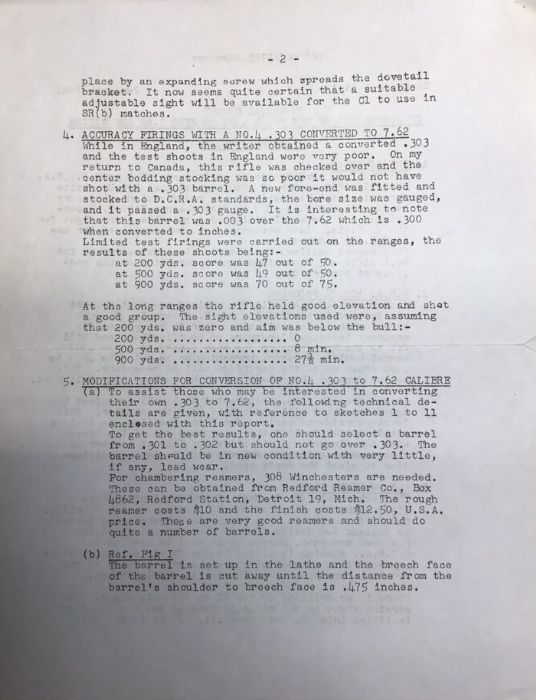      |
Replies:
Posted By: scottz63
Date Posted: December 07 2022 at 5:40pm
|
That is a bad way to convert, to me anyways. 7.62 bore is .30, .303 is way too big. Where are you going to find a .303 barrel that is .301 to .302? Even .302 is getting too big for 7.62 as I like under .302 for my .30 cal rifles. Not a good way to do this IMHO.
Thanks for the document! Interesting. ------------- 14EH AIT Instructor-PATRIOT Fire Control Enhanced Operator/Maintainer |
Posted By: britrifles
Date Posted: December 07 2022 at 5:54pm
|
.301 to .302 is quite common. And it worked quite well even with a .303 bore, read Para 4. This was done for DCRA SR(b) Matches with good results. It’s also been shown that .308 bullets will shoot quite good when loaded into the .303 case. So, not surprising it works quite well when re-chambering a .303 barrel to 7.62. Agree, a better way is to find a 7.62 barrel for the No. 4, but good luck finding one. |
Posted By: scottz63
Date Posted: December 07 2022 at 6:12pm
Yup, agreed. It just does not sit well with me. I'm usually a stickler for tight bores. Starting out with a .302 bore for a .30 cal round is just backwards to me. It may have worked well enough, but I don't like it. Lol! All of my U.S. Military .30 cal rifles are well under .302, most under .301
------------- 14EH AIT Instructor-PATRIOT Fire Control Enhanced Operator/Maintainer |
 britrifles wrote:
Posted By: Goosic
Date Posted: December 07 2022 at 8:40pm
scottz63. Just a FYI. An actual 7.62 projectile is .309" (Source 7.62x39) and as britrifles mentioned, it is not uncommon for the Enfield to have bore measurements of .301" - .302". My BSA 5 groove measures @ .300". An old target shooter buddy of mine got me invested into shooting 168grn .308" BTHP's out of a No4Mk1* with a 2 groove barrel because it will grip the bullets a tad better than the 5 groove. I have even used the Lapua 200grn 7.62x54R .3105" FMJ Rebated Boattail. In retrospect of what britrifles has shown to us, doing the necessary work and rechambering a .303B to 7.62x51mm is fairly straightforward and will still offer good accuracy results using projectiles between 150 and 180grn with better than average results using the 155grn and the 168grn match grade projectiles. DCRA actually did this procedure to many No4Mk1/Mk2 rifles with no issues... An old target shooter buddy of mine got me invested into shooting 168grn .308" BTHP's out of a No4Mk1* with a 2 groove barrel because it will grip the bullets a tad better than the 5 groove. I have even used the Lapua 200grn 7.62x54R .3105" FMJ Rebated Boattail. In retrospect of what britrifles has shown to us, doing the necessary work and rechambering a .303B to 7.62x51mm is fairly straightforward and will still offer good accuracy results using projectiles between 150 and 180grn with better than average results using the 155grn and the 168grn match grade projectiles. DCRA actually did this procedure to many No4Mk1/Mk2 rifles with no issues...
|
Posted By: scottz63
Date Posted: December 08 2022 at 6:06am
|
I get it, and understand that it works. Just sounds odd to me. ------------- 14EH AIT Instructor-PATRIOT Fire Control Enhanced Operator/Maintainer |
Posted By: scottz63
Date Posted: December 08 2022 at 6:12am
Just checked my No4 sporterized barrel. I has the best bore out of all 3 of my No4 barrels. Too bad it has been cut down.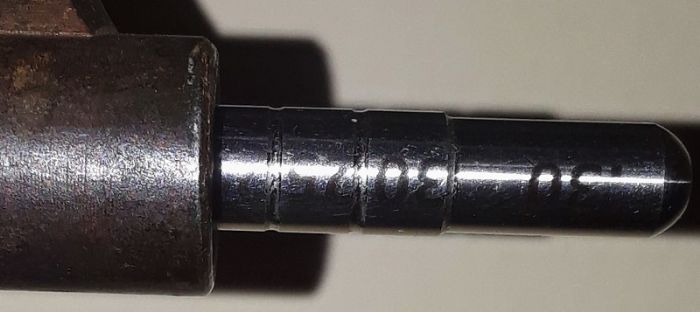 ------------- 14EH AIT Instructor-PATRIOT Fire Control Enhanced Operator/Maintainer |
Posted By: britrifles
Date Posted: December 08 2022 at 6:43am
| Hard to read that, is it .3020? Or .3015? |
Posted By: scottz63
Date Posted: December 08 2022 at 6:44am
|
.302 ------------- 14EH AIT Instructor-PATRIOT Fire Control Enhanced Operator/Maintainer |
Posted By: britrifles
Date Posted: December 08 2022 at 6:48am
Yes it does. But there was a pretty compelling reason to do this. The DCRA matches relied on government issue ammunition at the match. That was to help keep cost to the shooters down and have a level playing field. The stocks of .303 ammunition were on the decline by 1960 and new 7.62 No. 4 barrels were not yet available. |
Posted By: scottz63
Date Posted: December 08 2022 at 6:49am
|
Got it. :) ------------- 14EH AIT Instructor-PATRIOT Fire Control Enhanced Operator/Maintainer |
Posted By: Moosm14
Date Posted: December 12 2022 at 10:37am
|
Is the mating of Ishapore 2a .762x51 barrels to No4 actions I’ll advised or unworkable? ------------- There is room for all of gods creatures ... right next to the mashed potatoes |
Posted By: britrifles
Date Posted: December 12 2022 at 10:40am
| Goosic has successfully done this. He should be along here to comment. |
Posted By: Goosic
Date Posted: December 12 2022 at 10:59am
Definately not unworkable just really time consuming, and only ill-advised if you do not have the proper skill set to do it correctly. There is alot of fitting up and re-fitting up just to get the barrel indexed correctly which involves removing excess metal from the barrel that contacts the reciever. Once that is accomplished, the next step is to check the headspace using 7.62 headspace gauges and not 308W. This is the time consuming part. You will have to shorten the boltface by stoning it until the correct headspace is achieved and that take alot of patience. A 2A1 magazine can be modified to fit into the No4 mag well but keep in mind that cartridge extraction is going to be hit or miss.
|
Posted By: lawndart
Date Posted: December 15 2022 at 3:47pm
|
Thank you very much for posting this britrifles. Moosm14, to add to Goosic's comment, it's actually very easy to re-index the 2A1 barrel if you have access to a lathe. The shoulder needs to be shortened by about 35 thousandths. It's pure pain if you only have hand tools... But trivial if you have a lathe. You may need to file the extractor cut a bit deeper to match the deeper chamber. The headspacing part is also very easy if you have a chamber reamer. I've never finish-reamed/set headspace on a lathe, but you can readily rent a pull-through reamer (at least in the US) from reamerrentals.com or others. You cut the chamber deeper rather than grinding the bolt face down and re-heat-treating it. A .308 Win headspace gauge should be fine. It's marginally shorter than a 7.62 NATO gauge. The 7.62 NATO leaves looser tolerances in the chamber to maximize reliability in military applications. Headspacing to .308 Win spec should leave a tighter chamber and improve potential accuracy. Where you need to be careful is in the throat. The 7.62 NATO has a longer throat, which decreases chamber pressure vs. the .308 Win. If you use a .308 Win reamer, make sure you load very mild loads. If you use the 7.62 NATO reamer, you should be fine, but don't seat your bullets way out, or your throat will effectively be the same as if you'd reamed to .308 Win. specs. Lawndart
|
Posted By: Goosic
Date Posted: December 16 2022 at 9:22am
You actually should never use 308 headspace gauges for a rifle chambered in 7.62x51mm. There are specific reasons as to why this is ill-advised. Another point that needs to be addressed here is that you need to have whatever bolthead you will be using re-proofed to that particular calibers maximum chamber pressures. If not done accordingly, the potential for a catastrophic bolt failure is highly plausible. When I did my conversions, I followed a very specific set of instructions. This is NOT a "Plug-N-Play" situation lawndart and headspacing is the most critical part of the conversion step. Use the correct NATO gauges ONLY! There is more to just cutting the shoulder back on the 2A1 barrel to get it to index correctly that many a first-timer gunsmith overlooks as well lawndart...
|
Posted By: lawndart
Date Posted: December 16 2022 at 10:43am
That "first-timer gunsmith" jab rubbed me the wrong way. By all mean, please tell me about those "specific reasons". I may not know much about the Enfield, but I'm a mechanical engineer and an 07 FFL. I also spent a good amount of time working in my unit's armory while in the Army. I'm always eager to learn, but am certainly not a "first-timer gunsmith". I've headspaced dozens of rifles, and checked hundreds. The difference in standard Go gauge dimensions between 7.62 NATO and .308 Win is 0.0055", or 5.5 thousandths of an inch. The armorer's Go gauge used for the L42 is actually 2 thousandths shorter than the .308 Win. The one for an FAL is a mere 2.5 thousandths longer. For reference, these variances are roughly what you'd get if you rotated your FL sizing die by 1/32nd of a turn. The differences relate to fits, tolerances, and reliability, not pressures or safety. Yes, you may have a bit more trouble closing your bolt on a dirty, corroded, de-linked Indonesian 7.62 NATO cartridge if you chambered your rifle using a .308 Win Go gauge... But as long as you don't need the ability to blast bottom-shelf military ammo with 100% reliability, .308 Win headspace spec will give you a tighter chamber and higher accuracy potential. That's why the L42 is chambered to an even shorter headspace spec than .308 Win. Keep in mind that I'm not talking about the throat. As I mentioned earlier, you need a 7.62 NATO chamber reamer with a properly-dimensioned throat to avoid running into pressure issues caused by the shorter throat/leade of the .308 Win. Also keep in mind that I'm not talking about No-Go or Field gauges. Essentially, .308 Win No-Go and Field gauges tell you nothing when inserted into a 7.62 NATO chamber. But it's important to note that these gauges are simply QC checks in the context of finish-reaming a chamber. You'd be very hard-pressed to ream past a No-Go gauge if you're working carefully and checking often. Now back to the subject of Enfields, where I don't know very much... Were the bolt heads really any different, or were they simply re-proofed as part of the QC process? It would be good to know what proportion of them failed the re-proof, but I'd be very surprised if the vast majority of non-military conversions out there were not re-proofed to military standards. I expect that would only be a factor if you've taken a significant amount of material off your bolt face to set headspace rather than reaming your chamber deeper. Lawndart
|
Posted By: Goosic
Date Posted: December 16 2022 at 12:58pm
| Just to be clear on this subject so as to avoid anymore confusion. My "first timer gunsmith" comment was just that, a comment and should not have been misconstrued and taken as a direct jab towards yourself. It was a generalized comment, nothing more and nothing less... |
Posted By: lawndart
Date Posted: December 16 2022 at 1:12pm
Got it, thanks. Sometimes things come across differently over a screen than over a beer. I just want to make sure I don't come across as shade tree Bubba with a hack saw and a hand file! Happy Friday! Steve
|
Posted By: Goosic
Date Posted: December 16 2022 at 1:15pm
| Some of the most famous gunsmiths got started with just a hacksaw and file... |
Posted By: lawndart
Date Posted: December 16 2022 at 1:15pm
If only my hands were steady enough...
|
Posted By: britrifles
Date Posted: December 16 2022 at 2:30pm
Yes, this one is tricky! I checked both my DCRA conversions with .308 Win headspace gages. The bolt closed on the GO gage and was a fair way off from closing on the NO GO gage. Based on this, and the article written by Dave Reynolds, I’ve come to the conclusion that the DCRA 7.62 conversions were set up to .308 chamber specs rather than 7.62. Or, perhaps the Long Branch chamber specs for headspace just happened to be within .308 Win specs, I don’t know. I don’t see much of a downside to setting up a 7.62 barrel on a No. 4 using .308 Win headspace gages. The worse that could happen is a 7.62 NATO cartridge made to the long end of tolerances may not chamber. That cartridge should not be used. Even with the tight chambers in my DCRA conversions, I’ve not experienced this problem with any of the Canadian surplus ball ammo I have shot. Now, the throat leade may be a different issue. I’m not sure what the NATO specs are for the throat leade. |
Posted By: lawndart
Date Posted: December 16 2022 at 2:58pm
Thanks for checking! The leade is longer in a 7.62 NATO chamber. That's what keeps the pressure lower when using the same load in 7.62 NATO vs. .308 Win rifles.
|
Posted By: The Armourer
Date Posted: December 17 2022 at 2:04am
Which NATO 7.62 headspace gauge are you referring to ? There are actually 12 different sized NATO 7.62 headspace gauges that serve a variety of functions and different rifles from the L8 to the 'mini-gun' and this is why the (NATO) gauges are marked with the rifle model. The Ishapore 2A1 (1.633"-1.642") is very close to L1A1 (1.625"-1.643"), which is not quite the same as the L42 (1.628"-1.635"). The other 'problem' is where the datum point is taken from on the 'tapering neck' - one manufacturer could take it from one position and another from another position - same gauge with different measurements, or quoting the same measurment but the guage is very different. The military STANAG guages all have known datum points, but are the SAAMI gauges using the same datum points ?
|
Posted By: britrifles
Date Posted: December 17 2022 at 3:58am
|
The SAAMI .308 Win chamber specs define the headspace datum point at 0.400 inches in diameter at the shoulder. What is the datum for the STANAG gages, are they all different? No wonder there is confusion on this…. All of these issues (differences in .308 vs 7.62) is exactly why I would rather load my own cartridges for my 7.62 Conversions. That way I have control of the pressures I’m comfortable with. I have shot a few hundred rounds of 1959/60/52 Canadian 7.62 Ball ammo, but only for some initial testing and to get the cases for reloading. My loads with military brass are reduced, about 2 grains below minimum .308 Win published data. |
Posted By: The Armourer
Date Posted: December 17 2022 at 7:39am
I have no idea about where the datum is (I just put the correct gauge in and it passed or failed). I know from talking with Peter Laidler that some commercially made gauges that show (say) the same sizes as the STANAG gauges are nowhere near alike - they can only be using a different datum. STANAG 7.62 gauges very rarely escape into the wild, I guess they are still 'on the books' and need to be accounted for.
|
Posted By: Goosic
Date Posted: December 17 2022 at 8:33am
The STANAG 7.62 gauges I have came from my dad. He was a Base Armourer between 67' & 69"
|
Posted By: Shamu
Date Posted: December 17 2022 at 10:16am
|
There was a trick used to index (align) FN-FAL barrels that might work. get some Wet 'n Dry "sanding discs" in various grits & punch or cut out a hole that JUST clears the barrel threads. Slip over the breech end (you decide which face you're sanding, for the FAL its the barrel shoulder) then tighten the barrel on the receiver front just enough top apply some pressure & rotate the disc. Usual recommendation was back & forth a few times about 1/3 turn then 1/2 a turn & repeat. gently apply tension as the abrasive wears down. Remove & check frequently. It might work for a L-E because neither headspace by the standing breech but by the rear of the bolt locking. ------------- Don't shoot till you see the whites of their thighs. (Unofficial motto of the Royal Air Force) |
Posted By: lawndart
Date Posted: December 17 2022 at 3:18pm
My knowledge about NATO gauges pales in comparison to yours. My only point was that using a .308 Win Go gauge isn't going to cause any danger.
|
Posted By: lawndart
Date Posted: December 17 2022 at 3:21pm
Thanks for that tip! I'm planning to have a friend with a lathe set the shoulder back for me. It does seem like a bear of a job to do manually.
|
Posted By: Goosic
Date Posted: December 17 2022 at 3:36pm
| You might have to trim the Breech Face back as well. The down and dirty trick is to get the barrel screwed on, "if using a 2A1 or just a plain No1Mk111 barrel" mark the location of were the extractor cut is to be made, remove the barrel, make the cut, and screw everything back together. The barrel knox form,"flat spot" will typically be 180° off but, that doesn't matter in the slightest. |
Posted By: lawndart
Date Posted: December 17 2022 at 4:10pm
Thanks. How hard was it to make a new extractor cut? Were you able to do it with a file? I think I'll want to go the method of shortening the shoulder, because finish-reaming the chamber deeper should give me a tighter result. Not sure if it would matter if I'm just neck-sizing my brass, but it seems like a tighter chamber is rarely a bad thing for accuracy potential. Once I have the 2A barrel and the .307 Win case, I will measure the gap between the front of the rim and the rear of the breech face of the barrel. If the see if the gap is smaller than ~35 thou I'll have to take some
|
Posted By: Goosic
Date Posted: December 17 2022 at 4:31pm
| I used a Dremel Tool with a cutoff wheel for the course work and then cleaned it up with a file when I did the down and dirty trick... |
Posted By: Goosic
Date Posted: December 17 2022 at 4:49pm
lawndart: I found one of my spare 2A1 barrels. The following photos show a standard No4Mk1 barrel on the left and a 2A1 Ishapore barrel on the right. Measurements may vary but on my particular No4 barrel from the breech face back to the shoulder measures 0.695" and that is what I cut the 2A1 to and that got me with the proper indexing and lock up when tightening the barrel to the No4Mk1 reciever... 
|
Posted By: lawndart
Date Posted: December 18 2022 at 9:24am
Damn, that take a lot of skill...
|
Posted By: lawndart
Date Posted: December 18 2022 at 9:25am
This is awesome, thanks. This picture also does a great job of showing how much lighter that 2A1 barrel is...
|
Posted By: Goosic
Date Posted: December 18 2022 at 10:01am
| There is a company in Texas that sells a 45ACP conversion kit for the No4Mk1 and it is a straightforward installation process. I had one but it just was not my cup of meat. IIRC, the company is Rhineland Arms... |
Posted By: Zed
Date Posted: December 18 2022 at 10:14am
What did you modify with the Dremel and file? Did the extractor slot require modification after indexing the barrel? I assume you lathe turned the shoulder of the 7.62 barrel to clock the extractor slot the 180° required for the no4 receiver. Apologies if this is a dumb question; but I don't get what the "down and drity trick" is!
------------- It's nice to be important, but it's more important to be nice! |
Posted By: Goosic
Date Posted: December 18 2022 at 11:05am
|
Posted By: lawndart
Date Posted: December 18 2022 at 11:53am
I had one of those 45 ACP conversions for a while, but it was from the now-defunct Special Interest Arms. I reached out to Rhineland though, and he told me he'd sell me barrel nuts if I go with a barrel nut rather than a shoulder.
|
Posted By: Goosic
Date Posted: December 18 2022 at 12:40pm
| That is what I had which made the installation a snap... |
Posted By: lawndart
Date Posted: December 19 2022 at 9:19am
I just reached out to Shaw Custom barrels to see if they'd do a Savage-style tenon but in 1" x 14 tpi Whitworth instead of the 1-1/16" x 20 tpi. If not, I can order it unthreaded and try to get that done locally. it doesn't seem like an overly exotic thread spec. Lawndart
|
Posted By: lawndart
Date Posted: December 19 2022 at 12:19pm
|
Shaw replied and said they won't do that tenon. Could I run a tap through the receiver to convert the threads from Whitworth form to standard 60-degree V form? Lawndart
|
Posted By: Goosic
Date Posted: December 19 2022 at 12:29pm
| I have never attempted it but, that is not to say that it cannot be done... |
Posted By: lawndart
Date Posted: December 19 2022 at 12:30pm
Thanks, I'll post on some of the machining forums in the meantime. I bet there's some knowledge out there on thread forms.
|
Posted By: Goosic
Date Posted: December 19 2022 at 12:47pm
| May inquire as to why the opposition to keeping the original threads? |
Posted By: lawndart
Date Posted: December 19 2022 at 1:00pm
The cheaper custom barrel makers I'm talking to aren't used to cutting other forms. I'd prefer to keep the original form if I could get that from a barrel maker that would turn a barrel for a reasonable price. Otherwise, I'm open to chasing the threads if that would work and give me options. For example, I could do Shaw Custom for a hair under $200, or McGowen for a bit under $300. Lawndart
|
Posted By: lawndart
Date Posted: December 19 2022 at 3:13pm
|
For posterity's sake, McGowen told me that they always cut 60-degree V-form threads for these and that it doesn't cause issues due to the tolerances in the thread spec. If it's too tight though, I'll just chase the threads like I said. Lawndart
|