The Whitaker Special
Printed From: Enfield-Rifles.com
Category: Enfields
Forum Name: 7.62 Enfield
Forum Description: All things to do with the 7.62 Enfield
URL: http://www.enfield-rifles.com/forum_posts.asp?TID=12782
Printed Date: March 26 2026 at 3:47pm
Software Version: Web Wiz Forums 12.07 - https://www.webwizforums.com
Topic: The Whitaker Special
Posted By: Strangely Brown
Subject: The Whitaker Special
Date Posted: August 10 2023 at 8:33am
|
It was about twenty five years ago after I had shot an HBSA (Historical Breechloading Small Arms Association) match with my L39 that we discussed multiple entries in the same competition but with different rifles. I was bemoaning the fact that Palma Envoys were now fetching significant sums and a friend said, why not look for a Whitaker Special? (Don't you just hate it when somebody mentions something you have never heard of, be it a rifle, camera or car! ) After lunch I walked into Fultons at Bisley and started asking questions, a few days later I walked out with my first Whitaker Special which was fitted with a Swing rear sight, although I found out much later that both Wilkes & Swing sights were made by Churwick Engineering before the company became RPA makers of fine target rifles.  The Whitaker Special is one of the more unusual 7.62mm conversions of the No.4; it was the brainchild of Herbert (Bert) Whitaker who was a contemporary of Major EGB Reynolds and both had worked worked at the Royal Small Arms Factory at Enfield Lock. Bert Whitaker's previous work at Enfield had included working on the ill fated EM2 project and then afterwards on the FN designed FAL making it a more acceptable package for British troops, although I for one found it rather long for urban use as a young squaddie back when Bert was designing his "Special". In essence Bert was not only a very good engineer he was also along with Major Reynolds one of the UK's top shots winning the Grand Aggregate at Bisley.  The rifle features a one piece wood stock which was made in a furniture factory in Hackney London, the owner of the factory believes Bert was directed there by the owner of Sterling Armaments who had tries to sportify the AR18 rifle by fitting a wooden stock & butt to make it look less military to the UK police forces. Bert wanted his rifle finished in walnut which was proving to be expensive, Victor Toogood the factory owner suggested Afromosa, an African hard wood with a reddish appearance which proved cheaper and equally as durable as walnut. Out of a total number of 117 Whitaker's built, 8 had walnut stocks and 3 were made of Rosewood and the rest all had Afromosa stocks. 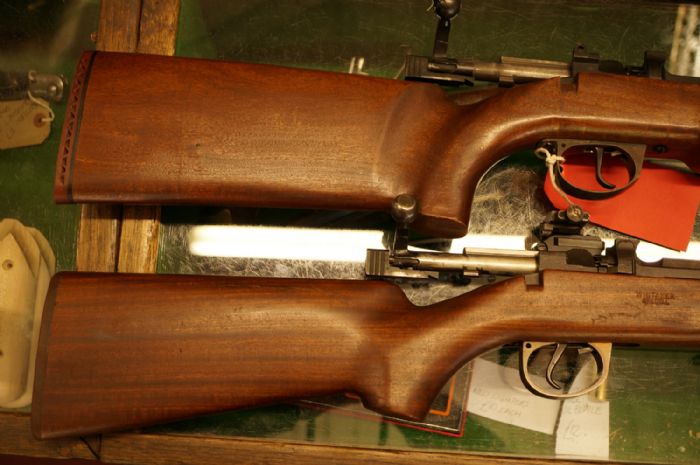 Two examples with differing stocks, note also the trigger guard from the donor No.4 fitted backwards, I had owned my first Whitaker for well over a year before I noticed this oddity, the engineers amongst you will probably think, if it works like that, it works! Bert sold his first Whitaker Special in July of 1973 and by the end of the year has sold almost thirty of them. Many examples bear the marks of being a former No.4 T, not only was Bert a good engineer he was also a first class salesman, who could resist not buying an ex sniper rifle! Although having virtually nothing left of the No.4 T after the barrel and woodwork were junked it was still an "ex sniper" in many peoples eyes so had to accurate. And accurate they were.... 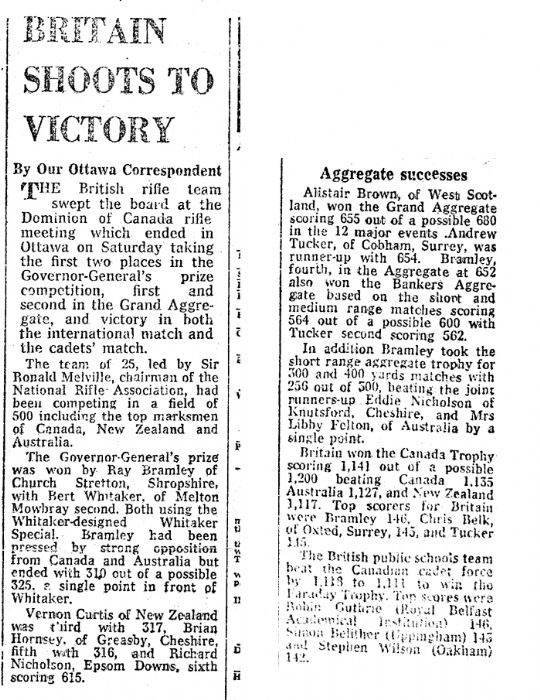 1976 was to have it highs and lows, having come first and second in the Canadian Governor Generals prize (Bert was second to his friend Ray) they then travelled on to Camp Parry where Bert failed to emerge from his tent one morning and had died of heart failure during his sleep. Bert's son Christopher told me that Bert was aware of his ill health but carried on regardless. After his death the rest of Bert's unfinished stock went to Geoff Hart a Cheltenham gunsmith who was also a winner of the Grand Aggregate at Bisley, Geoff was able to fit different stocks and also a Brindles trigger to make what I believe was probably overall the best conversion of a No.4 there has ever been. I've always felt that life had robbed Bert of progressing with his design. 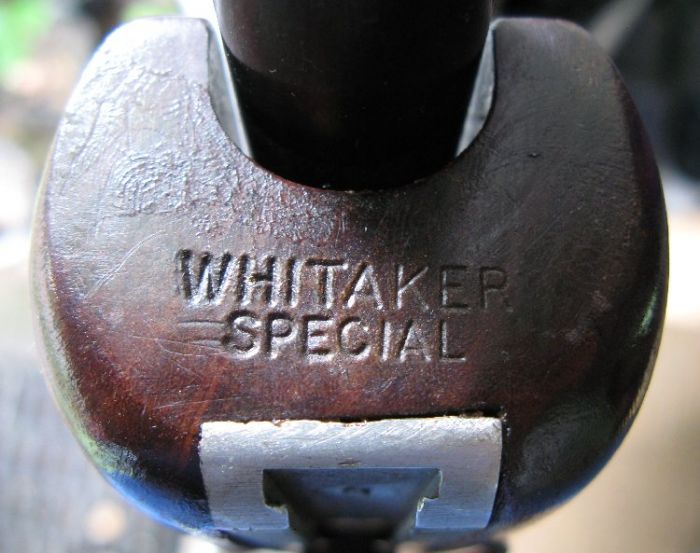 Foreend detail proclaiming to the world exactly what this rifle is.  Swing sight (Churwick Engineering) on my first Whitaker, the one I use now has an AJ Parker 4/47 twin zero which is my favourite rear sight for these transitional rifle as we call them in Bisley's historic class system. On a very trivial point, most of Bert's rifles were assembled in the gun room of the South London Rifle Club which is in the same building as Fultons being directly behind. And lastly, because the stock lugs were cut off during the conversion process Bert has had a number of detractors in recent years, it must be remembered that the UK gun trade was awash with No.4's during the 1970's and they could be purchased very cheaply, the No.4T receiver's that were used didn't have scopes on them as far as my research has revealed to date. ------------- Mick |
Replies:
Posted By: britrifles
Date Posted: August 10 2023 at 9:53am
|
Great article Mick. I had not heard of these rifles until you came along, but I have heard of one piece stock modifications. I think these rifles in their own right deserve recognition as a highly successful conversion and a place in Lee Enfield history. Would like to hear how these rifles shot. As good as the ammunition I would suppose. I wonder if DCRA and UK NRA were still issuing ammunition on the line at that time? More than likely yes… |
Posted By: Canuck
Date Posted: August 10 2023 at 10:02am
|
Great article and a learning experience for me. Thanks for sharing this information with the board! ------------- Castles made of sand slip into the sea.....eventually |
Posted By: Strangely Brown
Date Posted: August 10 2023 at 10:17am
Geoff, I've really only been trialing heavier weight bullets with this rifle since meeting you! With a 150 gr SMK I've achieved a typical 1 1/2 ~ 2 MoA in the past; ironically I shot it yesterday at 200x on the Kongsberg targets and didn't do very well. I had 7 spare 167gr Scenars I wanted to see if they would group, fired 5 and was looking at my plot when I noticed 7 rounds had been fired on my target. A quick look revealed that I still had two to go and noticed the bloke next to me peering at his screen wondering his last two had gone! Best results of the day were with my standard 150 SMK's and they weren't that spectacular. Shooting this off my elbows is no longer easy for me, hence my renewed interest in a standard No.4 in 7.62mm. ------------- Mick |
 britrifles wrote:
Posted By: britrifles
Date Posted: August 10 2023 at 11:43am
Ahhh, the dreaded “cross fire”. Happens to the best of us  . . We tease our good friend who it seemed would cross fire at least once every match. So we renamed the cross fire to his last name with a “ed” extension. We only do this of course, because he is an exceptional shot and such a good friend. We all try to get next to him on the line hoping we will be the beneficiary of one of his cross fire X’s. The frustrating thing is he would still win the match even with loosing 10 points from cross firing! As we have discussed, you may get better results with a longer (heavier) tangent ogive bullet, like the 175 SMK. Those secant ogive and hybrids are tricky to get to shoot well, which I think the Scenar is. Hopefully the availability of bullets in the UK will get better soon. |
Posted By: Shamu
Date Posted: August 10 2023 at 6:48pm
|
I remember firing a loaner at Bisley, way back in the day It had a one-piece stock & the butt socket had been machined off & a longer rear trigger guard screw went up thorough it to a tapped hole in the bottom of the bolt raceway. Maybe one of these? Unfortunately the owner had been a bit sloppy with it & it wouldn't zero for beans. ------------- Don't shoot till you see the whites of their thighs. (Unofficial motto of the Royal Air Force) |
Posted By: Strangely Brown
Date Posted: August 11 2023 at 2:11am
Shamu, this was Bert's incarnation after he had died and Geoff Hart had started doing the conversions; it's believed some of the conversions were done as late as the 1980's when things likes Swings dominated the target rifle scene in the UK. This one was mine (now sold) which had a Brindles trigger fitted, I'm of the opinion that this was as good a No.4 conversion could get, in this case it's an ex No.4T. http://highwoodclassicarms.co.uk/Firerms%20For%20Sale/0226.htm" rel="nofollow - http://highwoodclassicarms.co.uk/Firerms%20For%20Sale/0226.htm ------------- Mick |
Posted By: Shamu
Date Posted: August 11 2023 at 10:58am
|
That seems about right. I don't remember the reversed trigger guard, but it was long, long ago. ------------- Don't shoot till you see the whites of their thighs. (Unofficial motto of the Royal Air Force) |
Posted By: A square 10
Date Posted: August 11 2023 at 6:45pm
| very nice looking rifdle |