Bore erosion, pitting and tool marks
Printed From: Enfield-Rifles.com
Category: Enfields
Forum Name: Enfield Gunsmithing
Forum Description: Submit any how-to's or other gunsmithing suggestions here.
URL: http://www.enfield-rifles.com/forum_posts.asp?TID=13206
Printed Date: March 26 2026 at 8:52pm
Software Version: Web Wiz Forums 12.07 - https://www.webwizforums.com
Topic: Bore erosion, pitting and tool marks
Posted By: DarioPirovano
Subject: Bore erosion, pitting and tool marks
Date Posted: February 15 2024 at 1:53pm
|
JB bore paste & bore bright have arrived, so i started the cleaning and polishing job. Following Geoff’s advices, started with bore paste with 10 full strokes, with the patch wrapped around a worn brush. It cleaned more carbon away immediately and lightly polished lands and grooves.. but my patches are smaller then the suggested so it felt not so snug when working… I decided to use VFG bore pellets around a “spiral threaded” jag to do the job   Very snug fit inside the bore, you can feel it scrubbing when pushing the cleaning rod. The result unfortunately is not the best I hoped, even after 3 complete treatments, but it signifantly cleaned and polished the bore. I believe this barrel is irreversibly damaged by pitting, I’m maintaining it since this rifle shoots moa at most distances. For those who don’t know this rifle is a fazakerley (PF) no.4 mk2 from 1949, converted in sr(B) target rifle with center bedding, ajp tz4/47 rear sight and target sling. Here’s the before and after:     After 3 complete treatments:    
|
Replies:
Posted By: DarioPirovano
Date Posted: February 15 2024 at 2:09pm
|
I did the same job to my long branch 95L no.4 mk1 target rifle from 1950. The barrel was clean but it have very bad tooling marks in to the lands. Excellent result with a bore in better condition. Hard carbon and carbon ring removed immediately. Before and after:      After one treatment:     
|
Posted By: britrifles
Date Posted: February 15 2024 at 2:57pm
|
For bores that are pitted, the best we can hope for with using JB is removal of all fouling and any high spots created by either tooling or by the oxides from the corrosion process. What is left is relatively clean pits in the steel. I would now oil the bore, perhaps with Kroil or something similar. Then dry patch out the bore right before you shoot it.
The fact that your rifle shoots MOA in spite of the pitting is telling us that this amount of pitting is inconsequential to accuracy in these rifles. If this were a heavy barreled Match, F-Class or Benchrest barrel, it would be much more evident. I doubt my AR Service Rifle would shoot MOA at 600 yds with a barrel in this condition, but the .303 seems more tolerant of barrel condition. I suspect it might take some fouling shots for accuracy to return after this level of deep cleaning. Let us know how it shoots after this. I definitely have seen a significant improvement in a few of my No. 4 rifles after I got all the fouling out, but it took a few rounds for it to settle down again. |
Posted By: britrifles
Date Posted: February 15 2024 at 3:07pm
|
Forgot one other comment. Even though these were target rifles, clearly the cleaning and preserving routine that was used by previous owners was seriously lacking. Not what you might expect from a serious competitive rifle shooter. The same is true for the two rebarreled No. 4 rifles I got from my Dad, although they don’t appear to be quite as bad as yours. I believe this is why we see few LEs in the vintage military rifle matches here in the US. So few LE rifles have good barrels, and few gunsmiths have the tools or access to new barrels to replace the old pitted or worn barrel. I believe much of this depends on the environmental conditions in which the rifle is stored. If humidity is above 50%, there is little hope to prevent pitting unless all fouling is removed and the bore is protected by a preserving oil or grease. |
Posted By: DarioPirovano
Date Posted: February 15 2024 at 3:35pm
|
I agree,I have oiled the bores with clp after the cleaning.. Do you believe it is a bore tolerances or harmonics matter? I have an m16 a1 with the pencil chromed barrel, it is super sensible to fouling, I had to remove the flash hider to clean it because the previous owner have never cleaned the bore, do you believe me if I tell you I had to break the carbon out with a chisel and a hammer? There was a huge carbon build up inside. After that cleaning and reinstalling the flash hider within torque specs, the carbine is shooting horribly… This had me think, sometimes gunk and carbon may be help accuracy in some way? Usually when I deep clean guns it take almost 20 rounds to restore accuracy, one of my Swiss k31 took 30+ rounds to get on point. |
Posted By: DarioPirovano
Date Posted: February 15 2024 at 3:46pm
|
I converted them to target rifles, the no4 mk2 was used by a German police shooting team, it only had the action bedded horribly and the barrel free floated, it was really neglected… The no4 mk1 was in standard issue conditions, I had a spare forend that I center bedded. Correct barrel cleaning is something not quite popular or taken seriously in Italy, the proof is that Italian armory’s don’t keep solvents and other serious cleaning products, many “guru’s” of shooting here advice novices to never clean surplus rifles because of loosing of accuracy, but it is a matter of 10-20 rounds!!! I have measured the humidity in my gun safe it is at circa 40%, some times I left it open for an hour and dry it out with an hair dryer, it works good for me.. |
Posted By: britrifles
Date Posted: February 15 2024 at 4:02pm
|
Yes, that does not surprise me. On a very good barrel, like the BSA ball burnished barrel on my Fulton No. 4, it always shot great clean. The first round out of a clean cold bore was right in the group. My sighter shots would be in the X ring, so I usually would tell the scorer verifier that I was “going for score” after my second sighter even though the vintage matches allow 5 sighters. But, on a badly pitted barrel, I believe some amount of fouling is needed to fill in the pits and smooth the rough spots. But, once fouling builds up again, accuracy will suffer. Worse than that, corrosion can begin again under the copper and hard carbon fouling if left in the bore for extended periods.
All this discussion got me curious and I pulled out my other DCRA 7.62 conversion. This is #580, that is the 580th No. 4 7.62 conversion done by Long Branch done circa 1965. It belonged to a good friend of my Dad’s. He passed away in 1967, and had only put about 120 rounds thru the barrel. I have his target scorebook. Dad and I shot about 50 rounds thru it, and then I shot another 50 several years back. So, total round count is 220. I have not shot this rifle in several years, and I suspect I cleaned it with Bore Tech Eliminator after the last shoot as there is no copper in the bore. A fair bit of carbon though. This is probably the first time I borescoped this barrel. I was presently surprised to see there is no pitting at all. I’ll give it a good scrub with JB, as there could be pitting under the carbon, but I don’t think so. From the looks of the throat, the barrel does indeed have very few rounds through it, barely any detectable firecracking:  And about 6 inches down the bore:  |
Posted By: britrifles
Date Posted: February 15 2024 at 4:10pm
This much I do know. A Benchrest shooter who does not meticulously clean the bore will never win a match. I’d say the same is true for F-Class shooters. They know that a clean smooth bore is absolutely critical to maintaining accuracy. Barrels are considered to be consumables. Once a drop in accuracy is detected, the barrel gets replaced. That is certainly true for my AR Service Rifle. I have retired two barrels within one year of shooting. The two Bartlein barrels that I carefully monitor and clean with JB about every 400 rounds are going strong after about 3000 rounds on each. It’s not as obvious on a typical WWII service rifle because we don’t expect sub-MOA accuracy. I know a few service rifle shooters who are not as particular about barrel cleaning, but I’ve also seen them shoot poorly at times and wonder what is wrong. The winners keep their rifles in top shape and bores are kept clean. |
 DarioPirovano wrote:
Posted By: DarioPirovano
Date Posted: February 15 2024 at 4:24pm
|
Usually since I don’t compete, I start measuring groups at the second 10 round target.. my no4’s starts 1/2” high and right when cold. I once listened to a metallurgy engineer that said, some copper and lead fouling is needed exactly because of micro pitting and tooling marks… You are a lucky man Geoff, it is impossible to find a dcra or fultons rifle nowadays! Indeed that is an excellent barrel, you can see why those where target rifle just by the bore finish from the factory, much more superior then the service rifles standard barrels. OT, have you ever tryed a L39 or envoy? |
Posted By: britrifles
Date Posted: February 15 2024 at 4:52pm
|
This is the same #580 DCRA Long Branch barrel I posted above, after 20 strokes of JB. This barrel is every bit as good as any new production Krieger or Bartlien barrel I’ve seen. Much better than war time .303 production. The throat:  About 3 inches forward of the chamber, the rest of the bore looks just like this:  The rifle is a No. 4 Mk 2 PF 212, and in pristine condition. However, Dad’s shooting friend was struggling to get this rifle to group well. His last experiment was to completely bed the full length of the barrel in glass fiber. If only he knew that the problem everyone was struggling with in the mid 1960’s was sub-standard 7.62 NATO Ball ammo that was entirely the cause of indifferent to poor grouping. I’ve shot this rifle at 200 and 300 yards with my standard match load (168 SMK and 40.0 gr Varget) and it shoots fantastic, even with the fully bedded forend.  I’ve now oiled the bore well and put the rifle away. At some point, I’ll bring it out and test it at long range (800 and 1000 yds). |
Posted By: DarioPirovano
Date Posted: February 15 2024 at 5:11pm
I can’t imagine how much could cost to produce a barrel with the same specs today, probably more than an entire rifle in good conditions  This is the barrel of my uf55 no4 mk2 it has about 1000rds thru it, I’m going to JB treat it as well.  It is a very strange bedding indeed, I’ve seen some other dcra fully bedded in other forums. Same style used on Mauser rifles, does it have any pre load or it just hangs in there? Let us know how it shoots! |
Posted By: britrifles
Date Posted: February 15 2024 at 5:22pm
In 1965, the DCRA conversion done by Long Branch cost $30.00. That included installing a new Long Branch made 7.62 barrel, adjusting head space as required and proof testing the rifle. I think that even included shipping costs back to the member. I have two of these rifles, and the one I have been shooting at long range I have posted the results on the 7.62 Enfield Forum. It’s my best shooting No. 4 rifle. This second DCRA I have not shot enough to know if it’s as good or better than my primary DCRA. What I don’t know is how the rifling was made, I suspect it is cut or broached, not likely button rifled. Not hammer forged either. So, it should be good for perhaps 8,000 rounds before accuracy begins to fall off. |
Posted By: Mayhem
Date Posted: February 15 2024 at 6:18pm
I guess if you are relying on the Mk 1 eyeball a shiny bore screams "job well done". I was shocked at how back my shiny bore was when I scoped it. ------------- .303 - Helping Englishmen express their feelings since 1889 |
Posted By: britrifles
Date Posted: February 15 2024 at 6:32pm
|
True. You don’t realize how good, or bad, your cleaning method is until you borescope the barrel. It’s interesting to see the difference in the bore condition of my two DCRA rifles that were rebarreled about the same time. Dad shot only 5 or 10 rounds thru his, yet it formed mild pitting in the grooves. His friends rifle was shot more but that bore is pristine. Perhaps the difference was the storage environment and not the method it was cleaned. They lived perhaps 10 miles apart, Dads rifles were kept in the basement and no air conditioning in the house. Don’t know where his friend kept his rifle. I’ll bet some of us would rather not know what the bore looks like, and perhaps don’t care as long as it shoots well. Then, there are collectors and bore condition does not matter at all. |
Posted By: Zed
Date Posted: February 16 2024 at 1:01pm
|
I should get onto the JB clean for my Resistance No4Mk1 this weekend. And some crappy borescope pic's to see how it does.
------------- It's nice to be important, but it's more important to be nice! |
Posted By: DarioPirovano
Date Posted: February 16 2024 at 1:05pm
| Geoff, at their time they used corrosive primers? |
Posted By: britrifles
Date Posted: February 16 2024 at 2:15pm
|
Dario, I doubt either of my DCRA 7.62 barrels or the 1958 Long Branch CMk 4 barrel on my No. 4 T has seen a corrosive primer. Not the case for the majority of No. 4 rifles that saw service in WWII. I believe most of the British .303 Mk 7 cartridges used corrosive primers, while most of the Canadian Boxer primed .303 was non-corrosive. Long story behind this, but I spun the BSA Barrel back onto my Fulton No. 4 Mk 1/3 (removing the new Criterion barrel) and shot it today. I had cleaned it well before I had put the BSA barrel away. After 40 rounds it was heavily fouled. This barrel has upwards of 10,000 rounds thru it, fired by me. I cleaned it with Bore Tech Eliminator, and it was loaded with copper (evidenced by the blue on these patches).  Here is what the bore looked like AFTER cleaning with Eliminator: About 1 inch forward of the chamber. Note the significant firecracking. Also heavy carbon in the grooves that Eliminator did not remove.  10 inches down the bore. The rest of the bore looks like this, no corrosion pitting.  When barrels get this rough, fouling builds very quickly. Interesting enough, the first five shots I fired today grouped within 1 MOA. 10 shot groups then opened up to 2 to 3 MOA (shot prone in sling with Mk 1 service issue back sight). |
Posted By: DarioPirovano
Date Posted: February 16 2024 at 2:44pm
|
I tought all of the mk7 rounds were berdan primed, I need to come back study. Geoff, why the return to the bsa barrel? Did you want to finish completely the barrel life before using the new one? You did a good job with the criterion install! It was a nice shooter if I remember correctly |
Posted By: DarioPirovano
Date Posted: February 16 2024 at 2:46pm
| Firecracking apart, the ball burnishing job seems to have worked, this barrel is still very smooth |
Posted By: britrifles
Date Posted: February 16 2024 at 3:06pm
|
Most Canadian production Mk 7z in WWII was with Boxer non-corrosive primers. I have several thousand rounds of Defence Industries 1943 Mk 7z that is Boxer non-corrosive primed. It’s excellent brass for reloading. Note that Berdan primers are not necessarily corrosive, but I believe British Mk 7 and 7z was primed with corrosive Berdan primers during WWII. When I got the rifle, the BSA barrel was new as installed by Fultons. I did not understand the importance of barrel break in nor did I have a borescope. All I used to clean the bore was Hoppes 9 for the first several thousand rounds. I could see copper building up at the muzzle, so bought the Outers Foul Out system that removed the copper. Later I learned about Sweets copper solvent, and used that. My DCRA 7.62 was an entirely different story. It only had about 10 rounds fired when I got the rifle, but I understood the importance of barrel break in and copper removal. This barrel now has about 2200 rounds thru it and it remains quite clean and very little copper in the bore. Routine cleaning with Hoppes 9 is sufficient with occasional cleaning with JB. |
Posted By: Shamu
Date Posted: February 16 2024 at 3:34pm
|
Rule of thumb: If it British made MkVII its guaranteed corrosive primed & Errosive cordite. A "z"suffix" is nitro powder, but may still be corrosive primed. Canadian is a mix and match as mentioned. South African "303" is corrosive & errosive. South African "R1M3Z" is not. ------------- Don't shoot till you see the whites of their thighs. (Unofficial motto of the Royal Air Force) |
Posted By: britrifles
Date Posted: February 17 2024 at 4:47am
|
Cleaned the BSA barrel with Bore Tech C4. Three wet patches followed by nylon brush, 1 wet patch and let soak overnight. A bit of copper under the carbon, see it on the first wet patch on the second row after barrel soaked overnight. Then brushed with bronze brush followed by two wet patches and two dry patches. Doesn’t look like it took much carbon out by the looks of the patches, but it did when looking with the borescope.
 For about two inches forward of the chamber there is still a fair bit of carbon. First pic below is about an inch forward of the chamber. That will have to be removed with JB, but the rest of the bore is clean of all fouling (second pic below):   I have the camera light turned about 2/3 the way up to show the contrast. If it’s turned up much more than that, the bore reflects too much light to see any detail making it look cleaner than it really is. Looking down the bore with your eye you would think this is a brand new barrel, like a mirror. |
Posted By: DarioPirovano
Date Posted: February 18 2024 at 7:46am
|
Went to the range today with the no4 mk1 Started at 200mt, group was low and left, after 15 rounds it started grouping well and went to the 300mt target, fired two 5 shots groups. First rounds at 200mts:  300mts target:   I see a little improvement in group size after the deep cleaning. |
Posted By: Goosic
Date Posted: February 18 2024 at 10:44am
|
I will clean all my rifles as necessary after shooting, except for my target rifle. I leave that one partially fouled if I intend on shooting it within a week or two after its initial outing. While I am all for keeping your rifle clean and the bore unobstructed with unnecessary carbon and copper. I learned that a well worn rifle barrel is best left alone. In some instances, overcleaning the rifling on a well used and worn barrel can significantly reduce the accuracy...
|
Posted By: Shamu
Date Posted: February 18 2024 at 3:06pm
|
One thing I do occasionally is switch to a different cleaner for a couple of cycles then switch back. I've found that cleaner (A) my be really my preference, but like anything its not perfect. temporarily switching to cleaner (B) frequently finds & cleans something that (A) wasn't that good at! You just have to check that (A) & (B) aren't the same thing, rebranded! ------------- Don't shoot till you see the whites of their thighs. (Unofficial motto of the Royal Air Force) |
Posted By: britrifles
Date Posted: February 18 2024 at 6:19pm
|
Agree. I’ll do the same between using Hoppes 9 as routine cleaning, when switch to Eliminator. Then back to Hoppes. Then every 300 - 400 rounds, clean to bare steel with JB. The problem with rough or neglected bores is that it begins to strip copper off in lumps. Then accuracy goes to crap. The best approach I believe is to keep a new barrel clean, don’t let it build up with carbon and copper. Proper break in really helps with easy cleaning. Different problem if you’re trying to get an old shot out barrel to shoot decent. Living in a very dry climate like Goosic does removes the environmental factors that can destroy a barrel that is not kept clean of fouling. Not cleaning barrels in humid environments (like southern Ontario or the UK where home air conditioning is not that common) is asking for trouble. |
Posted By: Shamu
Date Posted: February 19 2024 at 2:50pm
|
That's another thing I like about the M-Pro, you can leave the bore cleaner in permanently,like Hoppes #9. Its a long slow steady form of deep cleaning with no physical scrubbing. ------------- Don't shoot till you see the whites of their thighs. (Unofficial motto of the Royal Air Force) |
Posted By: britrifles
Date Posted: February 19 2024 at 2:52pm
| Same for the Bore Tech products, also contains an oil that is a short term rust preventer. |
Posted By: DarioPirovano
Date Posted: February 19 2024 at 4:16pm
|
Im trying to find a suitable cleaning routine that prevents major carbon buildup, i don’t want to clean to bare steel every time I go shoot, just every 300rds. This time I tried just 10 strokes from breech to muzzle with a very tight bronze brush, and 10 patches soaked in alcohol, 1 soaked patch and one dry, till clean, then dry out the bore and a couple of clp soaked patches.. Did it with the bore still quite warm, most of powder fouling was dissolved by alcohol. I have c4 carbon remover and eliminator solvents, but I don’t know if I want to use them after every session… |
Posted By: britrifles
Date Posted: February 19 2024 at 4:37pm
|
I’m trying one other product that was recommended by an F-Class shooter. It’s a penetrating oil called Free All. Get it at the auto parts store, inexpensive. Seems to work fairly well with bronze brushing to remove carbon. I agree, it here is no need to clean to bare steel every time, I think that is overdoing it unless your shooting bench rest. My regular routine with good barrels is to just clean with Hoppes 9 letting soak overnight. Badly pitted barrels that quickly build up fouling you have to figure out what works best. The slow soak method with Hoppes might be best as it will leave some amount of copper and carbon in the bore. |
Posted By: DarioPirovano
Date Posted: February 19 2024 at 4:46pm
|
My bores works good when fouled, I still have to try the uf55 which have an almost new bore, last time, fouled it shot very good, next week I’m going with my two mk2’s and see how the pitted and the good barrel goes. I bought a set of roll pins, got one that fits just snug inside the mk1 aperture, hoping to get an improvement… reduced the hole from 2,5mm to a 1,6mm |
Posted By: Mayhem
Date Posted: February 19 2024 at 5:32pm
|
I'm not sure there is a 'one size fits all' approach any more. Now that I have a bore scope, I can use that to see what is in the bore and then target that. ------------- .303 - Helping Englishmen express their feelings since 1889 |
Posted By: DarioPirovano
Date Posted: February 25 2024 at 7:18am
|
Today went to the range with the no4 mk2, unexpectedly no fouling shots needed. 300mt sitting at the bench, light was constantly changing as you can see in the target the group was moving 1/2 moa when sun light started hitting the target, today sky is full of clouds with pretty heavy wind. I think tz4/47 is far superior to the ph5c. After 20 shots: 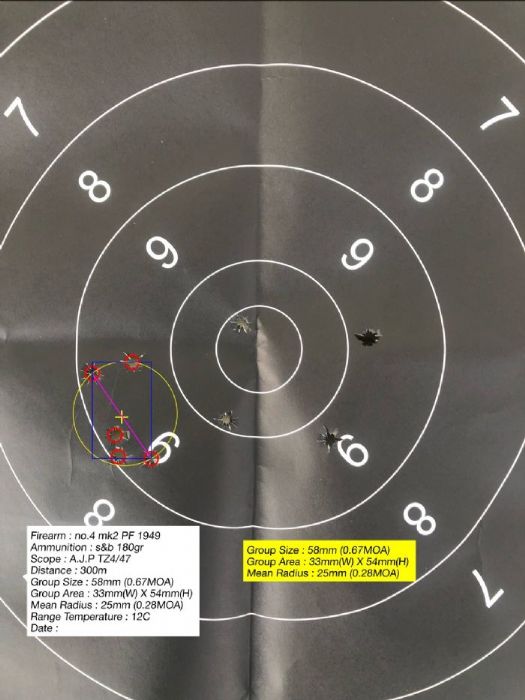 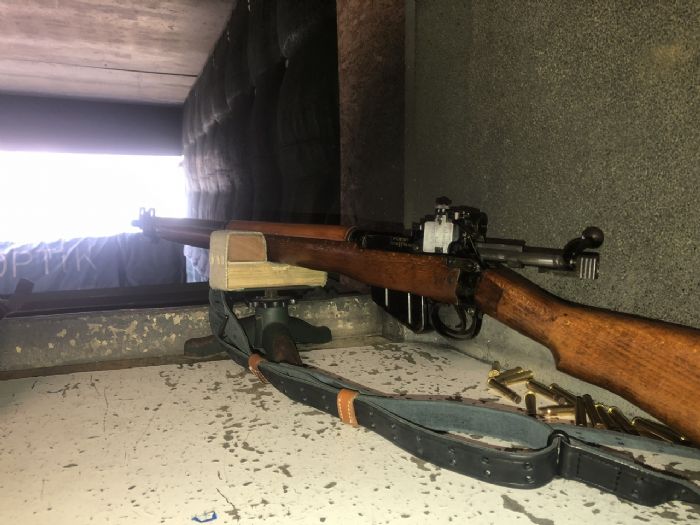
|
Posted By: britrifles
Date Posted: February 25 2024 at 10:31am
|
Excellent shooting! I’m curious why you think the TZ sight is superior to the 5C? I see 9 shots on the target, do you not include all the shots when determining the size of the group? Those 9 look to have grouped in under 2 MOA which is exceptional for a No. 4 with factory ammo. |
Posted By: DarioPirovano
Date Posted: February 25 2024 at 10:49am
|
Thank you! I believe it’s superior because of adjustments, in the tz4/47 i found a true 1/2 moa or probably a little less instead of the 0.65 i found with the ph5c, then it’s in the manufacture, better quality in my opinion, design apart, the tz suffer from iris holder canting on the windage arm because of high tolerances, an easy fix by putting a 0.1mm sheet under the windage arm tracks to tight the gap. No they are just 9, usually I charge the magazine with 5 rds per time to count,my was friend taking to me while shooting, I put one more in the previous target |
Posted By: DarioPirovano
Date Posted: February 25 2024 at 10:50am
| By 0.65 I mean inches at 100yds. |
Posted By: britrifles
Date Posted: February 25 2024 at 12:46pm
| Correct, the PH 5C sight is 0.010 inches per four clicks, this works out to about 1.25 MOA. |
Posted By: DarioPirovano
Date Posted: February 25 2024 at 12:54pm
| Exactly Geoff |
Posted By: Shamu
Date Posted: February 25 2024 at 1:35pm
|
Shimming the mount is pretty normal. Theres no "gauging requirement" on the side wall of the receiver! I agree the TZ is a bit nicer. That's the result of the infamous "Enfield Inch"  ------------- Don't shoot till you see the whites of their thighs. (Unofficial motto of the Royal Air Force) |
Posted By: DarioPirovano
Date Posted: February 25 2024 at 1:48pm
|
Yes Shamu, the ph5c on my no4 mk1 is canting to the right, I will shim it to make it level. But what if it was made on purpose to compensate the left canting of the rifle when sling supported? |
Posted By: britrifles
Date Posted: February 25 2024 at 2:04pm
|
I’ve shot my No.4 7.62 (1:12 right hand twist barrel) out to 1000 yds with the PH5C and the lateral POI tracks very nicely with increasing range (lateral POI does not change with range in calm conditions). If the sight was canted, you would see the groups moving to the left or right as the range increases. You would also see elevation POI changes as you adjust the rear sight left or right. I’ve never seen this with a PH 5C. Bullet spin drift is fairly insignificant out to 1000 yards (about 1 MOA at 1000x). Beyond that, it begins to take a significant effect. By the way, you will get significant lateral aiming errors if you cant the rifle to one side or the other, especially at long range. The trick is to hold the rifle the same way every shot, to within +/- a few degrees. Easier to do with a scope, but can be done with irons too. |
Posted By: Shamu
Date Posted: February 25 2024 at 4:55pm
|
It really wasn't. If you don't shim it for vertical (& horizontal) alignment as you make elevation or windage adjustments you'll also be applying a little of the opposite adjustment also because of the canting. Look back at the history & you'll se the PH5 series stared out with the PH5A, with the SMLE mount, which had the "long dog leg" to mount to the early bolt-mounted safety mounting holes. The instructions even say to "heat & bend, or shim" to fit to an non-gauged area (the butt socket). That was in turn a development of the earlier No9 series! The 5C was essentially a 5A with a different mounting bracket for the No4 series, & carried the "shim to fit" legacy from its parent version. Its also why "matching" sight arms & bases are a big deal This was Victorian era hand-fitting of precision parts, like the dovetail between arm & base, not modern "plug & Play" There were a lot of "legacy" features in the development of the series. That was a big part of the fascination with those older target sights!   ------------- Don't shoot till you see the whites of their thighs. (Unofficial motto of the Royal Air Force) |