No. 4 "Compensation" Tests
Printed From: Enfield-Rifles.com
Category: Enfields
Forum Name: Enfield Gunsmithing
Forum Description: Submit any how-to's or other gunsmithing suggestions here.
URL: http://www.enfield-rifles.com/forum_posts.asp?TID=14091
Printed Date: March 26 2026 at 3:39pm
Software Version: Web Wiz Forums 12.07 - https://www.webwizforums.com
Topic: No. 4 "Compensation" Tests
Posted By: britrifles
Subject: No. 4 "Compensation" Tests
Date Posted: July 28 2025 at 5:51am
|
Thought I would start a new post on fore-end fitting. I'll start by abbreviating "fore-end" to "forend". I'm lazy I guess. I've begun some experiments with the No. 4 T on forend fit and barrel bedding in order to see if I can induce what Maj Reynolds called "Positive Compensation". Per Reynolds book "The Lee Enfield Rifle", compensation trials done by RSAF Enfield during development of the No. 4 were inconclusive. The No. 1 SMLE was well known for possessing positive compensation, at around 800 yards, and it was favored for many years in the final stages of the Kings/Queens Prize (900/1000 yards) for this reason. A simple definition of "Positive Compensation" is that the point of impact in the vertical (elevation) plane on the target is independent of muzzle velocity at the compensation range. This obviously cannot be true for a very large velocity spread, but it can, and is true, for as much as 75 fps, perhaps 100 fps. Here is how Maj E.G.B Reynolds illustrated “Positive Compensation”:  At 600 yds, my No. 4 T is not showing any sign of positive compensation, in fact, it may even be "negative" compensation. Fast bullets are impacting much higher, and slow bullets much lower, than a simple bullet drop trajectory predicts. In an effort to induce positive compensation, I'll be trying various barrel packing methods and will post the results here. My interest is strictly at 600 yards where I'm seeing significant vertical stringing as a function of muzzle velocity. If I could produce ammunition that gives less than 30 fps extreme spread in muzzle velocity, this would not be an issue. While my loads do get down to the 25-30 fps ES range, at times is exceeds 50 fps and result in vertical fliers into the 8 and 9 ring. Regarding the ES values of 50 fps and higher, I intend to start to cull cartridge cases giving very low or very high muzzle velocities and set them aside. I'm weighing each powder charge, prepping cases all the same way, so this seems to be the only way to potentially reduce ES. |
Replies:
Posted By: Zed
Date Posted: July 28 2025 at 9:16am
|
I look forward to seeing your results. In fact I am looking at my latest Maltby No4mk1, and considering making it an accuracy project. The reason being that it's not as original as I first thought. This rifle came with the deal for the 1907Mk1*. So only got a quick check at the time of purchase. Having now had time to remove the fore end, it is evident that the barrel has been replaced. It is a 1943 dated barrel, but the parkerizing is much better than the receiver. Which has marks on it from the tooling to remove the old barrel. This one gauge's well, it is a two groove barrel. But it's in good shape, so should be ok. The Knox form area of the wood doesn't have much contact with the barrel, and the up pressure at the muzzle is low. To address the Knox form problem, I have cut a sliver of oak, along the grain, about 1 mm thick. I then form it to the curvature, by placing it in boiling water for about 20 minutes, then pressing it between two semi circular pieces of metal pipe. The inner diameter of the exterior pipe is equivalent to the curve of the Knox form in the wood. The inner pipe has enough clearance to allow the wood to flex into shape. It's now sitting in a vice while it dries out into shape. I will then glue a 3/4" square at the knox form wood and adjust to get good contact with the barrel. Once that is done, I will see if I go to centre bedding. Ideally, I will test it prior to any modifications, then note the changes at each stage. ------------- It's nice to be important, but it's more important to be nice! |
Posted By: britrifles
Date Posted: July 28 2025 at 10:27am
|
Shaun, you lucked out, this rifle could well be a good shooter with a 1943 barrel. Do you have a Hornady OAL gage? This is a good way to assess erosion of the throat. On my next installment, I'll discuss the various barrel bearing locations, some of which are discussed in Reynolds book. Of the four common locations of forend barrel bearing, I have at least one of each of them along with one that a full length forend bearing! |
Posted By: Shamu
Date Posted: July 28 2025 at 12:38pm
|
I'd find that interesting too. My No4 Mk2 seems to be compensated at least out to 650 yds, which is the longest range I can get to round here. It does have a slight,1.5 MOA or so Left<>Right difference though, but that may be because I'm getting the higher velocities with the lighter 150Gr bullets it seems to like. Vertical dispersion is minimal. But again that may be bullet weight & BC as much as velocity. ------------- Don't shoot till you see the whites of their thighs. (Unofficial motto of the Royal Air Force) |
Posted By: britrifles
Date Posted: July 29 2025 at 7:39am
|
To really determine if the rifle has "positive compensation" you need to record both muzzle velocity and bullet POI on the target. A rifle that gives consistent tight vertical spreads of say 1 to 1.5 MOA for 10 shots at all ranges out to 1000 yds would indicate no compensation exists and you have very good loads with tight velocity extreme spreads (less than 30 fps). What I'm referring to is vertical stringing of the group, 2 MOA or more, where individual shot vertical POI at the target is strongly correlated to muzzle velocity and is not just a random placement of shots. With "positive compensation" these two variables are inversely related (i.e. fast bullets impact low and slow bullets impact high) at short range and show no correlation at all at the compensating range. That is "Positive Compensation". I've been digging thru my plot sheets (score book) results on my No. 4 T where I've recorded the muzzle velocity of each shot, plotted the POI on the target diagram and calculated the elevation spread per fps change in velocity. That value is about 3 times more than the bullet drop trajectory accounts for. On a rifle that compensates (at the compensating range), you would see no correlation at all with elevation POI at the target and muzzle velocity. |
Posted By: Zed
Date Posted: July 31 2025 at 9:16pm
|
I have my Fulton's No 4 Mk1/2, to look at the bedding of the fore end The Knox form oak shim, I used once before on the 1929 BSA No1. That made a difference, and was the last modification. Prior to that I had been experimenting with Play Doh to work out the thickness required. We are currently enjoying our vacation. ------------- It's nice to be important, but it's more important to be nice! |
Posted By: britrifles
Date Posted: August 02 2025 at 7:39am
|
I’ve ran some Strelok bullet trajectory calculations to establish a baseline of expected vertical (elevation) spread on the target as a function of range and muzzle velocity extreme spreads. With this, we can judge if a given rifle shows signs of positive compensation or not. First, the ballistic absolute bullet drop (in inches) from the muzzle. These were based on two different loads as follows: Case PPU Primer WLR Powder Varget, 40.0 gr and 41.5 gr Bullet 174 gr Sierra MatchKing, G7 BC = 0.249 OAL 3.07” 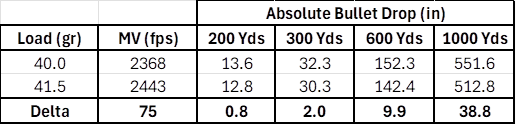 From this, we can see that the 200 yard delta drop is really not much to be concerned with even with extreme velocity spreads of 75 fps, but is quite significant at 1000 yds. I then calculated the delta bullet drop in Minutes of Angle (MOA) for various muzzle velocity Extreme Spreads (fps). Note these are not true minutes of angle, as I am using 1 inch per 100 yds, close enough. 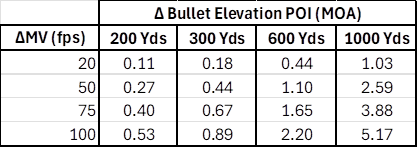 A 20 fps Extreme Spread is about the best handloads I can produce, but it’s typically 30 to 50 fps ES. I had two 10 shot groups yesterday with a whopping 100 fps ES, and I don’t know why. Even with a 100 fps ES, we would be hard pressed to notice a 1/2 MOA elevation difference at 200 yards as this is well within our shooting ability. This is why we don’t concern ourselves with muzzle velocity variation in short range service rifle shooting. But at 600 yards, it becomes quite significant. This would easily push the bullet out of the 2 MOA 10 ring, possibly into the 8 ring on the US NRA Mid Range Target. To these elevation variations, we have to add our own hold and aim errors, although sometimes they can cancel out these velocity deviations. You can see why positive compensation in a rifle was so important at long range ( tel:800-1000" rel="nofollow - 800-1000 yd) competition, otherwise, a 100 fps velocity deviation could cause a miss! Next, I’ll post on results of shooting tests with measured elevation variations as a function of velocity variation. We will see that my No. 4T is showing a “negative” compensation, exaggerating these elevation deviations and my No. 4 7.62 is showing strong Positive Compensation. |
Posted By: Zed
Date Posted: August 02 2025 at 10:32am
|
An interesting thread Geoff, I look forward to seeing your results. ------------- It's nice to be important, but it's more important to be nice! |
Posted By: Sapper740
Date Posted: August 02 2025 at 10:57am
|
Thank you for this very informative thread Geoff, I had never heard of Positive or Negative Compensation before. I have heard throughout the decades of this effect with revolvers and pistols whereby the heavier and thereby slower bullets tend to hit high due to being in the barrel longer and thus subject to more muzzle flip before being free of the bore. On a related issue, I have a Fulton regulated No1 Mk III but I've been loathe to take it apart for fear of undoing what Fulton and Son did during the accurizing process....that, and I've heard they may have used asbestos matting in the process. The rifle is wonderfully accurate so I plan on leaving well enough alone.
|
Posted By: britrifles
Date Posted: August 03 2025 at 2:07pm
|
Derek, as my Dad would say, “leave well enough alone”. I wouldn’t take the forend off either if the rifle shoots good. I can be done in a way to not cause harm, but it can also be done in several ways to destroy the good fit at the draws. |
Posted By: britrifles
Date Posted: August 03 2025 at 2:30pm
|
Through a lot of testing and data collection/analysis, a picture is emerging on the No. 4T that suggests there may not have been anything wrong with the CMk4 Long Branch six groove barrel and the new CBI five groove barrel previously installed. In fact, I will write CBI back and offer to buy the barrel back from them if they still have it. This rifle most definitely shows a “Negative Compensation” at 600 yds. To illustrate this, I’ve plotted up the bullet elevation POI on the target at 600 yds vs Muzzle Velocity. In my previous post, you will see that the expected elevation change for a 100 fps muzzle velocity extreme spread would result is just over 2 MOA. But, I’m getting considerably more than that, 4 to 5 MOA elevation spread:  These were all the same loads, 40.3 gr Varget with 174 gr SMK, PPU case. Why I’m occasionally getting velocity spreads of 100 fps is still a mystery. I’m weighing out all the charges on my RCBS digital scale. The only thing I can think of is the cartridge case, so I’ve been putting cases that give very low (or high) velocities aside. Note the slopes of the trend lines, all about the same for the four 10 shot groups. I have many more groups that have shown this with the three different barrels I had installed over the past 5 months. So why is it that this rifle strings shots vertically about 2-3 times more than the velocity variations alone would account for? The bedding method? Loose butt stock, forend not fitting well? Numerous possibilities perhaps, some of which I have investigated already with no success. The plot below shows what “Positive Compensation” looks like. This is my No. 4 Mk 2 DCRA 7.62 at 800 yards. Note that there is no correlation at all between muzzle velocity and bullet elevation POI at the target despite a 100 fps velocity variation.  My next step is to experiment with the forend on the No. 4 T to see if I can get Positive Compensation as I do with the DCRA 7.62. |
Posted By: britrifles
Date Posted: August 03 2025 at 4:02pm
|
I have some suspicion that the scope affects how the action deflects under the thrust load from the bolt. It would seem that the added stiffness from the scope and bracket mounted above the bolt/bore axis would result in a muzzle down bending deflection under the bolt thrust load. The No. 32 scope and mount is obviously very stiff/rigid! This might explain why fast bullets exiting the muzzle sooner before the full downward deflection is reached result in shots going higher than the trajectory would account for. If this is true, there is not likely anything I can do to alter the compensation characteristics with different bedding methods. I’ll need to shoot the rifle without the scope at 600 yds to see what the compensating behavior is compared to with the scope attached. More to do in this. |
Posted By: Canuck
Date Posted: August 03 2025 at 4:08pm
|
That is an interesting thought. It makes sense. ------------- Castles made of sand slip into the sea.....eventually |
Posted By: britrifles
Date Posted: August 03 2025 at 4:35pm
|
A clue to this appears in page 172 of Reynolds book. Trials carried out at Enfield in 1945 with 26 No. 4 T rifles determined that the scope and mount had the effect to lower the angle of “jump” by 6.5 minutes of angle (on average). On some rifles, the “jump” was found to be as much as negative 2 minutes. Could well be that a slow bullet gives a negative angle of jump and a fast bullet a positive angle of jump. Unfortunately, it’s very difficult to verify any of my results with other No. 4T rifles. The issue I have with vertical stringing at 600 yards may well have been considered acceptable, particularly since it is effectively mitigated with selected ammunition that gives consistent velocity. For the sniper, a shot that drops 18” low at 600 yds (3 minutes) would still do its job, and that would only occur should that shot fall below about 2370 fps from the nominal 2440 fps based on the slopes of the POI vs MV lines in the above plot. At least based on how my T shoots. If I could produce a load with a muzzle velocity ES of less than 20 fps, the rifle would stack shots on top of each other, within the 1 MOA X ring. I may not be able to solve the compensation issue, but hopefully I can find out why I’m getting velocity spreads as much as 100 fps! Mick’s email on the other thread on the book about Furness may also be another clue. The T may well be more sensitive to poor quality ammunition for the reasons I’ve explained above. Where is Reynolds when you need him! Some days I wish I could travel back in time… |
Posted By: Doco Overboard
Date Posted: August 03 2025 at 4:54pm
I would think the additional weight added to the rifle would have more effect than stiffness. Like a fly rod, the center section will bend faster and move before the tip when more weight is added to the butt once stressed. (I think I have that right). But more importantly, the weight is added to the end of the barrel at the receiver which has an effect on the harmonics produced in the barrel and technically should, have a profound effect on barrel "whip" at the other end. I think Whelen goes into this in the second edition of the two volume design and ballistics works. However with a slightly different take from what he extracted and acknowledged/credited from the British small arms textbook. Also more weight means less recoil so that could have an effect as well the more I think about it. How much for a few fps one way or the other I'm not smart enough to figure out. Maybe that could be a factor Im not sure. I seem to recall also that there was a short range test using site height above the bore and measuring the distance from point of aim to bullet strike at like 10 or 12 yards that was used to determine positive or negative compensation in either volume one or two I would have to look to refresh my memory its getting cloudy anymore all of the sudden.
|
 britrifles wrote:
Posted By: britrifles
Date Posted: August 04 2025 at 5:27am
|
No doubt, the additional weight would alter the vibratory response as well. Both weight and stiffness play a big role in dynamic response to impact loads on structures and mechanisms in both amplitude and frequency. I think it was in Reynolds book where experiments were made hanging a weight off the muzzle with wire and it didn't change the angle of jump, but a fixed mass, like the bayonet, did change it significantly. Reynolds and Robin Fulton's book, Target Rifle Shooting, (many thanks to Mick for this recommended reading) has a good explanation of "jump" and "compensation". Unfortunately, they don't discuss the No. 4T at all. They describe a test procedure to determine if the rifle has positive or negative compensation by shooting groups at 25 yards with handloads having -1.0 gr and +1.0 gr below/above the standard powder charge (to generate mean velocity differences). But, I don't see any reason why this could not be done at 100 or 200 yds since the bullet drop differences due to velocity variations are quite small at that range and could be accounted for analytically. In Reynolds book, The Lee Enfield Rifle, he does refer to trials conducted that determined some of the T's showed a negative angle of jump; and this indicates the muzzle is moving downward when the bullet exits the barrel, whereas the No. 4 with standard service metallic sights, the muzzle is moving upward (positive angle of jump). I estimate the source of Elevation spreads at 600 yards that I experience with the T with the No. 32 Scope fitted for muzzle velocity extreme spread of 100 fps consist of the following contributions: Bullet Drop/Trajectory + 2.2 MOA Negative Compensation + 2.5 MOA Aiming/Holding Errors + 1.0 MOA TOTAL ERROR + 5.7 MOA Whereas a rifle that gives positive compensation like my No. 4 7.62 DCRA with iron sights looks like this: Bullet Drop/Trajectory + 2.2 MOA Positive Compensation - 2.0 MOA Aiming/Holding Errors + 1.5 MOA TOTAL ERROR + 1.7 MOA This clearly illustrates the significance of "positive compensation", although this only occurs at one fixed distance where it cancels out the bullet drop effect. At 200 yards, I'd estimate the T would perform as follows for 100 fps muzzle velocity spread: Bullet Drop/Trajectory + 0.5 MOA Negative Compensation + 2.5 MOA Aiming/Holding Errors + 1.0 MOA TOTAL ERROR + 4.0 MOA With muzzle velocity variations of zero, the Bullet Drop/Trajectory and Compensation values are zero and we are left with a 1 MOA shooting rifle dependent on shooter ability. Of course, the aiming/holding errors do not always add to the other errors, which is why the group sizes vary somewhat, they can cancel out the trajectory and compensation errors. What I don't know for certain is if the compensation is a fixed MOA value independent of range. If the angle of jump is constant as a function of muzzle velocity, then I suspect it is independent of range. But, the vertical movement of the muzzle would impart a vertical velocity component on the bullet that would result in increasing vertical deflection of the bullet (either up or down, depending on the direction the muzzle moves when the bullet leaves the barrel) as a function of distance travelled. Vertical deflection at the muzzle must be fairly small (perhaps on the order of 0.1 inches) but it is moving quickly, perhaps at 100 hz (cycles per second) and could well be much higher. If the bullet leaves the muzzle at the middle of the sinusoidal response, it would impart a vertical velocity component on the bullet on the order of 20 inches per second (upward or downward, depending on the direction the muzzle moves when the bullet leaves the barrel). That's not an insignificant amount of vertical travel of the bullet at 600 yds. Need a ballistics expert to confirm this, but seems intuitive. Now for the big question, can we alter the angle of jump and direction of muzzle movement when the bullet leaves the barrel by different barrel bearing locations in the fore-end? Sounds like a good retirement project! |
Posted By: Zed
Date Posted: August 04 2025 at 4:07pm
|
I am enjoying your post Geoff. I was thinking about this issue, and considering how you can differentiate between the error caused by the velocity and the barrel deflection? So I have an idea, but it's open for debate, to see if it would be worthwhile. So assuming the rifle bedding and the receiver rigidity/flexing is causing one part of the vertical spread, and the velocity differential is also causing part of the spread. Can we lay the rifle 90° to vertical, and test it? The idea being that the barrel deflection should present itself as a sideways error, and the velocity differential would remain in the vertical plane. So, it's just an idea, would it work? ------------- It's nice to be important, but it's more important to be nice! |
Posted By: britrifles
Date Posted: August 04 2025 at 5:38pm
|
Interesting thought Shaun! I don’t know what degree gravity plays a role in the vertical deflections of the barrel and action as the bullet travels down the barrel (when the rifle is held in the correct orientation). And would the rifle dynamic response change if rotated 90 deg? If deflection of the barrel and action to the bolt thrust loads is the principle cause of the compensation, and gravity plays a minor role, I believe your suggestion would work. An increase in muzzle velocity would thus result in a lateral POI shift at the target if the rifle is held at a 90 deg cant
I do know what the elevation change is for a given muzzle velocity change based on the external ballistics (Strelok) and the difference from what I measure must be due to compensation (positive or negative). If this rifle indeed has negative compensation (faster bullets leave the muzzle at a higher angle of departure from the line of sight) then this will be evident at 200 yards where bullet drop due to a 100 fps velocity spread is still quite small. I’ll run this test this weekend with and without the scope fitted. It’s interesting to read how strong the Compensation was on the converted 7.62 No. 4 rifles, presumably due to the higher muzzle velocity of the 7.62 NATO ball round and perhaps the greater deflection of the action under the higher chamber pressures. |
Posted By: Zed
Date Posted: August 05 2025 at 7:58am
|
Some thoughts on the issue. If a difference in receiver rigidity and flexing is creating the barrel to deflect , why is it only in the vertical plane? It would seem logical ( to me) that a flex in the receiver caused by the difference in strength of the left and right sides, would cause a deflection in the horizontal plane. Does the upward pressure of the barrel and at the knox form cause it to always be vertical? To solve the problem, we need to understand exactly what is causing the deflection? It an interesting subject, which it seems, no one has really been able to diagnose completely. We know it exists, we know it is not in every rifle. Geoff, if your No4mk1 T has the same issue with the different barrels, that makes it very interesting! ------------- It's nice to be important, but it's more important to be nice! |
Posted By: britrifles
Date Posted: August 05 2025 at 9:07am
|
Yes, this behavior I observe with the T at 600 yards has occurred with all three barrels, to almost the exact same degree. While it should not be surprising that a chamber pressure of some 45,000 psi acting on the bolt will cause deformation (elastic) of the bolt, body and barrel, the reason this seems to be mostly in the vertical plane may be simply the geometry of the action body and vertical position of the locking lug recesses within the body. The addition of the scope bracket and scope would alter the action stiffness considerably and since it sits vertically above the body, it would have more affect on body vertical bending stiffness than lateral stiffness. Having said that, I do see a pronounced lean to the right with bullet POI as velocity increases. This might be attributed to the fact that the scope mount is attached to the left side of the body, thus changing the bending "neutral axis" of the body in the lateral plane. I will have to dig out my test data where I plotted the group POI centers for the load ladder tests (by varying charge weights from 39.0 to 42.5 gr), its about 10 to 15 deg upward/right slope IIRC. From the descriptions I've read, this is all to do with the initial deflection that results from the very high impulse load to the locking lugs (like it was hit with a 12 lb sledge hammer) and how the action body initially distorts under that impulse load moving the muzzle before the bullet exits the barrel. This is really not about follow-on stable barrel harmonics after the bullet leaves the muzzle. We are talking about a change in the angle the barrel is pointing relative to the line of sight of around 0.03 - 0.05 deg; that is not very much for a very flexible barrel! |
Posted By: britrifles
Date Posted: August 06 2025 at 11:07am
|
As I continue to think on this question in my "spare time", more pieces of the puzzle fall into place. Reynolds (both Maj E.G.B Reynolds and SQNLDR Dave Reynolds of DCRA) wrote about the compensation feature of the Lee Enfield and the particular frustrations with the No. 4 7.62 Conversions. Velocity variations were particularly high with 7.62 NATO ball ammunition in the 1960's when the No. 4 7.62 conversions were first being used at Bisley and Connaught. What they saw was good scores at long range (900 and 1000 yds) but very poor grouping at short range (200 and 300 yds). Positive compensation would have this very effect with large velocity spreads. I also suspect that the higher muzzle velocity of the 147gr 7.62 bullet (compared to the 174 gr .303 bullet) resulted in the 7.62 bullet leaving the muzzle at the moment when the barrel was quickly moving upwards. The .303 bullet travelling slower may have been been close to the point of maximum upward barrel deflection when the barrel movement had considerably slowed down. What causes positive compensation is a rapid upward movement of the barrel when a bullet at nominal velocity exists the muzzle, and variations in velocity result in different angles of departure of the slow and fast bullets. All this conjecture and theory may be interesting (well, maybe only for me!), but I believe this can be proven, perhaps only indirectly. In the Table I generated earlier in this thread, I show the delta bullet Elevation at 600 and 1000 yards for a 100 fps velocity extreme spread. That was 2.2 MOA and 5.2 MOA respectively. Now, for a rifle that fully compensates for velocity variations (like my No. 4 7.62 does at 800 yards), the positive compensation effect is equivalent to the bullet elevation variation (and in the opposite direction). Ergo, something approaching 5 MOA! A 5 MOA elevation change for 100 fps velocity change would be dramatic at 200 yards where bullet drop trajectory change is just 1/2 MOA for 100 fps velocity change. 5.0 - 0.5 = 4.5 MOA. And that's about exactly what has been reported during the 1960's for group elevation values at 200 yards with the No. 4 7.62. The 200 yd Bisley target at the time had a 2.5 MOA bull, and if your ammo was giving velocity spreads of 100 fps, you would see elevation spreads of 4.5 MOA, not very satisfying. I've experienced this myself with some poor quality 1960's DAC 7.62 Nato ball ammo which I discovered had velocity variations of 100 fps and more. I pulled the bullets on some of this ammo and found powder charges varied by as much as 3 grains! The testing I intend to do this weekend should be interesting. I'll load up .303 ammo with 40.0 and 42.0 gr Varget, 174 SMK, and shoot the T with and without the scope at 200 yards to see how much elevation change occurs as a function of velocity change and in what direction it is. My prediction? Negative compensation with the scope attached (fast bullets hit substantially > 0.5 MOA higher than slow bullets) and perhaps neutral or slight positive compensation (fast bullets hit about the same elevation as slow bullets) without the scope. |
Posted By: Strangely Brown
Date Posted: August 06 2025 at 11:17am
I'm following this with great interest Geoff; every day should be a learning day! ------------- Mick |
Posted By: A square 10
Date Posted: August 06 2025 at 7:20pm
| iagree , im reading every day , i seldom post on things im not knowledgable about but i do read to learn , thanks |
Posted By: britrifles
Date Posted: August 07 2025 at 4:33am
|
I finished prepping cases last night (something that really has become a "chore"). I culled about 20 of the 180 case lot that I've been using for the T, those that gave high/low fliers at the target due to high/low muzzle velocity. I will be able to determine if those cases were the reasons for the high/low muzzle velocities (ES as much as 100 fps) tomorrow when I run the compensation tests. If I still get muzzle velocity spreads of 100 fps, I'll be scratching my head for a while to figure out what else could cause this! The next step would be to experiment with barrel bearing pressures and bearing locations to see how it affects compensation. The ideal outcome would be to have a slight positive compensation that reduces elevation spreads at 600 yards and minimize the adverse impact to spreads at 300 yards, i.e. a compensation range of around 500 yds. Easier said than done and it may not be possible with a scoped T to change from negative to positive compensation by barrel packing. |
Posted By: britrifles
Date Posted: August 07 2025 at 5:06am
|
Some additional reading on the subject of compensation for anyone with boffin-like tendencies (which I confess to). https://www.ctdshooting.com/post/the-science-of-tuning-the-important-correlation-between-muzzle-angle-and-bullet-exit-time" rel="nofollow - https://www.ctdshooting.com/post/the-science-of-tuning-the-important-correlation-between-muzzle-angle-and-bullet-exit-time |
Posted By: Shamu
Date Posted: August 07 2025 at 11:51am
|
I got curious, so I checked my reloading records. Over 279 "batches" loaded between Mar 9th 2002 & Jan 20th 2020, some for the 174/180 gr loads the SMLEs & No5 prefer, others for the 150 Gr ones the No4 Mk2 prefers. These include several primer types & a few different powders. (caused by availability) I have: A LOWEST E.S. of 13.8 FPS. A handful of 14 or 15 FPS. A whole bunch of 40~50 FPS & 2 at 104~108FPS Plus a dreadful trio at a whopping 138FPS** more on that later! All the low Numbers were CCI 200 primers & IMR 3031 & 150 Gr projectiles All the mediums (40~50's) were with Fed 210 primers & it happened with both 150 & 174/180 Gr projectiles. The sky-high ones were with Fed 210 primers & H335, a powder I had all sorts pf problems with in.303 loadings. I'm not sure what you can infer from this, but I went back to CCI #200 primers when I could find them & as 3031 seems to be hard to find round here IMR 4895 powder. I haven't had a chance to try the CCI 200 & 4895 recipe with anything yet, but plan on trying it with 150 gr & 174 gr tailored for the rifles individual preferences. LATER **  The whopping 138 FPS was with factory loaded RG & S African R1M3z! Just as a control!  All cases were either HXP or PPU/nny. They were all trimmed, chamfered, deburred, primer pockets uniformed & flash holes reamed. The later firings were also annealed after every 3rd load. Cases were trimmed to min length, minus 10 thou as I use a Dillon progressive this is the measured average elongation when resizing. when meeting or exceeding max COAL. The vast bulk of them were "Partial full length resized" to fit the individual chambers of the rifles they were to be fired in.
------------- Don't shoot till you see the whites of their thighs. (Unofficial motto of the Royal Air Force) |
Posted By: britrifles
Date Posted: August 07 2025 at 2:07pm
|
Good info Shamu. Are these muzzle velocity Extreme Spreads (ES)? I assume so, a Standard Deviation (SD) of 40-50 fps would be pretty bad. I’m probably getting an average ES of 40-50 fps. But also a fair number in the 30-40 fps range too, and these group well at 600 yds. But, I’ve had perhaps 3 or 4 ten shot groups at 90-100 fps! This with weighing out charges! Virtually all of this data was with WLR primers. I did a test with CCI BR-2’s and it gave me higher ES and SD values. I will try regular CCI 200’s next time. |
Posted By: Shamu
Date Posted: August 07 2025 at 6:51pm
|
They are E.S. SD for the 40~55 ES range were in the low 20's as calculated ------------- Don't shoot till you see the whites of their thighs. (Unofficial motto of the Royal Air Force) |
Posted By: britrifles
Date Posted: August 08 2025 at 3:13pm
|
I completed the compensation tests today, results are summarized here. BLUF Addition of the No. 32 Scope alters Muzzle Jump substantially compared to iron sights and results in Negative Compensation. With a 174 gr bullet at a muzzle velocity of 2400 to 2500 fps, the No. 4 T Negative Compensation increases elevation spreads by nearly 0.2 MOA for every 10 fps velocity change. This combines with bullet drop effects to result in a total elevation spread of 0.4 MOA for every 10 fps velocity change at 600 yds. Test Results - Scope Removed The first test was to determine the degree of Compensation with the scope removed. To do this, I fired two different loads at 200 yards. Both loads with PPU cases, 174 gr SMK and WLR primers. Load 1: 40.3 gr Varget Load 2: 41.5 gr Varget After initial sighting in, I fired a 10 shot group of Load 1. I had one shot with a low velocity of 2343 fps, so discarded that from the muzzle velocity statistics and calculation of group MPI: Load 1 Results (9 shots): MV = 2405 fps ES = 26.9 fps Elevation Mean POI = -0.20 inches below target center. Load 2 Results (five shots): MV = 2476 fps ES = 40.9 fps Elevation Mean POI = + 1.56 inches above target center The resulting elevation difference is +1.76 inches (+ 0.88 MOA) for a 71 fps muzzle velocity increase. From my Strelok trajectory calculations, the elevation POI rise for +75 fps muzzle velocity increase at 200 yards is +0.40 MOA. Therefore, this rifle without the scope has a slight Negative Compensation of 0.88 - 0.40 = + 0.48 MOA for a 71 fps muzzle velocity increase. This works out to + 0.07 MOA rise in elevation per 10 fps velocity increase, excluding bullet drop effects. So even a 100 fps velocity ES at this range would not result in elevation spreads much more than 1 MOA, making it a good short range shooter. However, what I did find is that at the higher muzzle velocities of Load 2, the bullet POI of the five shots taken were very flat, less than 0.2 MOA vertical spread for a ES of 41 fps. For Load 2, the fast bullet hit low and slowest bullet hit highest on the target. This indicates the 41.5 gr charge is at an accuracy node and the barrel is likely near the top of its vertical rise, whereas bullets leaving the muzzle with the lower 40.3 gr charge occur later when the muzzle is moving downward. At muzzle velocities between 2450 to 2490 fps, the rifle compensates just beyond 200 yds. 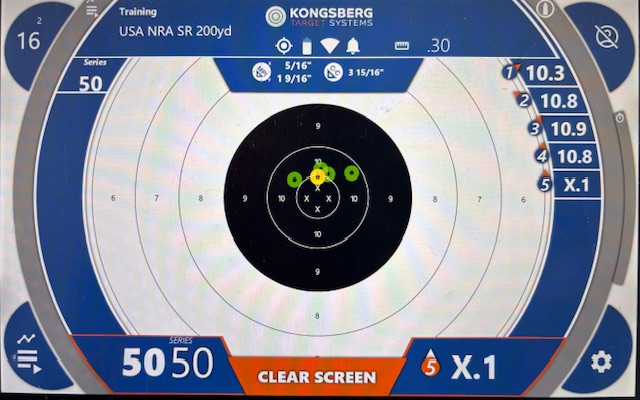 Test Results - Scope Fitted The above test was repeated with the No. 32 scope installed. The same loads were fired at 200 yards giving the following results: Load 1 Results (five shots): MV = 2415 fps ES = 29.5 fps Elevation Mean POI = + 0.81 inches above target center Load 2 Results (10 shots) MV = 2482 fps ES = 59.5 fps Elevation Mean POI = +3.94 inches above target center The resulting elevation difference with the scope fitted is 3.94 - 0.81 = +3.13 inches at 200 yards (+ 1.57 MOA) for a muzzle velocity change of 67 fps. Now, subtracting the contribution of the elevation rise due to change in trajectory bullet drop of approx 0.35 MOA, we get a net +1.22 MOA elevation rise for 67 fps velocity change for a negative Compensation effect of +0.18 MOA elevation rise per 10 fps velocity increase. This is more than 2X the elevation rise as compared to the scope removed. Where Do I Go From Here? I think what is happening is the added stiffness and mass to the action body from the scope and mount shortens the time it takes for the muzzle to rise and reach its first peak. Bullets are leaving the muzzle after the first deflection peak as the muzzle is moving downward., giving Negative Compensation. The options are to increase muzzle velocity and see if I can get the bullets to exit the muzzle on or before reaching the peak of muzzle rise. The other option is to experiment with barrel bearings/packing to alter the timing of muzzle rise/fall. I may try a 150 grain bullet to get the muzzle velocity over 2700 fps, this may prove the theory. More to do. |
Posted By: Doco Overboard
Date Posted: August 09 2025 at 8:19am
|
Here's what I would do the more I thought about this. Eliminate errors with sighting and hold by shooting at a closer distance. I would determine line of sight above the bore, level the rifle, peer through the bore laying an aim onto a target about 10 -12 yards away and mark the target. Then, whether through the sights or the telescope make a mark the same distance precisely above the first mark for an aiming point an equidistant distance. Obtain a ballistic or true zero or absolute trajectory zero. Not a corrected zero trajectory. Line of sight and bore are parallel. Then, go ahead and fire the rifle using the preferred sighting method using a consistent hold at the top mark and then finally determining where the shot strike occurs minus the diameter of the bullet. Once you know the velocity, drop, environmental conditions, temps etc you'll know what sort of compensation you have. And the finally you can remove/ add scopes try differing holds sling tension ammunition's, bedding packing etc to see what other effects come into play. The reason for my thinking is, you don't have to shoot a rifle at any kind of distance to determine trajectory, it can be done at short distance once you have a certain bit of information available to you and may save time effort ammo and all that sort of thing. I think off the top of my head you can determine Line of sight above bore trajectory or parallelism by dividing both the bolt and scope tube diameter in half and then by understanding the measurement from the top of the bolt and the bottom of the scope tube or some other fixed apparatus used for sighting. Thanks for sharing your experiences-following with interest. Brian
|
Posted By: britrifles
Date Posted: August 09 2025 at 1:24pm
|
It probably would have been better to shoot at 25 yds, as that does practically remove the bullet drop from the calculation entirely. Although hold and aim errors still apply, group spreads are considerably smaller. But it also moves group centers much closer together. 200 yard is a short range for this rifle and these results have convinced me the rifle with scope indeed has negative compensation. But I already knew that by comparing 600 yd elevation spreads to POI elevation spreads at the target. This test allowed me to quantify it by removing most of the bullet drop by shooting at short range rather than 600 yds. My elevation error at 600 yards is entirely due to velocity variations, as bullets with the same velocity stack on top of each other at 200, 300 and 600 yds. Looking back at the plot sheets, very good groups only occur when velocity extreme spreads are less than 30 fps. This figure below shows what is occurring. Without the scope attached, bullets faster than about 2400 fps exit the muzzle on the left side of the peak, along the blue line, showing positive compensation. Bullets slower than 2400 fps exit on the right side of the peak, showing negative compensation. With the scope attached, the increased stiffness is making the muzzle rise sooner, and this entire muzzle projection curve is shifted to the left such that bullets slower than 2500 fps exit on the downward side of the peak along the red line. I don’t know about bullets faster than 2500 as I’ve not pushed my loads that fast. Question is, what muzzle velocity do I need to get them to exit close to the top of this curve and preferably on the left side of the peak? 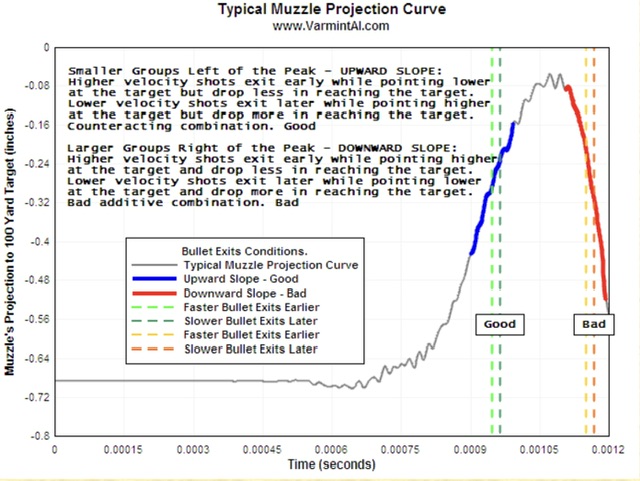 It’s possible that shooting with a sling rather than the forend rested on a sandbag and pulling the rifle into my shoulder might change the rifle dynamics enough to make a difference. I will also try 150 gr bullets at higher velocity to see if I can get them to exit the muzzle sooner along the blue line. The compensation with the scope, although negative, is not nearly as much as what the No. 4 7.62 rifles experienced back in the 1960’s which were particularly bad at short ranges. A rifle that fully compensates for bullet drop at 1000 yards will have vertical spreads as much as 5 MOA at short range for muzzle velocity spreads of 100 fps. Very poor ammunition with an ES of 200 fps will be double that! I dug up some early notes I made on my Fulton No. 4 and it also possessed negative compensation with a scope fitted. At the time, I did not realize this, and I did not have a chrono. The elevation rise at 100 yards was 0.83 inches per grain of powder (approx 50 fps increase in MV per grain) and very linear over a 3 grain charge range. If the rifle had positive compensation, the POI would have decreased for an increasing powder charge. |
Posted By: britrifles
Date Posted: August 10 2025 at 4:39am
|
In sorting thru my bullet stocks, I found several boxes of Lapua 123 gr .311 inch open base FMJs. I can load these up to 2900 fps and see if that moves the bullet exit time from the muzzle as it is moving upwards (positive compensation). I’ll load three different velocities, approx 2700, 2800 and 2900 fps. I tested these some years back in the Savage and Long Branch No. 4 and they shot quite well at 200 yds. Of course, I don’t expect a 123 gr bullet will perform beyond 300 yds, but worth seeing what it does at 600 yds, who knows, might be just the ticket. 123 gr Lapua on the left and 174 gr SMK on the right. 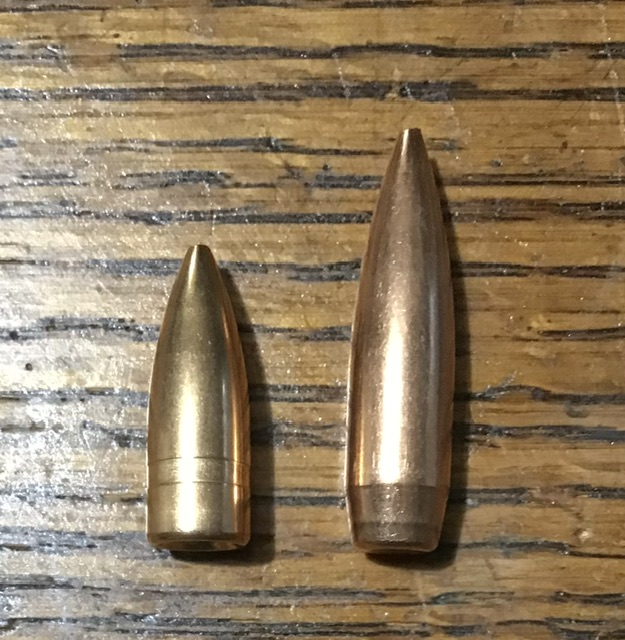 |
Posted By: Shamu
Date Posted: August 10 2025 at 1:05pm
|
Its worth a shot, if only to confirm or refute you theory! ------------- Don't shoot till you see the whites of their thighs. (Unofficial motto of the Royal Air Force) |
Posted By: britrifles
Date Posted: August 10 2025 at 2:05pm
|
Exactly Shamu. I’ve now loaded up 42.0, 43.5 and 45.0 gr N135 with the 123 gr Lapua .311 FMJ bullet to book velocities of 2700, 2800 and 2900 fps. Hope to get back to the range on Friday. |
Posted By: britrifles
Date Posted: August 17 2025 at 12:16pm
|
I complete a series of compensation tests today at 200 yards with the T with light bullets. I have a fair bit of data to compile, but the results are clear: the higher muzzle velocities attained with the 123 gr Lapua bullets did indeed produce “Positive Compensation” indicating bullets are leaving the barrel as the muzzle is moving upward. This is completely opposite to the slower 174 gr bullets which leave the barrel as the muzzle is moving downward. I’ll provide the details on this thread, but here is the top level summary: Charge MV (fps) Mean Elevation POI (MOA) 42.0 2827 +0.44 43.5 2920 -0.25 44.0 3015 -1.62 Note that the group elevation mean point of impact is measured from the target geometric center and it drops as bullet velocity increases. With the slower 174 gr SMK loads, the POI increases as velocity increases (the opposite). Basic Load Data: Case - PPU Primer - WLR Powder - VV N135 Bullet - Lapua 123 Flat Base FMJ OAL - 2.90 in. The 1:10 twist barrel is likely over-stabilizing these bullets, particularly for the higher velocities (2900 - 3000 fps). The smallest group was with the 42.0 grain charge giving a mean velocity of 2827 fps, ten shot group was at 1.3 MOA center to center extreme spread, a good result. 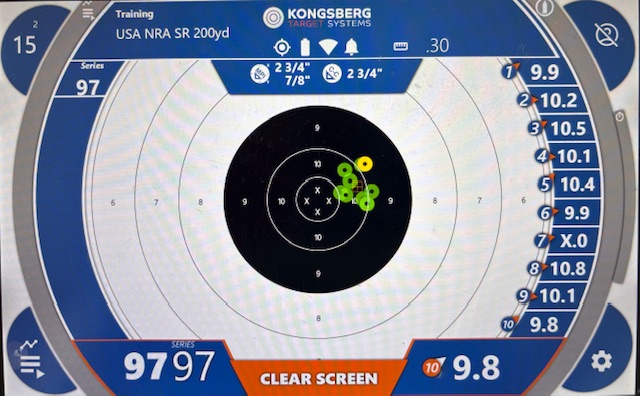 |
Posted By: Shamu
Date Posted: August 17 2025 at 2:01pm
|
Very interesting. I played briefly with light 125Gr .312 bullets for the No4 a while back.The results were disappointing to say the least, maybe because of the over-stabilization. IIRC I tried IMR 3031 & H335. The results were so disappointing I actually greyed out the load in my reloading spreadsheets. ------------- Don't shoot till you see the whites of their thighs. (Unofficial motto of the Royal Air Force) |
Posted By: britrifles
Date Posted: August 17 2025 at 5:41pm
|
What all this testing points to is a 150 grain bullet pushed to around 2650 fps should result in a neutral or slight positive compensation and be an ideal accuracy compromise at 300 and 600 yds for the Vintage Sniper Matches. My next test is to load PPU 150 gr FMJBT bullets, will probably use Varget for this, it brings good velocities with mild pressures. Hodgdon web site gives the following for a 150 gr bullet: Charge Vel Pressure (gr) (fps) (CUP) 39.0 2458 39,600 43.0 2656 42,700 The .303 is rated for 45,000 CUP, so the max charge listed on the Hornady site has some leeway. If anyone has tried this bullet, I'd like to hear what the results were. I think pushing the 174 gr SMK beyond 2500 fps is probably not the best option to achieve some degree of neutral compensation (or less "negative" compensation). |
Posted By: britrifles
Date Posted: August 22 2025 at 12:12pm
|
I ran the tests with the 150 gr PPU FMJBT bullets today in the No. 4 T. They did better than I expected. Load data: Case - PPU neck sized Primer - WLR Powder - Varget, 41.0, 42.0, and 43.0 grains Bullet - PPU 150 gr FMJBT Temp - 79 to 82 degrees F. I shot the three loads at 200 yds at the same elevation settings on the scope to record the mean point of impact of the group to see if this bullet will show positive compensation with these results: Charge MV Mean Elev (gr) (fps) (MOA) 41.0 2488 +1.2 42.0 2564 +1.9 43.0 2616 +3.4 Note that the increasing group elevation is substantially more than the bullet trajectory at 200 yds accounts for, indicating that bullets are exiting the muzzle at the barrel is moving downward resulting in negative compensation. The elevation MPI of the group rose as mean velocity increased, so these loads did not show positive compensation. However, the elevation spread of the 43.0 gr load was just 1.0 MOA with a velocity ES of 45 fps and slow bullets hit high and fast bullets hit low on the target indicating that for velocities above about 2580 fps, this load gives positive compensation. Target below is the 43.0 gr load, shot 4 was called high, the remaining 9 shots had an elevation spread of 1.0 MOA. I think this is quite good given how inexpensive the PPU bullet is (compared to a 174 gr SMK). 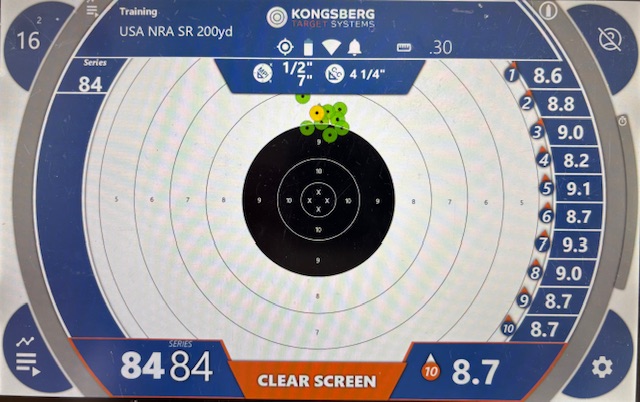 I will load up more of the 43.0 gr load to try at 600 yds and also load 43.5 gr to confirm positive compensation at 600 yds. 43.0 gr Varget with 150 gr bullet is listed as max on the Hodgon website, but absolutely no indications of high pressure, easy case extraction. |
Posted By: Strangely Brown
Date Posted: August 22 2025 at 12:54pm
|
Phenomenal...! ------------- Mick |
Posted By: Zed
Date Posted: August 22 2025 at 1:05pm
|
That's very interesting results Geoff. I have not tried the 150 grain bullet. Is it a flat base? Also, what is the overall length of the cartridge? ------------- It's nice to be important, but it's more important to be nice! |
Posted By: britrifles
Date Posted: August 22 2025 at 2:16pm
|
Shaun, this is the 150 grain FMJ boat tail. I loaded these to an OAL of 2.98 inches. I wasn’t able to find any load data specific to this bullet. The diameter measured .3111 with my micrometer. Velocities ran a bit lower than expected, though the Hodgdon data is based on a flat base bullet. I wasn’t expecting much in the way of accuracy as I wouldn’t think PPU bullets would be “match grade”, and the boat tail on a light bullet would not give much bearing surface in the bore. But, I was pleasantly surprised. Will they shoot as accurately at 600 yds? I will soon find out. |
Posted By: Bear43
Date Posted: August 22 2025 at 4:42pm
| Good Lord, that's impressive! |
Posted By: Shamu
Date Posted: August 22 2025 at 4:49pm
|
I was going to chip in with some "150 Gr PPU" I have, but weighing them they all came out as 173.9~ 174.1 Gr! They came in a baggie as part of a batch of bullets from a prior member here! At least They were FB & I didn't load them to 150 Gr power levels!  ------------- Don't shoot till you see the whites of their thighs. (Unofficial motto of the Royal Air Force) |
Posted By: britrifles
Date Posted: September 08 2025 at 11:38am
|
Haven’t updated this thread in a while. Testing continues with the No. 4 T, with varying results. They all show “negative compensation” with 174 grain bullets at typical velocities this bullet is loaded to. I’ve tried three different fore-end barrel bedding methods/pressures as follows: 1) center bearing at 8 inches from the front of the action body, pressure at the muzzle to lift the barrel off the bearing is 35 lbs, no muzzle bearing, 2) as above, with pressure at 12 lbs, and 3) as for 2) above plus two layers of cork under barrel at front of fore-end bearing location to lift the muzzle 0.01” from its free position. Yesterday testing method 2) above gave mixed results at 300 yards. It was too windy to test at 600 yds. I was using my standard match load: PPU Case Neck Sized WLR Primer 40.3 gr Varget 174 gr SMK 3.07” OAL View thru the No. 32 Scope at the 300 yard target. This is about what the actual sight picture looks like. Target is the US NRA Short Range SR-3 target with a 3” diameter X ring and 7” diameter 10 ring. I didn’t get the rifle sitting on the bag rest quite right, vertical graticule was pointing to the left of the center of the target. I use a 6 O’Clock hold on the black aiming mark (8 ring).  The photo below clearly shows my frustration with vertical stringing caused by high and low velocity shots. 8 of 10 shots held a group of just under 1 minute of angle, quite pleased with that. Those 8 shots in the X ring had a velocity extreme spread of just 10 fps. BUT, shot # 6 (low in 9 ring) was 32 fps below the mean velocity (2407 fps) and shot # 1 was 23 fps above the mean for a total ES of 55 fps. A 55 fps ES should not cause this much vertical stringing at 300 yards (only about 1/2 MOA). Barrel movement/ deflection at the moment the bullet leaves the muzzle is exaggerating the velocity differences (a very distinct “negative compensation”), this has been a repeatable condition with this rifle for all three barrel bedding methods used. 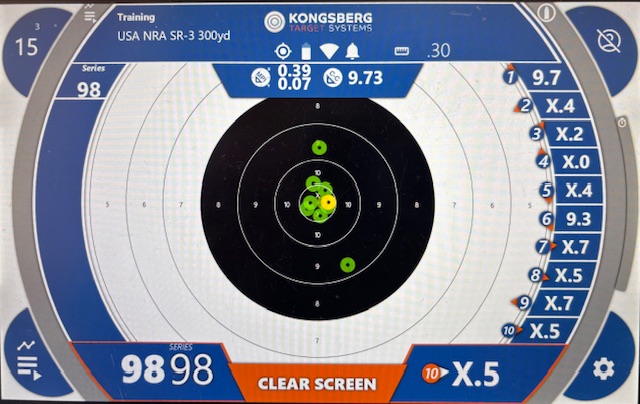 My plan is to next try the orthodox barrel bedding, relieve the center bearing and add a muzzle bearing at 5-7 lbs pressure. This will give me an idea of how the T performed “as issued”. |
Posted By: britrifles
Date Posted: September 08 2025 at 12:06pm
|
Another 300 yd target from yesterday. This was with new PPU cases, first firing. Same load as above. In this group, the 9/10 shots within the 10 and X ring had an ES of 23 fps and a center to center spread of 1.25 MOA. Quite good. The 10 shot group has a ES of 31 fps, respectable. Shot #2 high in the 9 ring was the highest velocity shot in the group, but just 16 fps above the mean velocity of 2410 fps. Again, a very exaggerated elevation increase for a relatively small velocity increase. 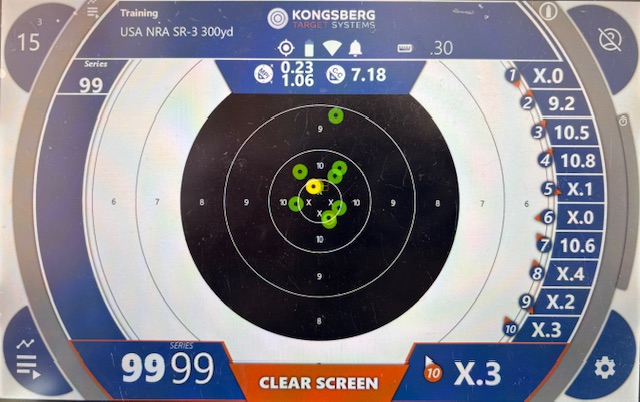 |
Posted By: Shamu
Date Posted: September 08 2025 at 2:30pm
|
Its interesting how they group so well then WHAM out in the weeds. I wonder where the actual "break point" in variation is? ------------- Don't shoot till you see the whites of their thighs. (Unofficial motto of the Royal Air Force) |
Posted By: britrifles
Date Posted: September 08 2025 at 3:00pm
Exactly Shamu, it seems the elevation shift is dramatic above 20 fps. Less than that, it’s hard to see any correlation of muzzle velocity with POI elevation and the groups are very tight. Vertical POI spreads from a 50 fps ES look ugly. I can predict where the bullets will impact (high/low and which score ring) just by looking at the chrono, it’s very predictable. There is a bit of scope parallax error, but that is random with head/eye position and likely less than 1/2 minute. I’ve gone back and looked at my 150 gr PPU FMJBT results, they did not have nearly this much elevation spread with a velocity ES of 54 fps. One group showed no correlation of velocity to vertical POI, which makes me believe these bullets are fast enough to exit the muzzle as it is near the top of its vertical deflection. More testing is needed. It’s all about repeatability. By the time I figure this out, I’ll need another replacement barrel. I have a new CBI and a new LW barrel on hand. |
Posted By: britrifles
Date Posted: November 26 2025 at 7:46am
|
Been a while since I've updated this thread. It's been a journey here and I'm not finished yet! Last week, I decided to clear out the hardwood bearing that had been fitted in the fore-end at 8 inches forward of the back of the barrel (often referred to as center bedded). This was done in the 1960's by DCRA Technical Advisor/Armorer Dave Reynolds. Using a barrel channel scraper, I scraped the bearing down to the surface of the fore-end channel to get clearance. I then added two layers of cork material under the barrel at the normal No. 4 muzzle bearing location which had been cleared out by Dave to obtain the center bedded fit. This gave me 5 lbs of barrel pressure with barrel clear of the fore-end between muzzle bearing and chamber reinforce consistent with the standard factory stocking up procedure. Initial tests at 200 yards looked very promising, but the rifle soon showed the same "negative compensation" which results in vertical stringing of the group from bullet muzzle velocity variations, fast bullets impacting high and slow bullets impacting low on the target. First three shots just over 1 inch spread at 200 yards.  I've now removed the cork shims at the muzzle and have added a cork shim under the barrel at the sling swivel band location on the fore-end to give 14 lbs of pressure (i.e. 14 lbs of muzzle weight needed to lift the barrel off the bearing). This bearing location was used for the No. 4 7.62 conversions and was very successful in DCRA competitions at long range by fully compensating for muzzle velocity variations as I've shown here on this thread. The search for accuracy never stops... |
Posted By: Strangely Brown
Date Posted: November 26 2025 at 8:30am
Indeed it doesn't Geoff! After the problems with the No.4 in 7.62mm I had put together at Bisley a couple of years ago, conversations with friends over here have confirmed we are running out of the people who knew all about the correct bedding of Enfield's. Which is why I find your posts so informative on the subject. ------------- Mick |
Posted By: britrifles
Date Posted: November 26 2025 at 12:46pm
|
Here is the temporary setup. The light coloured rectangular piece in the fore-end barrel channel is a 2.0 x 0.75 x 0.060 inch thick cork sheet at the position of the sling swivel (middle) band. Behind that is the remains of the hardwood bearing that was positioned 8 inches forward of the front of the action body. It is sitting on top of a wood plug shaped to fill the middle lightening slot cut into the fore-end. I have scraped this bearing surface clear of the barrel. The barrel now has about 0.05” clearance everywhere except at the middle band bearing and the chamber reinforce bearing surfaces. The new cork sheet bearing is 11 inches forward of the front of the action body and this replicates the stocking-up methods used by the DCRA to a high degree of success at the 1967 Palma long range matches. My best shooting No. 4 is stocked up this way. At the rear of the action body bearing surface there are two Bakelite shims approx 0.050” thick which applies the force to offset the barrel bearing pressure. Thus the fore-end does not contact the action forward bearing and chamber reinforce bearing surfaces until the main screw is tightened down. 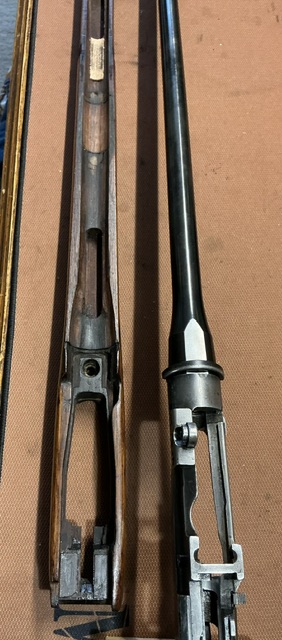 Seen more clearly in this photo. The cork is tack glued in place. It applies about 14 lbs upward pressure to the barrel when the main screw is fully tightened. I’m hoping that it will alter the barrel displacement response when the bullet is traveling down the barrel, ideally such that the muzzle moves upward as the bullet leaves the barrel. 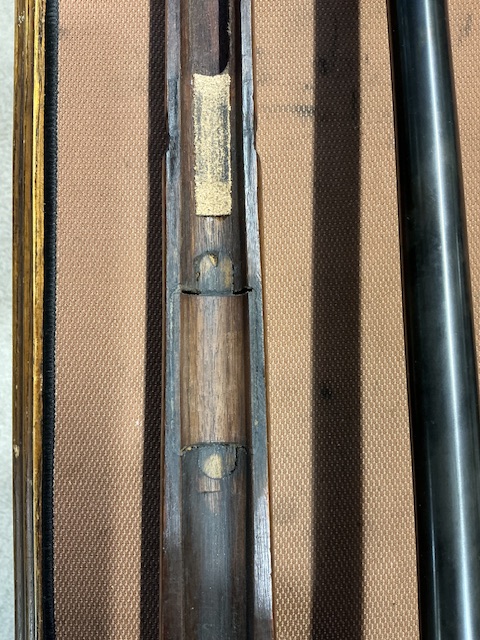 |
Posted By: DarioPirovano
Date Posted: November 26 2025 at 3:54pm
|
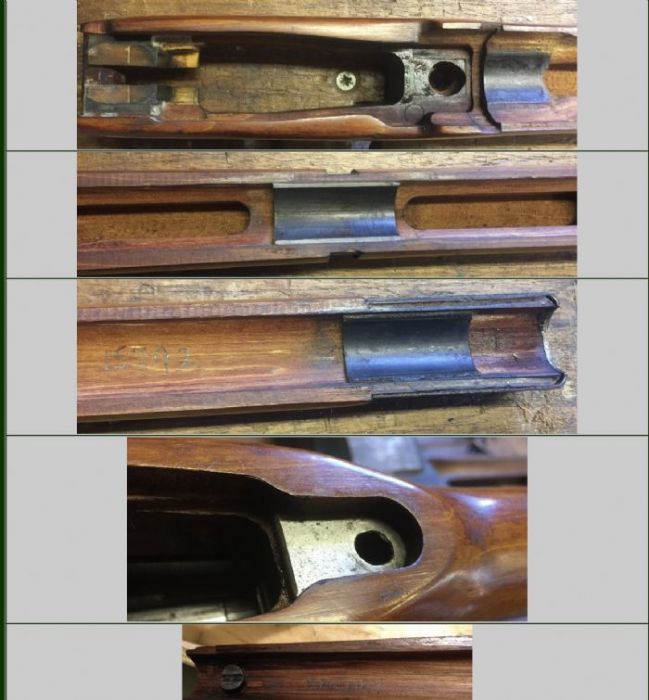
Hi Geoff, when I started finding out what barrel preload my no4 mk2 liked, I made a starting point at center bedding position with 10lbs preload and every 10rds, starting at cold bore, I added a paper shim on the bearing until the grouping was acceptable, I measured about 16lbs of preload, with cork applied in the rear handguard just over the forend bearing. I did found out that the forend bearing length actually had its effect on grouping, two of my no4 did liked more long bearing surface. I suggest you to try mid-center bearing also i read that it work very well. Take a look at this no4 tuned by Fultons for Mr. Walter Magnay: |
Posted By: DarioPirovano
Date Posted: November 26 2025 at 3:57pm
|
Posted By: DarioPirovano
Date Posted: November 26 2025 at 3:58pm
|
Hi Geoff, when I started finding out what barrel preload my no4 mk2 liked, I made a starting point at center bedding position with 10lbs preload and every 10rds, starting at cold bore, I added a paper shim on the bearing until the grouping was acceptable, I measured about 16lbs of preload when the rifle started printing 1.5 moa repeatable groups at 100mts, with cork applied in the rear handguard just over the forend bearing but a little shorter and centered. I did found out that the forend bearing length actually had its effect on grouping, two of my no4 did liked more long bearing surface. I suggest you to try mid-center bearing also i read that it work very well. Take a look at this no4 tuned by Fultons for Mr. Walter Magnay: 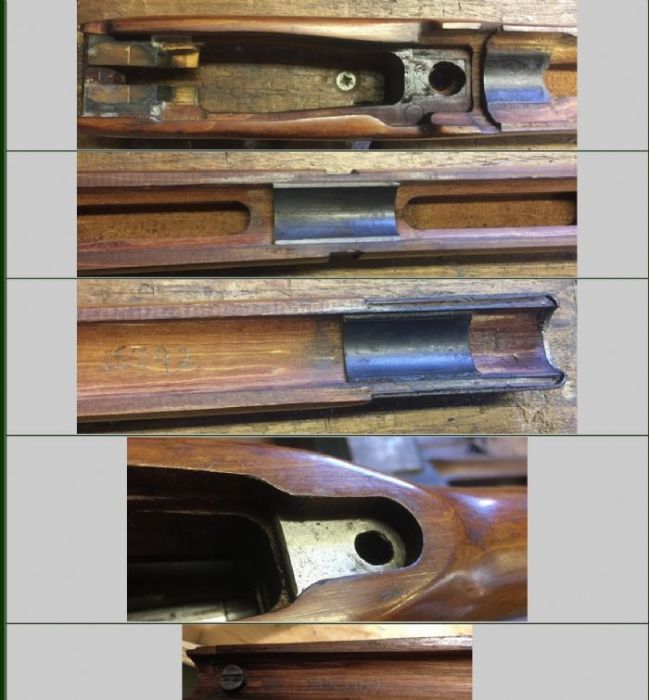 They used a no1 bearing and spring, applied in to the handguard just over the forend bearing. Would be very interesting to find out how much force the spring applied based on their fitment. |
Posted By: DarioPirovano
Date Posted: November 26 2025 at 4:00pm
| I’m sorry for the double reply I think I sent before and after correcting my gibberish English |
Posted By: britrifles
Date Posted: November 27 2025 at 3:42am
|
Dario, Are these photos of the same fore-end, which has a bearing at the middle band and also at the muzzle? I’ve thought about adding cork between the hand guards and barrel at the middle band bearing, and intend to experiment with that as well. I’ve also used paper shims to adjust the bearing pressure on one of my No. 4 rifles. My Fulton No. 4 has the bearing between the first and second lightening slot, about 5 inches forward of the front of the action body. Is this what you mean by “mid-center” bearing? |
Posted By: Zed
Date Posted: November 27 2025 at 4:09am
|
Interesting stuff. I will be working on my No4 Mk1 when I have tested it as is. I need to know the starting point, to find out what difference can be made. ------------- It's nice to be important, but it's more important to be nice! |
Posted By: DarioPirovano
Date Posted: November 29 2025 at 12:23pm
|
Yes they are from the same forend, fultons did a double bearing. Check out the photo source: https://www.highwoodclassicarms.co.uk/Firerms%20For%20Sale/0151.htm By mid center bearing i mean another experimental bedding method that mixes center bearing and mid bearing, it was proven to be effective. Go to page 173: https://www.nzha.co.nz/wp-content/uploads/2015/08/the_2012_complete_book_on_lee_enfield_accurizing.pdf Green mid barrel bearing, red mid-center bearing, blue center bearing. 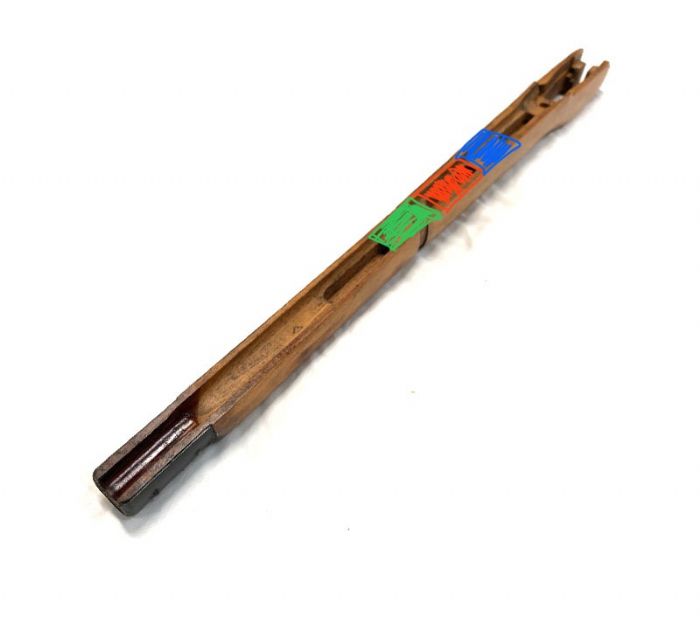
|
Posted By: Strangely Brown
Date Posted: November 29 2025 at 1:22pm
Dario, there's an amusing story attached to that which I have mentioned to Geoff (britrifles) in the past; the owner ( pictured in the advert) is somebody I shoot with most weeks and he told me he was selling his No.4, a friend and I wrongly assumed it was a heavy barrel conversion so didn't question him further about it. I actually recommended he try Highwood Classic to sell it...had I known exactly what the rifle was I would have bought it without question. I'm shooting with him again this Tuesday and he has an annoying habit of telling me what a wonderful rifle I missed out on!
------------- Mick |
Posted By: DarioPirovano
Date Posted: November 29 2025 at 1:33pm
| Thats what I call a missed train, I feel sorry for you. |
Posted By: britrifles
Date Posted: November 29 2025 at 1:47pm
|
Thanks Dario. I’ve got one No. 4 set up with each of these three different bearing positions. I found the rear position (center bearing, shown in blue) gave best short range accuracy (particularly at 200 yds) and the green mid-band bearing gave best long range accuracy (800 to 1000 yds). My No. 4 T was stocked up with the mid-center bearing position shown in red, 8 inches forward of the action body. It required a wood plug to be glued into the lightening slot in the fore-end. I’m loading up ammo for the compensation tests. I will test with -1 and +1 grain below and above my standard match load. I’ll do this with two different bullet weights, 150 gr PPU FMJBT and 174 gr SMK. My fingers are crossed that the mid-band bearing will result in positive compensation. I’ll do the tests with and without the scope fitted. |
Posted By: DarioPirovano
Date Posted: November 29 2025 at 1:55pm
| Let us know!! |
Posted By: britrifles
Date Posted: December 07 2025 at 7:19am
|
Compensation Testing continues. I had some interesting results yesterday with the No. 4 T, now with barrel bedded in the fore-end at the lower (sling swivel) band, 11 inches forward of the front of the action body. Pressure at muzzle to lift the barrel off the bearing is 14 lbs. The bearing is only temporary, made of 0.060 inch thick cork sheet and tack glued in place. This is all described above in this thread. I tested three loads: Case - PPU neck sized 10 times Primer - WLR Powder - Varget 39.0, 40.3 and 41.2 grains Bullet - 174 gr SMK OAL - 3.07 inches Weather was overcast, 45 degrees F, light winds from 3 O’Clock 5 shot groups fired off the bench at 200 yards with and without the No. 32 Scope fitted, Mk 1 Aperture sight used w/o scope. In order to assess the amount of “jump” at the muzzle with and without the scope, I first boresighted the rifle as best I could by removing the bolt and carefully centering the target black round aiming mark inside the bore. This won’t be perfect, but close. Then I adjusted the scope elevation to give me a 6 O’Clock sight picture on the target. I did the same with the scope removed using the Mk 1 Aperture sight. The above test resulted in a 3 minute positive jump without the scope (meaning shots hit 3 minutes high) with the aperture sight and a 3 minute negative jump with the No. 32 scope fitted (shots hit 3 minutes low). This agrees with tests done at Enfield described by Maj Reynolds with the No. 4 T. This test was done with 40.3 grains of Varget. The next tests were five shot groups with each powder charge and observe the shift in the elevation Mean Point of Impact (MPI) as muzzle velocity changes. I recorded: Mean Velocity (MV) Velocity Extreme Spread (ES) Group Center to Center (C-C) Extreme Spread Group Elevation MPI above or below the center of the target in Minutes of Angle (MOA) Results with Scope Fitted 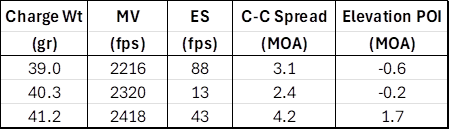 Results with Scope Removed, Mk 1 Aperture Sight 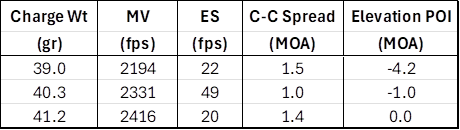 What stands out here is the group sizes shot using the aperture sight is less than half the group sizes shot with the scope. Not at all expected. The good news is the rifle and bedding method shoots very well with aperture sights, the bad news is the scope may be buggered. While the group size shooting with the aperture sight was just 1 to 1.5 MOA, there was a very large elevation drop with the 39.0 gr charge (3 minutes below the standard 40.3 gr charge). This indicates that muzzle velocities below around 2300 fps results in pronounced negative compensation. There was much less elevation change between 40.3 and 41.2 gr charges (just 1 minute). With the scope, the elevation changes between loads was significantly less. This is a good thing and indicates neutral compensation. Positive compensation may occur at a different muzzle velocity with the scope vs with aperture sights. Looking at the data, there is very little elevation change for muzzle velocities between 2200 and 2320 fps, about 0.5 MOA. That is very encouraging. Some examples of the target results: With Aperture Sight: 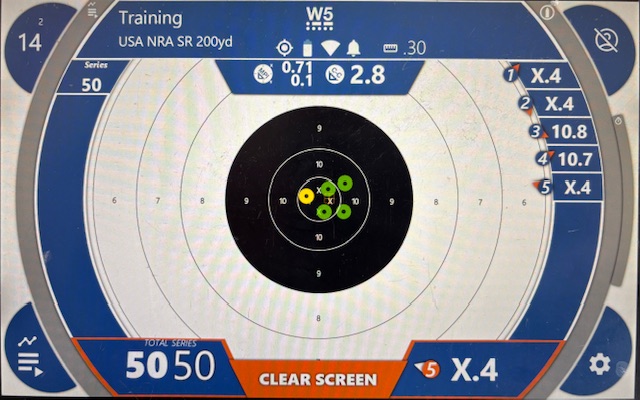 With Scope (best group): 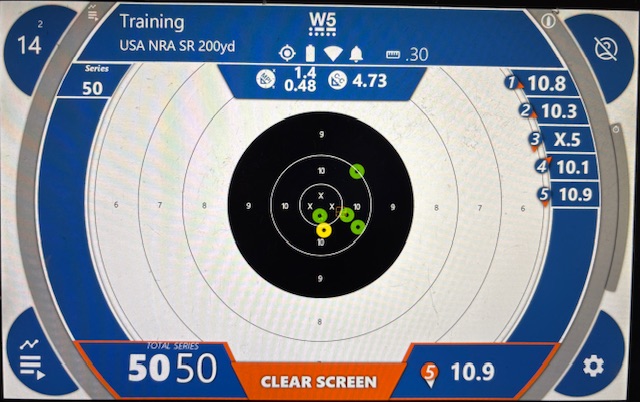 Here was the worst group with the scope. I thought after the first 2 shots, this load would hammer the X ring, but then the group shifted upwards by a full 3 minutes! No explanation for this. 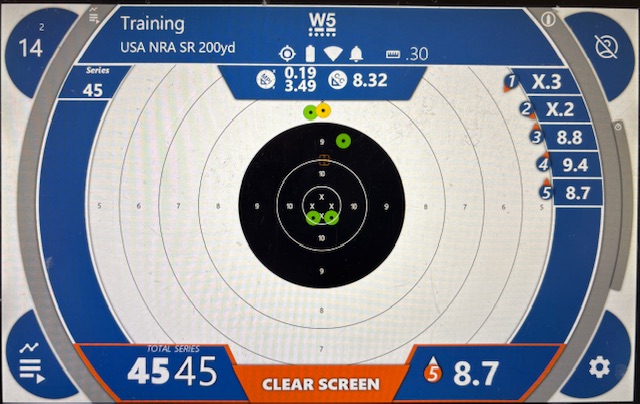 My next tests will be with PPU 150 grain FMJBT bullets. This rifle shoots so well with the aperture sight, I may shoot it this way in the next Vintage Sniper Match. The guys will think I’m nuts… |
Posted By: Zed
Date Posted: December 07 2025 at 7:49am
|
That's impressive. I agree that shooting a Sniper match with iron sights will be a challenge, and probably loads of fun too! Thanks for sharing your results. ------------- It's nice to be important, but it's more important to be nice! |
Posted By: britrifles
Date Posted: December 07 2025 at 8:18am
|
One thing I forgot to mention, I had cleaned the bore down to bare steel with Bore Tech Eliminator prior to this shoot. It reduced muzzle velocities by 70 fps. I don’t think that is playing into this, but it explains the 2320 to 2330 fps muzzle velocity from my regular 40.3 gr Varget Match Load which typically gives 2390 to 2400 fps. I’ve lightly clamped the scope in a vice to see if the graticule moves by gently tapping the vice with a brass hammer. I can’t detect any movement. The pointer returns to its position after moving the windage and elevation drums thru their range. This has me stumped… 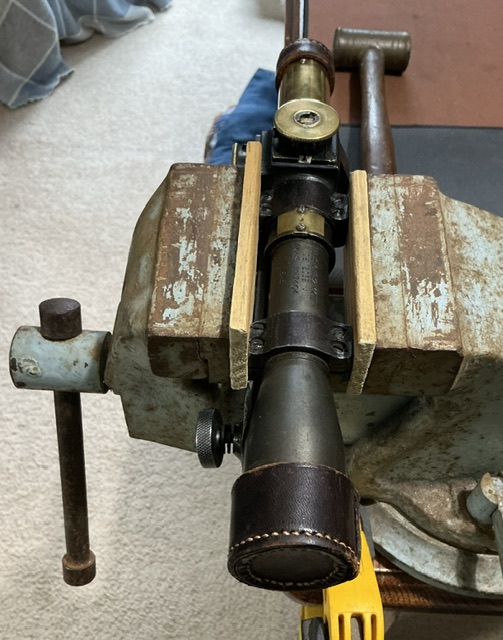 |
Posted By: Zed
Date Posted: December 07 2025 at 9:19am
|
In the first Scope target you have one shot higher than the others. Could that be similar to what occured on the second target? Did you shoot aperture first, then fit the scope? ------------- It's nice to be important, but it's more important to be nice! |
Posted By: britrifles
Date Posted: December 07 2025 at 10:41am
|
Shaun, I shot the scoped groups first, a total of 20 rounds. Then another 20 with the Mk 1 aperture sight. I had 5 rounds left over and kicking myself for not refitting the scope and shooting those five rounds. Perhaps it took those 20 rounds to settle the fore-end into the action? Probably wishful thinking on my part.
|
Posted By: britrifles
Date Posted: December 07 2025 at 12:18pm
Looking at the first scoped target, the elevation spread of 4 of the shots was just 0.5 MOA . That one shot increased it to 2 MOA. Now here is the interesting part, if I exclude that one shot, the elevation MPI is nearly identical for the 39.0 gr and 40.3 grain loads which had a velocity spread of a whopping 123 fps. That is an indicator of positive compensation in that velocity range. More testing to do. I will also confirm the grouping standard with 40.3 gr Varget and 174 SMK load next trip to the range. |
Posted By: DarioPirovano
Date Posted: December 08 2025 at 6:15pm
|
Great job, consider fitting a Parker hale diopter to it, in Italy rifles with diopters are excluded from iron sights matches and you will be automatically challenge scoped rifles, with a super small target but at 100mts. With the diopter at least you can address wind and light changes |
Posted By: britrifles
Date Posted: December 09 2025 at 1:08am
|
Unfortunately, the rear scope mount pad interferes with fitting a PH 5C backsight. The PH 4 would be the answer. Wish I could find one! |
Posted By: Zed
Date Posted: December 09 2025 at 4:06am
|
Dario, in France we have a "modified" class for the sniper rifles and standard service rifles with dioptre sights. However my L39A1 is not allowed because it was a special made for the Army shooting teams and competition. ------------- It's nice to be important, but it's more important to be nice! |
Posted By: Strangely Brown
Date Posted: December 09 2025 at 4:25am
That's a shame Shaun because it's an L42 in everything but the scope. Whilst the L39 was meant for Tripartite service competitions I never saw one until I left the army; virtually all of the existing records seem to indicate the RAF managed to blag the majority of them. ------------- Mick |
Posted By: Shamu
Date Posted: December 09 2025 at 1:56pm
|
How about an Aussie "Central", that ought to fit if you can find one.  ------------- Don't shoot till you see the whites of their thighs. (Unofficial motto of the Royal Air Force) |
Posted By: Zed
Date Posted: December 09 2025 at 10:49pm
|
Mick, the thing is, you can have a modified calibre, so if you have a Charnwood heavy barrel kit that is marked No4 Mk1, it would probably be allowed as it's not specifically banned! We can use the L39 in the ISR competitions. ------------- It's nice to be important, but it's more important to be nice! |
Posted By: britrifles
Date Posted: December 10 2025 at 8:01am
|
One thing we can all count on not changing, is that competition rules will change over time but remain inconsistent between the various national associations that host and run these matches. Especially those that are historic/vintage matches. The rules in the US are governed by the Civilian Marksmanship Program (CMP). There are still matches hosted and run by the National Rifle Association but this seems to be gradually fading. The CMP and NRA rules differ, which is a source of frustration. Until recently, there was no appropriate class to compete with a L42 Sniper rifle. These rifles did not conform to the "Pre-1954" date of manufacture cutoff for the Vintage Sniper Rifle matches (now referred to as Category A). A new class was added last year (or year before?) for a "Vietnam" Era Sniper rifle, manufactured from 1954 - 1976 (referred to as Category B). Not that we see many L42's over here, I've not seen one yet at a match. Note, what they really mean by date of manufacture is the date of design. For example, a M70 Winchester or M700 Remington current production rifle can be used in the Category B Vintage Sniper Rifle Match providing it conforms to the other rules listed. If you want to compete with a L39, it would probably qualify for the "Match Rifle" classification or an F-Class Rifle and shooting against more modern rifles. The CMP does usually separate out Match and F-Class rifles with and without scopes, but for some matches, you would be competing against others with unlimited power scopes. In reviewing the CMP rules, I see it specifically states that only optical sights can be used in the Vintage Sniper Rifle matches. I might go dispute this because the No. 4 T was issued with usable iron sights and I'll bet has been fired that way by snipers in action. |
Posted By: Zed
Date Posted: December 10 2025 at 10:26am
|
The ISR in our region, is a new competition. However it is shot at the same range as our Service Rifle qualifying round and just two weeks before it So last year I used the ISR event as a practice for the Service Rifle competition. So I used the No1MkIII* with the PH dioptre for the modified class and the No4 Mk1 in the standard This range is 200m indoor. It's has partial roofing and high stone walls. Built in Napoleonic time for musketry training. It's quite dark inside, so often requires adjustment. So worthwhile getting some practice prior to the qualifying round. ------------- It's nice to be important, but it's more important to be nice! |
Posted By: Strangely Brown
Date Posted: December 10 2025 at 10:49am
|
The NRA UK Classic & Historic rules can be found here: https://nra.org.uk/wp-content/uploads/Classic-Historic-Handbook-2025.pdf" rel="nofollow - Classic-Historic-Handbook-2025.pdf Very much a work in progress as some dates and matches will change next April when the new book comes out. Having assisted on this tome I can testify you cannot please everybody! ------------- Mick |
Posted By: britrifles
Date Posted: December 14 2025 at 5:30am
|
Edited 12 Jan 26 I discovered that this test was actually done with the PPU 174 gr FMJBT bullet and not the PPU 150 gr FMJBT bullet as I had intended. I would not intentionally load the 174 gr bullets above 42.0 grains of Varget, so the 43.0 gr is potentially a slight overload for the .303 British in the No. 4 rifle. The No. 4 rifles were converted successfully to shoot the 7.62 NATO round, so I don't believe the 43.0 gr Varget load with the 174 gr FMJBT exceeded 45,000 CUP, and highly unlikely it reached 50,000 CUP of the 7.62 NATO ball round. I've edited this post to change the 150 gr FMJBT to the 174 FMJBT bullet. No change in conclusions or observations. ___________________________________________________________________________ Weather: Clear Temp: 45 to 55 degrees F Load: 41.0, 42.0 and 43.0 gr Varget, PPU Case, WLR Primer, 174 gr PPU FMJBT seated to 3.03 inch OAL All shots taken at 200 yards off a bench rest. I followed the same routine as the last test. First, shot 5 rounds of the 42 grain load with the scope fitted. The MPI was 3.6 MOA above and 2.0 MOA to the right of my 40.3 grain Varget load with 174 gr SMK. Interesting the group moved to the right as well as up. Then fired five rounds of each of the 41, 42 and 43 grain loads and recorded the Mean Point of Impact (MPI), group center to center (C-C) spread (MOA), Muzzle Velocity of each shot and the Mean Velocity (MV) and Extreme Spread (ES). The ES values of these loads were considerably better than average ES values of my regular match load of 40.3 gr Varget and 174 SMK; presumably because of the higher load density, however, these are only 5 shot groups which we might expect a lower ES than a 10 shot group. WITH NO. 32 SCOPE  Note the trend of increasing MPI for increasing Muzzle Velocity. Group results rather poor for a No. 4 T, in fact, it fails the accuracy standard for a T (must place 7 out of 7 shots in a 5 inch circle at 200 yards, that’s 2.5 MOA). However, the elevation change between 41 and 42 grains is fairly small, just over 1/2 MOA which may indicate an accuracy node with the middle band barrel bearing. WITH MK 1 APERTURE SIGHT 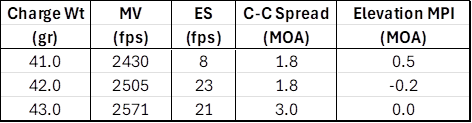 There was little to no correlation of Elevation MPI with increasing Muzzle Velocity. In fact, the slowest bullets hit higher on the target which indicates Positive Compensation. More tests would be needed to determine the compensating range, but it looks like it might be around 500 to 600 yds with this bullet at these velocities. Groups with the Mk 1 aperture sight with this bullet were a bit larger than the 174 SMK. That may have been due to the lighting conditions, I find it difficult to hold consistent elevation with the sun shining directly on the front sight from the front (range faces South) and target in the shade. The last group fired was the 43 gr load had one high shot that otherwise would have made the group about the same size as the others with a MPI the same as the 42 gr load. Where to go from here? I will make a more permanent barrel bearing at the middle band. I’ve re-tested the scope using the No. 32 Scope Testing Chart to confirm the elevation and windage movements of the graticule track perfectly to the chart range and deflection index markings. It also meets the requirement for return to zero after removing and reinstalling the scope. Why the rifle groups better with the Mk 1 aperture sight than with the scope is the mystery. |
Posted By: DarioPirovano
Date Posted: December 16 2025 at 12:08pm
|
Geoff, I’m starting to believe that with the scope installed, the rifle somehow changes its harmonics, at this point the action being stiffer because of the scope mount doesn’t flex or vibrate as it does without, if you have time, I suggest you to try the rifle with the scope installed with another forend or a different kind of receiver bedding |
Posted By: britrifles
Date Posted: December 16 2025 at 12:28pm
|
Dario, that has been my thinking as well. I also thought it possible that the scope graticule is not holding it's position after recoil. Weak or sticking springs perhaps. But the correlation of muzzle velocity and elevation POI is very strong, which might dispel that theory.
I do have a NOS spare No. 4 Mk I fore-end, and that will be the last resort if I can't find a suitable bedding method with the current fore-end. Something has changed with this rifle, the grouping standard declined rapidly this year. I thought it was the barrel, and I've changed it twice since February/March, first a new CBI then a new LW barrel. The odd thing is that each time I replaced the barrel, it shot quite well for a short period of time. As it is now, it does not meet the wartime accuracy standard for a No. 4 T (to place 7 out of 7 shots within a 5 inch circle at 200 yards). It easily meets that standard without the scope, but not with it mounted. I've made an epoxy bearing at the sling swivel (mid) band position in the fore-end and will try that next. |
Posted By: britrifles
Date Posted: December 28 2025 at 5:36am
|
I got out to the range last weekend with the T to test fire with the epoxy barrel bearing at the middle (sling swivel) band. In an attempt to determine if the scope graticule block was moving under recoil and then sticking in the turrets not returning to its set position, I raised the elevation setting up to 600 yds then back to the range I was shooting at after every shot. When increasing range on the drum, a spring is pushing the grat block upward, when reducing range, the screw/plunger is pushing the grat against the spring. Sighting shots at 200 yds looked very promising, two 3 shot groups at 1 MOA. I then fired one 10 shot group at 200 yards which was quite good, 9 out of 10 shots were under 2 MOA. One flier was high, I believe I did not return the range drum to the same elevation setting prior to that shot, it was one minute high. I then shot two ten shot groups at 300 yards, using this same procedure with the range drum movements. This time I was very careful to return the elevation drum to the same setting before every shot. Both groups were less than 5 inches extreme spread, that’s 1.6 MOA, well within the accuracy standard for the T. These groups are half the size I’ve been getting lately. 300 Yard Group  But, at 600 yards, this did not work. I shot one 10 shot group turning the range drum up to 800 then back to 600 yds setting before each shot. Shots were still strung vertically. Note the first shot to the right at 3 0’Clock just out of the 9 ring, I then added one minute left windage and the lateral spread of the next 9 shots was about 1.5 MOA. 600 Yd Group 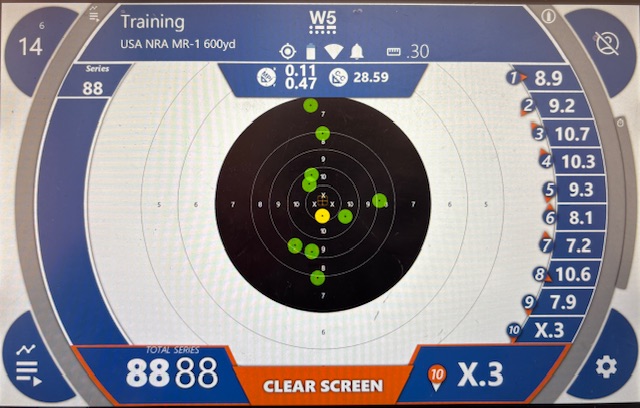 I still cant explain the results at 600 yards, after getting good results at 200 and 300, I really thought I had the answer. I decided to bring this into the MilSurps forum to see if I could enlist the advice of others with more experience. The consensus of several knowledgeable people is the scope is well overdue for servicing. The original grease would have congealed making repeatable elevation and windage adjustments unlikely. Dissimilar metal corrosion occurs and the very small clearances between the grat block and turrets becomes even smaller and the springs can’t cope with the increased friction. There are not many experienced people who can service and overhaul a No. 32 Scope. And without having an instruction manual, I don’t dare attempt it. My current plan is to send the scope to Warren Wheatfield in Sudbury, ON and he will disassemble the turrets, clean, polish and lubricate the moving parts. I will also shoot the rifle at 300 and 600 yds without the scope to have a comparison. If this does not solve it, the next step is to have Brian d**k examine the fore-end fit and also fit the NOS Long Branch fore-end I have on hand. This journey seems to have been taking one step forward and two steps back. Footnote: The accuracy acceptance test for the T was interesting. 7 out of 7 shots had to place within a 5 inch circle at 200 yards, that’s 2.5 MOA. “Where possible” the rifle was also tested at 400 yards where 6 out of 7 shots had to place within a 10 inch circle, also 2.5 MOA. Why 6 out of 7? Perhaps to accommodate the inevitable flier in Mk 7 ammunition which gets worse with increasing range? Was the rifle rejected if it failed this test, or was it tested again and if it passed, sent on its way? 400 yards was recognized as the maximum range a sniper was expected to get consistent hits on a man size targets, even though in practice, hits occurred well beyond this range as reported by snipers in WWII. But, I wonder just how well these rifles shot at 600 yards. The amount of vertical spread I’m getting is not at all satisfactory to go up against rifles like the 1903A3 USMC Sniper in vintage sniper rifle matches, but it would still result in a high probability of a hit at that range. |
Posted By: Shamu
Date Posted: December 29 2025 at 12:42pm
|
You're on to something because its better & "rounder" at the intermediate ranges. Have you thought of trying a different powder maybe? ------------- Don't shoot till you see the whites of their thighs. (Unofficial motto of the Royal Air Force) |
Posted By: Zed
Date Posted: December 30 2025 at 1:00pm
|
Seeing good consistent results at 2/300 yards then getting the vertical errors at 600 would suggest something is happening inside the scope around the 600 yard adjustment. Especially seeing as the rifle doesn't show the same error with the iron sights! I'm not at all familiar with the scope, but my day job has me diagnosing faults vehicles for the last 40+ years. So obviously, my opinion is based on more basic diagnostique process than actual experience with the scope. ------------- It's nice to be important, but it's more important to be nice! |
Posted By: britrifles
Date Posted: December 30 2025 at 2:15pm
|
Shaun, that was my thinking too. I’ve planned for some additional tests this coming weekend at 300 and 600 yds. I’ll test two different loads (with muzzle velocities separated by about 130 fps). I’m hoping this will be definitive in diagnosing the source of the vertical stringing. Brian d**k has offered to look at the rifle too, he may see something I’ve missed. I also have a Long Branch NOS fore-end that I would like to get fitted per the standard stocking-up methods to make comparisons to the mid band bedded fore-end. |
Posted By: Shamu
Date Posted: December 30 2025 at 4:37pm
|
Have you thought of trying the same range on a big target & walking the rounds out by adjusting the scope reticle to known distances? This would isolate ammunition performance at distance from the equation? ------------- Don't shoot till you see the whites of their thighs. (Unofficial motto of the Royal Air Force) |
Posted By: britrifles
Date Posted: December 30 2025 at 7:09pm
|
Shamu, I think you are suggesting shooting at a large target at close range and increase the scope elevation, perhaps in 100 yard increments and compare bullet POI with scope setting. Is that right? I have checked the scope with the No. 32 Scope Testing Chart and it tracks very well. Although it requires two clicks past the at 600 yard index mark on the elevation drum to align with the 600 yard chart line. It tracks perfectly from 0 to 400 yards. No indication of a sticking grat or backlash from 0 to 1000 yds. 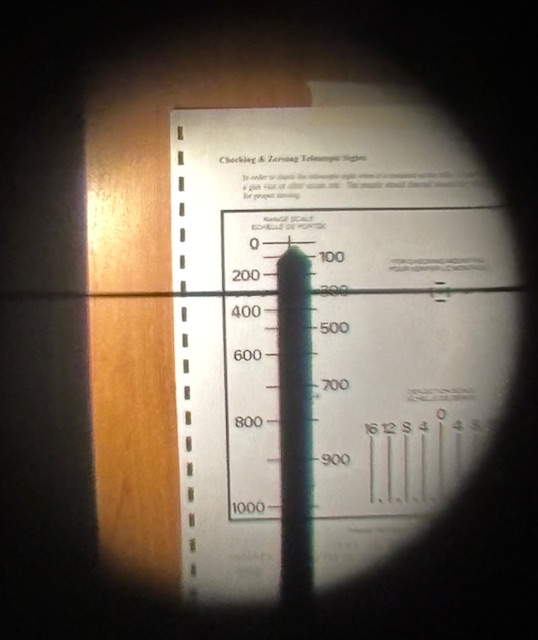 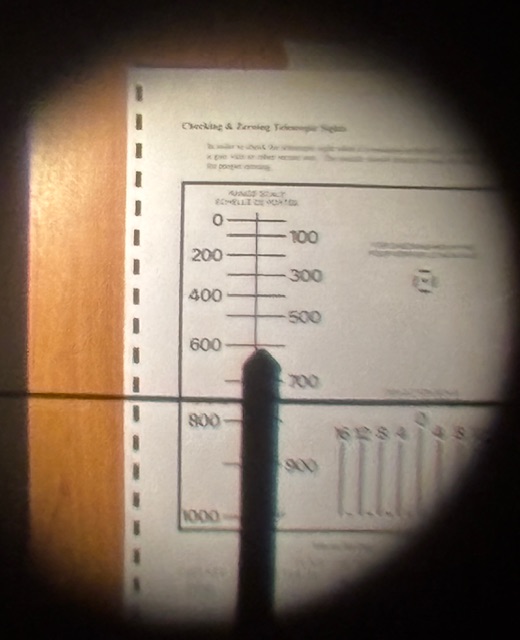 |
Posted By: Shamu
Date Posted: December 31 2025 at 9:31am
|
Yes that was the idea. Mainly to eliminate of confirm the sticking adjustment theory. ------------- Don't shoot till you see the whites of their thighs. (Unofficial motto of the Royal Air Force) |
Posted By: britrifles
Date Posted: January 01 2026 at 8:23am
|
Shamu, based on the graticule range and deflection function tests done as I described in my previous post using the No. 32 Scope Testing Chart, I don’t think the grat block is sticking when changes are dialed in. But, it may be possible that recoil is moving the grat block between shots and not held firmly in position by the springs. That is what I attempted to determine from my last shoot by moving the range drum up and down between every shot. That seemed to confirm this was indeed occurring based on the 300 yard results (which improved dramatically), but the one group I fired at 600 was still stringing shots vertically, and tied to bullet muzzle velocity (negative compensation). I had thought of doing a “box” test, but that’s what the Testing Chart achieves without having to shoot the rifle. You can see exactly where the grat is pointing to while the scope remains in a fixed position (which you can’t do when shooting the rifle. In all of this testing, I was able to induce strong Positive Compensation with light bullets at fairly high muzzle velocities, particularly with the 123 grain Lapua bullet. What the light bullet achieves is to get a high enough velocity such that it exits the barrel while the muzzle is moving upwards. The heavier/slower 174 SMK is leaving the barrel while the muzzle is moving downward having already reached its peak upward deflection. This is of course a conclusion made based on analysis of the data (muzzle velocity vs Elevation POI on the target) as I don’t have a means to measure barrel deflection while shooting. I have not tried shooting this out to 600 yards, but 200 and 300 yard groups were quite good. I suppose I could try shooting that bullet at 600, but I’m not expecting much. I’m going to bring the rifle to Brian (BDL) and have him do a complete check over and fit a new fore-end with standard stocking-up methods. |
Posted By: Shamu
Date Posted: January 01 2026 at 11:13am
|
I like your thought about old/dry lube in the turrets. That's something Ive found in a couple of old scopes. Its a job for a specialist though! ------------- Don't shoot till you see the whites of their thighs. (Unofficial motto of the Royal Air Force) |
Posted By: britrifles
Date Posted: January 04 2026 at 7:55am
|
EDIT: I discovered that Load B below was not with the PPU 150 gr FMJBT, it was the PPU 174 gr FMJBT. This explains why the MV was lower than I was expecting with 42.0 gr Varget. None of the conclusions change, because it’s the time it takes for the bullet to leave the barrel and if it is moving upward or downward when the bullet exits the muzzle. I have corrected the bullet weight in this and subsequent posts. ____________________________________________________________________ As a reminder, the T has a Lothar Walther barrel, bedded in the fore-end at the middle (sling swivel) band. Shot 5 and 10 shot groups off the bench, with and without the scope attached with two different loads: Load A - 40.3 gr Varget, 174 SMK, 3.07 in OAL Load B - 42.0 gr Varget, 174 PPU, 3.03 in OAL The PPU bullet is a FMJ Boattail, a shallower angle than the SMK. Results were generally quite good, I had one 5 shot group that strung vertically at 600 yds. A few examples of the targets: Target 1: 174 gr PPU bullet, 42 gr. Varget, 300 yards, No. 32 Scope, highest velocity shot hit low. 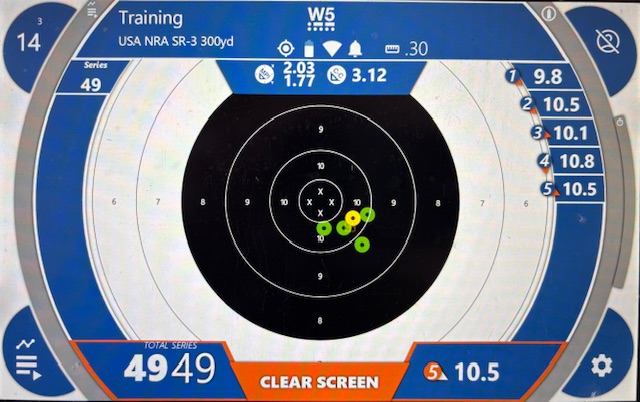 Target 2: 174 gr PPU, 42 gr Varget, 600 yds, No. 32 Scope, lowest and highest velocity shot hit center of group 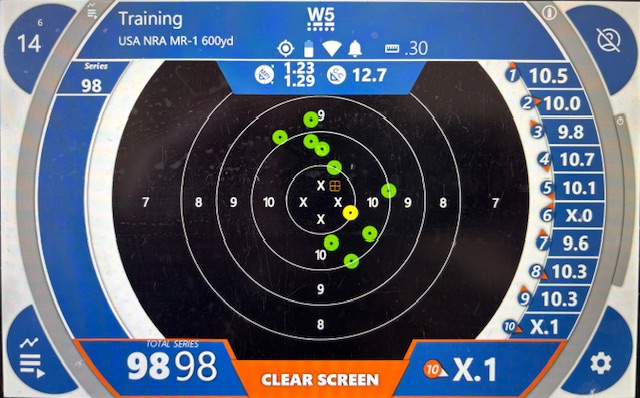 Target 3: 174 gr PPU, 42 gr Varget, 600 yds, Mk I Aperture sight, lowest and highest velocity shots hit in X-Ring. 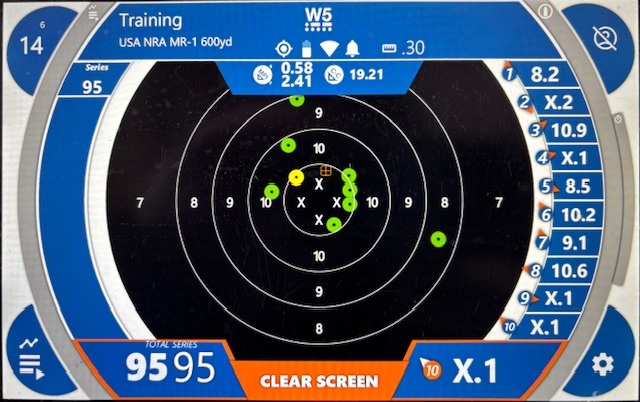 The group results are tabulated below. The third column “Sight” refers to sighting taken with the No. 32 Scope or the No. I Aperture Sight. MV is the mean muzzle velocity, ES is the muzzle velocity Extreme Spread. Delta Elevation is the vertical distance between the highest and lowest shot POI on the target, in Minutes of Angle. 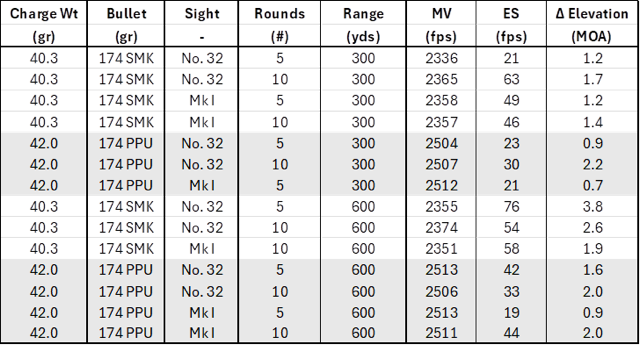 Some general Conclusions: 1. Elevation spreads are generally a bit smaller when shooting without the scope. 2. The 42 gr Varget Load generally exhibited less elevation spread than slower 40.3 gr Load. 3. Muzzle velocities from 2330 to 2400 fps gives NEGATIVE compensation, particularly with the scope, fast bullets hit high on target. 4. Muzzle velocities from 2490 to 2540 fps gives POSITIVE compensation, hence less vertical stringing, particularly at 600 yds, slow and fast bullets gave similar elevation POI. The No. 32 Scope does appear to alter the barrel and action body response to the forces exerted by the burning propellant while the bullet is traveling down the barrel. With muzzle velocities lower than about 2500 fps, bullets are likely exiting the barrel while the muzzle is moving downwards. Above 2500 fps, bullets exit the barrel while the muzzle is moving upwards, likely near the highest point of deflection at about 2500 fps. |
Posted By: Shamu
Date Posted: January 04 2026 at 12:09pm
|
Both loads look fine. Those spreads & SDs are very good. Maybe what you're finding is corroborating evidence for my scoped No4 Mk2 "preferring" 150 Gr bullets over 174/180 gr ones? I'm not using the bolt on side mount though, but the Fultons which also probably "stiffens the action" a hair, but in a different location over the top rather than on the side.? ------------- Don't shoot till you see the whites of their thighs. (Unofficial motto of the Royal Air Force) |
Posted By: britrifles
Date Posted: January 04 2026 at 12:25pm
|
That could well be Chaz. Odd thing is I’ve had some excellent 100 yard groups with the T shooting Mk 7 and hand load equivalents, but I bet that’s been when muzzle velocity variations were very small (spreads less than 30 fps). I didn’t always record muzzle velocity, but now that I do, I see the strong relationship it has to vertical POI. And it’s not so much about the bullet weight, it’s the speed at which it exits the muzzle. It’s difficult to prove this theory, it would take a very light weight accelerometer bonded to the barrel at the muzzle to record vertical acceleration at about 3000 hz. Synched to a high speed camera, we could determine which direction the barrel is moving as the bullet exits. Might make a good science project one day… Years ago, I had a Leupold 20x target scope on my Fulton Regulated Long Branch, and at 100 yards there was definitely “Negative” compensation with my 174 gr Match Loads. Increasing powder charge raised the vertical MPI, quite linear with powder charge weight. I did not have a chrono in those days, but if the rifle had positive compensation, the MPI would have decreased with increasing velocity. I will have to shoot that rifle again, without the scope, and chrono the shots to see what happens. |
Posted By: britrifles
Date Posted: January 04 2026 at 12:39pm
|
Here was the worst of the 14 groups fired yesterday. 174 gr SMK, first 5 shot sighter group at 600 yds. This had the largest velocity spread, 76 FPS, recorded yesterday and nearly a 4 MOA elevation spread. This would have failed the No. 4 T accuracy test with Mk 7 ball at the +/- 40 fps maximum specification variation. We usually like to show our good groups, but bad groups tell us more about what is going on with the rifle and/or load. The shooter too!
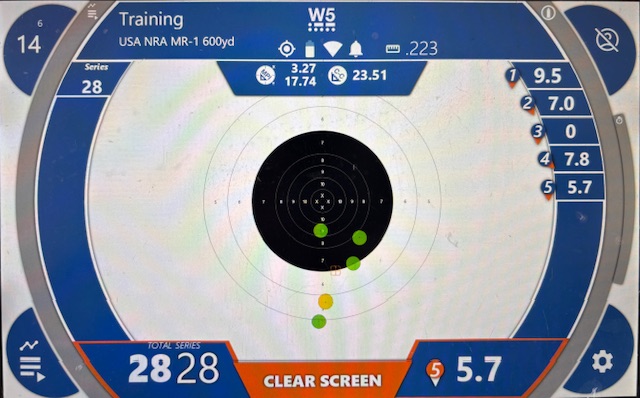 Harry Furness and Captain Shore wrote about how important it was to find and hold onto to ball ammunition that shot well out of the T, this was likely ammo that held a tighter than typical velocity ES. |
Posted By: Shamu
Date Posted: January 04 2026 at 4:16pm
You dug a lot deeper than I did. My results & observations were purely empirical, but overall the No4 Mk2 with the Fultons mount "preferred" (as in shot better constantly) than any 174 Gr loads I made, so I just went with the flow. ------------- Don't shoot till you see the whites of their thighs. (Unofficial motto of the Royal Air Force) |
Posted By: Zed
Date Posted: January 05 2026 at 4:09am
|
Geoff, I am impressed by your dedication and thoroughness to get into the details. Thanks for sharing your findings with us. It is very interesting and useful. Hopefully the fruit of your labours will show up in the results this year! ------------- It's nice to be important, but it's more important to be nice! |
Posted By: britrifles
Date Posted: January 05 2026 at 5:25am
|
Thanks Shaun. I'm fairly certain now that I was wrong about the barrel being shot out, and the replacement CBI barrel was not likely the problem either. This effort really shows that you cannot judge a load from a single group. While it might reveal it's a "bad" load, but not necessarily if it's good and able to tolerate typical velocity variations. 5 shot groups tell you very little, it really has to be averages of 10 shot groups over time to be able to determine how the rifle groups with muzzle velocity variations. I now better understand the Ladder Test approach, shooting increasing powder charges (to increase velocity) in a round robin style and plot group centers. You’re looking for a charge weight where the group center elevation POI on the target doesn't change from the typical Velocity ES of your load (i.e. an "accuracy node"). That would be a "compensating" load at that range where elevation POI is insensitive to velocity changes. When I tried this with the T initially, the group centers continued to climb vertically (about 0.5 MOA per every 0.3 grain difference), velocities with the 40.3 gr Varget Load were too low to induce a positive compensation (where the bullet exits the barrel while the muzzle is moving upwards). I plan to repeat the Ladder Test with the 150's at some point over a broader range of velocity, but from the data I have, I can see the rifle compensates above 2500 fps, this test would make defining that velocity range easier. |
Posted By: britrifles
Date Posted: January 05 2026 at 7:07am
|
For those in the US, Graf & Sons have the PPU 150 gr FMJBT bullets in stock, a good price compared to Sierra bullets. I also just ordered some Sierra 125 and 150 grain flat base SPTs to try. Not expecting the 125's to be very accurate at 600 yds, but bet they will work great at short range out to 300 yds. The 150 SPT should shoot good out to 600. The search for accuracy never stops... |
Posted By: Shamu
Date Posted: January 05 2026 at 12:45pm
|
I've had excellent results with the Hornady # 3120, .312" 150 GrSP. Its partly because of the shape of the bullet, not just the weight. You can see this in this illustration of several bullets all seated to the same COAL. Look at the different seating depths in the case neck! Its the one in thhe middle, the Speer is on the left & a MkVII ball on the right for comparison  ------------- Don't shoot till you see the whites of their thighs. (Unofficial motto of the Royal Air Force) |
Posted By: Canuck
Date Posted: January 05 2026 at 1:57pm
|
I use and like the #3120's as well. They shoot great and accurately in my sporterized LB No.4/MK1/2. ------------- Castles made of sand slip into the sea.....eventually |
Posted By: britrifles
Date Posted: January 05 2026 at 3:43pm
|
Shamu, do you have load and muzzle velocity data on those Hornady 150’s? I think I have some of those bullets. Will have to add that to the list. One thing I do like about the PPU 150 FMJBT is the boat tail retains velocity better than the flat base, higher BC. Not necessary for up to 300 yds, but starts to be a factor at 600. |
Posted By: Shamu
Date Posted: January 05 2026 at 4:18pm
|
Let me see if I can post this, hold on.  ------------- Don't shoot till you see the whites of their thighs. (Unofficial motto of the Royal Air Force) |