Trigger Modifications
Printed From: Enfield-Rifles.com
Category: Enfields
Forum Name: Enfield Gunsmithing
Forum Description: Submit any how-to's or other gunsmithing suggestions here.
URL: http://www.enfield-rifles.com/forum_posts.asp?TID=14280
Printed Date: March 26 2026 at 3:31pm
Software Version: Web Wiz Forums 12.07 - https://www.webwizforums.com
Topic: Trigger Modifications
Posted By: andrewmurray86
Subject: Trigger Modifications
Date Posted: November 29 2025 at 3:11pm
|
Good morning all, After searching the posts, I'm asking if any one here has conducted trigger modifications? I find my trigger has almost a modern "two-stage" feel. Though the first part of the trigger pull may be considered trigger creep it is entirely smooth and consistent on the pull weight. There is a definite point where the weight increases but once the weight required is reached, the trigger snaps very cleanly. This is why I describe it as being like a modern 2 stage trigger. My questions are as follows: Is this common? Can the pull weight be brought down? If trigger modifications happen, will the 2-stage effect go away? (I like it as my other hunting rifle has a 2 stage trigger). Thanks team.
|
Replies:
Posted By: Shamu
Date Posted: November 29 2025 at 3:51pm
|
OK, It is designed as a "two Stage" trigger, & so functions as one. Now to clarify it actually should have 3 stages: in a loaded & cocked position. Stage "zero", the trigger simply flops about randomly. Stage 1, a slow steady pull of somewhere about 3~4 Lbs. Stage 2, no perceptible movement then it "snaps" at 4 1/2~ 6 Lbs dropping the striker. There were (& may still be) single stage conversion triggers.You could, with then right knowledge & tools modify the"humps" on the trigger, where they bear on the sears bottom upper surfaces. I have a No5 Mk1 "Jungle Carbine" that's been sporterized that does this. This is independent of "lightening the trigger" though. That can be achieved with slow, gentle alteration of the front face of the cocking piece where it bears on the upper arm of the sear. Two things to bear in mind. It's a very delicate change for 2 reasons. The metal is only case-hardened, should you break through this it will constantly change as the surfaces wear. And the angle is critical. I'd suggest perhaps polishing (NOT GRINDING) that front face in a vertical motion to smooth over machining marks. & putting a little dab of grease on the surface to allow the sear tip to slide with less friction. if you look carefully at the face you'll actually see where the two trigger stages place the sear. The second stage being just that little polished area at the bottom of it. ------------- Don't shoot till you see the whites of their thighs. (Unofficial motto of the Royal Air Force) |
Posted By: Canuck
Date Posted: November 29 2025 at 4:45pm
|
As a side note, be careful to not lighten the trigger pull too much where if it is cocked and ready to fire and you bump something the trigger will release the firing striker. ------------- Castles made of sand slip into the sea.....eventually |
Posted By: britrifles
Date Posted: November 29 2025 at 5:11pm
|
The two stage trigger is intentional and is by design for many military service rifles. Only the first stage should have noticeable movement. As Shamu has described, the second stage should have no perceptible movement (creep) before it releases the striker. This is for safety and optimum accuracy. Yes, the pull weight can be lightened, but not something to attempt until you fully understand how the design functions. The face of the cocking piece (aka “bent”) must be stoned to alter the angle relative to the tangent of the arc of motion the sear takes as the trigger is pulled. This all assumes you are talking about the Lee Enfield. |
Posted By: Irish Blonde
Date Posted: November 30 2025 at 8:32am
|
I modified my trigger slightly by running the face of the bent on fine grit sand paper then a Flitz polish. Checking along the way. I've tuned a lot of other rifle type triggers & I sharpen a lot of knives so I've a solid background in keeping angles relatively precise. Even with that, I do think I got lucky on the last sanding and & polishing step I did. Because if I had gone another session it would have been too much. As it stands, there is not much weight to pull the 1st stage to the second, and the second then breaks at about 1.25lbs. (Feels like a well tuned Springfield Armory M1A trigger) The total trigger pull combining the two stages is 3lbs 10oz. The cocking piece has barely a perceptible movement and I've banged it a few times to test safety. So far so good. I did pick up a NIB cocking piece should this one fail over time. With all that said...my suggestion is to LITFA (Leave It The F Alone) the trigger, and at most do a metal polish without any metal removal. Or send to someone who really knows what they are doing.
|
Posted By: britrifles
Date Posted: November 30 2025 at 9:01am
|
I once took a No. 4 trigger down to around 3 lbs, won’t do that again. The trigger would not go back to “stage zero” as Shamu explained if it was released from a second stage pull, it was hung up on the second stage. That is dangerous. I have all mine set to 3.5 lbs to 4.5 lbs. That’s the total weight required to release the striker. I’m using a NRA “official” trigger weight tester. Always check trigger weight with the magazine fitted, the sear spring also serves as the magazine retention spring. You will get a lower reading with the magazine removed. |
Posted By: Strangely Brown
Date Posted: November 30 2025 at 10:18am
This post as made me look in the 1955 Bisley Bible where a minimum trigger weight of 5Lbs was allowed; the NRA (UK) have now amended that for Enfield's to 4.5Lbs. Geoff, I never knew that about removing the magazine to get a false reading, I doubt my old Parker-Hale trigger weights would notice! ------------- Mick |
 britrifles wrote:
Posted By: britrifles
Date Posted: November 30 2025 at 10:37am
|
Mick, this jives with my 1963 Parker Hale Scorebook, 5 lbs minimum trigger pull for SR(a) and (b). This made me go check my notebook for my No. 4 rifles. The lowest is my DCRA 7.62 at 3 lbs, 11 oz. My No. 4 T is at 4 lbs 4 oz and the highest is on my Fulton No. 4 at 4 lbs 15 oz. The remainder fall between these weights. Our vintage military service rifle rules here allow for a minimum pull of 3.5 lbs for bolt action rifles and 4.5 lbs for auto loading rifles. I once failed a trigger test on my No. 4 and later realized I did not have the magazine fitted. The CMP Vintage Sniper Rifle Rules allow for a minimum pull of just 2.5 lbs for bolt action rifles prior to 1954. I don’t dare try and reduce the pull on the T that low, but at 4 lbs 4 oz, I could reduce it a bit further. |
Posted By: Strangely Brown
Date Posted: November 30 2025 at 10:50am
|
Geoff, we rarely check triggers on historic rifles over here but a few years ago I was asked to check the Enfield's in the Methuen match (teams of six) as the "modern" rifles (AR15's in straight pull|) were being checked. One team kept failing the test and on questioning them it transpired that they were all using No.4's from the NRA armoury. After a bit of nudge, nudge wink, wink, wink I passed the same rifle 6 times and put the past sticker on the magazine, all 6 magazines! The following year after consultation with the powers that be it was decided not to test the Enfield's and only concentrate on the newer rifles. ------------- Mick |
Posted By: Shamu
Date Posted: November 30 2025 at 11:12am
|
IF you decide to do this i strongly suggest buying a couple of cocking pieces FIRST. Then replace the original & carefully have at it. Once you're done cock the action on your UNLOADED RIFLE's NEW trigger pull & smartly rap the butt stock on a wood floor. It the cocking piece flies forward its buggered, cock the action apply the safe, pull & release the trigger, release the safe, if the cocking piece flies forward its buggered, replace It & try again. Put a fishing scale on the trigger, cock the action & pull the scale to "fire it". If it anything under 3 3/4:Lbs its buggered, replace It & try again. If al else fails just replace the original & no harm done! ------------- Don't shoot till you see the whites of their thighs. (Unofficial motto of the Royal Air Force) |
Posted By: Strangely Brown
Date Posted: December 01 2025 at 5:48am
|
Talking of trigger modifications I put this on one of my rifles this morning; my trigger finger lacks sensation due to an old injury and these trigger shoes help with a softer release. It was a UK eBay purchase, the trick is finding one that will accommodate an Enfield trigger as the majority of them are too narrow to fit over the issue trigger. 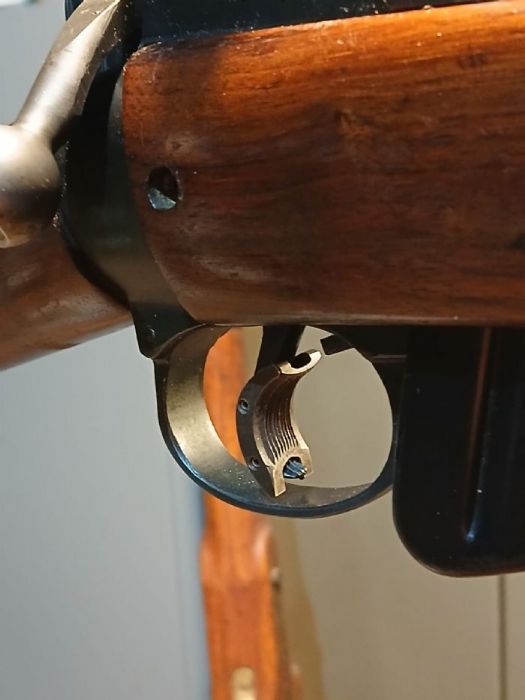 ------------- Mick |
Posted By: britrifles
Date Posted: December 01 2025 at 6:15am
|
I like the looks of that Mick. Might even "feel" like it takes less pressure to release the striker. On the weighing of triggers, it's done here for all the "major" matches (for modern service rifle and the historic "Games" Matches), which I would describe as a regional match (and also at the National Matches of course). The local "club" matches rarely do this. In the past, some of the CMP Armorers have been rather picky on the rules. I failed an inspection one match because the trigger guard on my AR-15 had a slight bow to it. I had not even noticed it before. The rules say it must be flat. Thankfully, I brought a back-up rifle which did have a flat trigger guard and swapped out the guard. It had passed inspection from this same armorer many times before, but he decided to clamp down on this. About a year later, the CMP changed the rules to allowed bowed trigger guards. Many shooters get annoyed at these rules that don't have any impact on how well the rifle shoots, it's all down to the skill and ability of the shooter. |
Posted By: Strangely Brown
Date Posted: December 01 2025 at 6:32am
Amen! Geoff, the current director of shooting at the NRA here in Bisley is somebody who recognises this and stopped the trigger testing of Enfield's, however AR15's and all the modern stuff are tested before the major summer Imperial meeting. ------------- Mick |
Posted By: Shamu
Date Posted: December 01 2025 at 11:32am
|
My only issue, apart from availability, with the shoes is they are wide enough to snag more easily than regular triggers do. but that's not really an issue for target shooting, more for hunting. ------------- Don't shoot till you see the whites of their thighs. (Unofficial motto of the Royal Air Force) |
Posted By: andrewmurray86
Date Posted: December 03 2025 at 12:59am
|
All, Thanks for the generous replies. I've got some considering to do. The process sounds very similar to how I modified my Howa trigger. That said the HACT trigger on the Howas has a tension screw you can use as a "back-up" to increase trigger weight. However, if you do take too much off the sear then it won't work. I do like a light trigger.
|
Posted By: DarioPirovano
Date Posted: December 05 2025 at 5:41pm
|
You can tune your trigger crispness by stoning the ribs of the trigger, if you stone too much it becomes dangerous. To alter the trigger pull weight, you need to modify the angle of the sear surface of the cocking piece, that’s a job that requires knowledge and tools. If you’re a newbie don’t do that yourself, ask your armourer for some helpful help |
Posted By: Zed
Date Posted: December 05 2025 at 11:36pm
|
One essential requirement to consider when altering the angle of the cocking piece face. When the trigger is pulled to first stage, the cocking piece moves rearward slightly. The Sear is then on the edge of the cocking piece face. If you decide not to shoot and release the trigger, it must return to it's forward position! If it doesn't, it is extremely dangerous, because the slightest knock knock could cause the release and fire the rifle. That's why it is essential to check the return to the forward position is always happening if you pull to first stage and let go of the trigger. ------------- It's nice to be important, but it's more important to be nice! |
Posted By: britrifles
Date Posted: December 06 2025 at 3:40am
|
^^^^^^^^ THIS ^^^^^^^ That happened to me once, I had worked the second stage pull to below 3 lbs. I don’t recommend anyone try that. I read something yesterday I did not know about the L39 development regarding trigger pull. According to Skennerton (page 242, The Lee Enfield Story): “The trigger pressures on the L39 are lighter than those of the L42, at a first pressure of 2-3 lb. and second pressure of 4 - 4.5 lb. In order to obtain the lighter trigger pressures, the angle of the face of the cocking piece has been altered slightly. Additionally, a second recess was cut into the magazine catch to allow the short arm of the sear spring to be seated in a lower position, in case the trigger pressures were still too heavy.” I worked the pressure down to 4 lb 4 oz on my No. 4 T by very carefully altering the angle of the bent (face of the cocking piece as described above). The trick is to be sure you keep the sear surface at right angles to the cocking piece. You only need to change that angle by a degree or two, taking very little material off the cocking piece. I check the return of the trigger just as Zed describes. The trigger MUST return to Stage Zero when released from Stage 1 and Stage 2. I also check this with my trigger weight rig, add weights just until the striker is released, then remove one ounce (I’m using cast lead Snider bullets to add about one ounce at a time), lift rifle with weights hanging on the trigger then lower rifle to set weights back down on the table. The trigger must return to stage zero. I do this three or four times. |
Posted By: Irish Blonde
Date Posted: December 06 2025 at 6:44am
|
@britrifles, Mine hung up at first, but after a while it stopped. Now I can't get it to hang up if I try. I wonder if it takes time for surfaces to find home or something. Or excess grease, even debris left behind from the sanding?
|
Posted By: Irish Blonde
Date Posted: December 06 2025 at 6:48am
Wish I would have thought about this before I did my original cocking piece, because I bought a new old stock cocking piece afterwards in case someday it went bad. I did it in reverse. Lol. I'm never selling this gun, so I'm not concerned about installing an unoriginal part. |
Posted By: Irish Blonde
Date Posted: February 20 2026 at 5:06pm
|
Guys, guys, guys! I made a weight of 3.5lbs, lifted it with the trigger and it didn’t fire! 🔥 Whoo-hoo! So I didn’t F things up and can compete! So looking forward to the vintage rifle competition!
|
Posted By: paddyofurniture
Date Posted: February 20 2026 at 5:37pm
| Enjoy! |
Posted By: Shamu
Date Posted: February 20 2026 at 6:58pm
 Nice job. Nice job.Just keep an eye on it for a while with a trigger gauge. Its Insurance against cutting through the hardening, nothing more. ------------- Don't shoot till you see the whites of their thighs. (Unofficial motto of the Royal Air Force) |
Posted By: Zed
Date Posted: February 20 2026 at 11:24pm
|
Good job! Enjoy your competitions. I'm starting my reloading for this year's competitions. My wife also competes with a No4, so there's quite a bit to do! ------------- It's nice to be important, but it's more important to be nice! |