
|
Replicating Mk VII Ball Ammunition And/Or Zeroing |
Post Reply 
|
Page 12> |
| Author | ||
Rick 
Groupie 
Joined: April 24 2025 Location: NW MT/SE BC Status: Offline Points: 83 |
 Post Options Post Options
 Thanks(0) Thanks(0)
 Quote Reply Quote Reply
 Topic: Replicating Mk VII Ball Ammunition And/Or Zeroing Topic: Replicating Mk VII Ball Ammunition And/Or ZeroingPosted: June 13 2025 at 10:46pm |
|
|
New owners: First, this is mostly of academic interest due to quality Mk VII ball ammunition being pretty much non-existent these days. However, it is worthy of addressing as so many new owners think of matching MkVII ballistics and military zeroing with their LE's adjustable sights. (I attempted this for Service Rifle competition, as did many both before and after me) Before going into the Mk VII round and zeroing with that round in depth, other than satisfying historical interest, best advice for the new owner is that their time and effort is probably best invested in determining which commercial ammunition or bullets for handloading best serve their personal needs, and then making loading and zeroing decisions after that. Part 1: Choices for most closely replicating the Mk VII ball round Some general information regarding the Mk VII ball round. The basic information is the bullet weighs 174 gr. and muzzle velocity is a nominal 2440 fps. The next logical question is what the BC of the Mk VII round is, whether under the G1 or G7 model. This is where the quest to replicate Mk VII ballistics over the course gets sticky. First, the Mk VII ball round is a FMJ spitzer with an open flat base, not a boat tail, and the front portion of the bullet core is composed of aluminum or another light material like card stock. No commercial ammunition offered today replicates the Mk VII other than some also being 174 grain spitzers. Most doesn't even replicate the Mk VII muzzle velocity, much less the core construction and open flat base. Second, for handloaders it isn't any better as far as bullets go. There is no readily available bullet on the market that replicates Mk VII. Speer, Hornady, and Privi Partizan do offer 174 grain spitzers, but that's where the similarity ends. All of them offer their 174 gr. bullets as boat tail designs, not flat based in construction, and without the lightweight insert in the core. As a result, with the significant differences between the Mk VII ball round and what is available today, it is not going to be a matter of simply identifying a 174 gr. bullet of the same design and then doing handload development. We can do an estimation of the BC of the Mk VII ball round by matching the historical military ballistic tables within ballistic calculators. By doing this, using a 174 gr. bullet at a muzzle velocity of 2440 fps, with the sights of a No.4 Mk1 being 1.0" above the bore, you will find that a BC of .467 (using the G1 ballistics model) will closely match those tables. So for comparison, three popular choices used by .303 British handloaders for range shooting: Hornady .303 Cal 174 gr. FMJ/BT: BC = .470 (G1) Sierra .303 Cal 174 gr. HPBT: BC = .499 (G1) Sierra .303 Cal 180 gr. Spitzer Pro-Hunter: BC = .411 (G1) Part 1: Zeroing Data For Mk VII And No.4 Mk1 Sights As per the Armourer's Precis No. SA/19A: 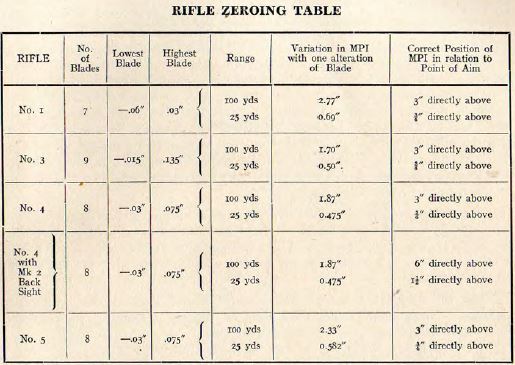 Before you begin, remember that a Lee Enfield is a battle rifle, not a precision rifle. For context, James Sweet in his Lee Enfield based book Competitive Rifle Shooting, pointed out that a Service Rifle competitor who had a 2 MOA capable Lee Enfield, had a very well set up and accurate rifle. In comparison, your rifle in good condition and as is, is more likely to be a 4 MOA grouping rifle with good quality ammunition. To zero your rifle at any of the distance settings on your rear sight, changes in POI above or below the specified range are made by changing out the front sight for one of the other sight blades which are taller or shorter. Each graduation in sight height moves the group 1.87" at 100 yards, and by the same MOA projected over further distances. This should enable you to obtain no worse than + or - .9 MOA when adjusting sights to achieve POA=POI at your chosen range (half of the maximum change). If your zeroing is not spot on, you can change out the front sight in the direction that results in the smallest amount of error in either being slightly high or slightly low. Zeroing calculations produced below from what I think is the best of the online ballistic calculators, JBM Ballistics: Rear sight setting at 200 yards: +.7"@25 yards, +3.0"@100 yards  Rear sight setting at 300: +1.5"@25 yards, +6.0"@100 yards: 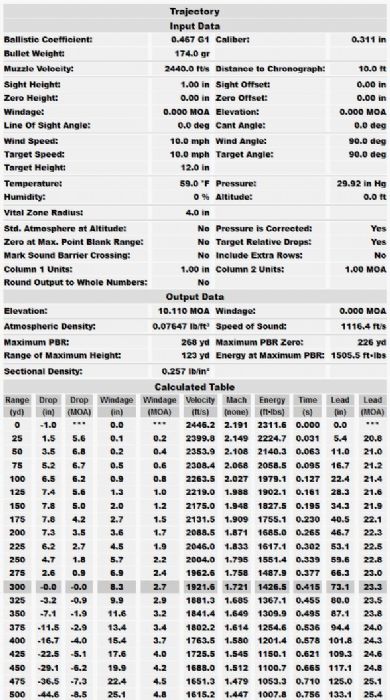 In closing, military history aside, the best approach is to first find the best ammunition for your purposes, then zero the rifle, set up to give what you consider the best ballistic curve and point blank range for your rifle and your use of it. |
||
 |
||
|
britrifles
Senior Member 

Joined: February 03 2018 Location: Georgia, USA Status: Offline Points: 8404 |
Post Options
Thanks(0)
Quote Reply
Posted: June 14 2025 at 4:14am |
|
|
Good info Rick.
I’m not sure where I got the Mk 7 bullet G1 BC data from, but I also have 0.467 in my ballistics calculator. Way back in 1964, one of my Dad’s notebooks lists it as 0.47, pretty close. You can replicate the Mk 7 trajectory fairly close with a 174 SMK by reducing the muzzle velocity slightly. Scope settings on my No. 4 T match the range index markings out to 800 yds (100, 200, 300, 600 and 800 yds all align with the elevation drum range index mark) with the 174 loaded with 40.3 gr Varget. A lot of tolerance stack up here. Variations in mean muzzle velocity, weather conditions, manufacturing tolerances on the rifle and sights, differences in shooters. |
||
|
||
|
Rick
Groupie
Joined: April 24 2025 Location: NW MT/SE BC Status: Offline Points: 83 |
Post Options
Thanks(0)
Quote Reply
Posted: June 16 2025 at 9:26am |
|
I arrived at something similar for a BC through trial and error and then "ground truthing" against my issue Mk I sights when handloads were allowed after the issue of Mk VII ball dried up. The Parker Hale vernier after that was inconsequential in comparison. As I remember, everybody else was doing similar things, then recording come-ups at each range with whatever handloads they developed. The BC I used here is from somebody who much later used the Brian Litz type route of using a modern chronograph to analyze the total flight of Mk VII ammunition every foot of it's ballistic path from muzzle out to beyond 1,000 yards. They pointed out a couple of things while reporting that: First, while this is a BC based on the G1 ballistics model and BC actually changes as the bullet slows in flight over the course, the MkVII ball round doesn't fit into ANY of the "G" series of ballistic models (I'm only familiar with the commonly preferred and used G1 model and the G7 model that most closely matches modern boat tail bullets like Sierra MatchKings). He expressed a belief that the .303 British was sufficiently unique in its external ballistics over the course that it would require a "G" model of its own. Second, as you related, they pointed out that there are great variations in Mk VII ball rounds as they were manufactured internationally over the life of the production of the Mk VII ball round. And third, with the UK Figure of Merit (and presumably a similar NATO C-MOPI standard just as there is for 7.62 and 5.56 military ammunition variants), the mean grouping standard for Mk VII ammunition from all NATO/Commonwealth sources is probably somewhere around 4 MOA. Perhaps that is why the Brits stayed with a Figure Of Merit for the round rather than bothering with creating a BC model and resulting number for all the .303 British ammunition variants. If I wanted to jump into another curiosity search, I would look for the C-MOPI standard from back when there WERE nations who were members of NATO still issuing and using the .303 British in wars. I would assume that C-MOPI would specify the mean radius of a ten shot group at 200 yards, as there is for 7.62 and 5.56 If my memory serves me correctly, the NATO standard for today's 5.56 ball ammunition is somewhere around 2.5 MOA, testing being done by measuring ten shot groups shot at 200 yards (not meters?) from heavy barreled bolt action test rifles. That's with modern bullet design and modern manufacturing machinery. Those thinking they can just whip up a replica 2 MOA Mk VII ball round, might want to keep that in mind. Or start by shooting some current 5.56 military ball from their AR-15 they built with carefully chosen components to see how THAT grouping goes. However, having invited that comparison, it is also true that NATO C-MOPI standards include many, many specifications that I have never seen in a pam concerning the specifications for Mk VII ammunition. Additional specifications whose achievement might also degrade grouping ability to some extent.
|
||
|
||
|
britrifles
Senior Member
Joined: February 03 2018 Location: Georgia, USA Status: Offline Points: 8404 |
Post Options
Thanks(0)
Quote Reply
Posted: June 16 2025 at 11:43am |
|
|
Agree on the comment about MK 7 having around 4 MOA extreme spreads, with a very large variation between different arsenals and different lots. As machinery wore out (particularly in the manufacture of bullet jackets), accuracy would suffer.
I don't recall reading what the accuracy acceptance standards were, usually given in Figure of Merit (mean radial dispersion) for a 20 shot group. I'd bet wartime production dispensed with these standards based on how atrocious some of the ammunition was in regards to accuracy. I'd be willing to bet that No. 1 and No. 4 rifle production accuracy testing used special lots of known good accuracy. No way "run of the mill" WWII ball ammo could have been used to pass the No. 4 acceptance tests.
On the other hand, I've got some lots of Defence Industries (DI)1943 Mk VIIz that shoots 2.5 MOA. And, another lot of Dominion Arsenal (DAC) 1951 Mk VIIz that still shoots 1.5 to 2 MOA. I have somewhere around 500 pulled MK 7 projectiles. I've loaded some of these, but accuracy was 3+ MOA. Not worth messing with. |
||
|
||
|
Shamu
Admin Group 

Logo Designer / Donating Member Joined: April 25 2007 Location: MD, USA. Status: Offline Points: 20510 |
Post Options
Thanks(0)
Quote Reply
Posted: June 18 2025 at 10:19am |
|
|
You want to trade some of those for something better, with a slight premium, of course? I can probably find you something in my stash.  |
||
|
Don't shoot till you see the whites of their thighs. (Unofficial motto of the Royal Air Force)
|
||
|
||
|
Rick
Groupie
Joined: April 24 2025 Location: NW MT/SE BC Status: Offline Points: 83 |
Post Options
Thanks(0)
Quote Reply
Posted: June 18 2025 at 11:42am |
|
Interest in shooting Lee Enfields over the course is diminished, but certainly hasn't disappeared and is still alive and well, particularly in the Commonwealth nations. Given my memories from my salad years of the benchrest shooting cult's obsession with swaging their own match bullets with spendy (at the time) Corbin and similar dies, I've always wondered why I've never heard of a Service Rifle competitor somewhere in the Commonwealth devoting the time to build a good or better replica of the Mk VII round, a close to identical design that at least included a flat, open base. My impression is that bullet swaging pretty much disappeared amongst the benchrest crowd when Sierra and companies like Penn and Burger got to the point where benchrest competitors could spend far less time (and money) driving to the local gun store to buy their benchrest bullets - the commercial bullets were the equivalent or better of the grouping ability of their match benchrest guns. My gunsmith, and friend in things other than rifles and hunting, Bill Leeper, once built an F-Class rifle chambered in .303 British, just because people kept telling him the .303 British cartridge simply was too handicapped to credibly be used in F-Class competition. Bill placed well enough making a point of using that rifle in F-Class that it proved his point. Bill when he was at his best could not only build a benchrest competition rifle as good as somebody like Knobby Uno could - he could then take that benchrest rifle to a match and be a credible threat to win or place with it. He could do the same thing building up a rifle for DCRA competition - build it, and then be a threat to win or place in a match with it. Bill just started a series of gunsmithing videos on YouTube called "Will Henry's Workshop", detailing how he does various gunsmithing tasks as his way of trying to retire from gunsmithing. He grew up in Idaho with Rocky Gibbs as his neighbor, so I think it would be a fair guess as to who motivated Bill's willingness to attempt unconventional things in gunsmithing and building rifles. I am going to ask Bill if he ever built a heavy barreled test rifle and chambered it in .303 British to see what potential grouping capability could be achieved with the bullets available. If he did, I am going to ask him if he ever fired any DCRA issued Mark VII ammunition through that setup to determine what kind of grouping ability he was able to achieve versus what Sierra, Hornady, etc offer.
|
||
|
||
|
SW28fan
Special Member

Donating Member Joined: July 02 2007 Location: Texas Status: Offline Points: 3388 |
Post Options
Thanks(0)
Quote Reply
Posted: June 18 2025 at 1:59pm |
|
|
I use the Sierra 180 grain softpoint flat base on 38-40 grains of IMR 4895 which is as close as I can come to MK VII ball
|
||
|
Have a Nice Day
If already having a nice day please disregard |
||
|
||
|
britrifles
Senior Member
Joined: February 03 2018 Location: Georgia, USA Status: Offline Points: 8404 |
Post Options
Thanks(0)
Quote Reply
Posted: June 18 2025 at 3:22pm |
|
|
I’ve done some direct substitutions of the best (most accurate lot) of Mk 7 bullets I have for 174 SMKs. At 100 yds, the two bullets had comparable accuracy. Will have to dig out that data, it is somewhere on this forum.
That lot of DAC ‘51 7z ammo was made for the 1952 DCRA matches, and used for several years. I’ve shot it out to 600 yards out of my T and it did about as well as my 174 SMK handloads. Unfortunately, the cases are Berdan primed, would have really like to use those cases in my match loads. I did find that the 174 SMK had about 50 to 70 fps higher velocity than the Mk 7 bullet when loaded with the same case, primer, powder type and charge weight. |
||
|
||
|
clancey1849
Groupie
Joined: August 27 2025 Location: USA Status: Offline Points: 23 |
Post Options
Thanks(0)
Quote Reply
Posted: September 01 2025 at 4:45am |
|
|
Does anyone know for Armourer's Precis No. SA/19A, what rear sight setting was being used to set it up?
For the No. 4 rifle, were they using the battle sight, or the leaf sight, and if the leaf sight, what setting for the 25 and 100 yard values?
|
||
|
||
|
britrifles
Senior Member
Joined: February 03 2018 Location: Georgia, USA Status: Offline Points: 8404 |
Post Options
Thanks(0)
Quote Reply
Posted: September 02 2025 at 4:57am |
|
The Mk 1 sight in the raised position. There was a different zero method for the simple Mk 2 "L" flip sight. To zero at 25 yds, set the leaf to the 200 yd index mark. Mk 7 ball ammo at 2440 fps has a near zero crossing for a 200 yd zero a bit under 25 yds. If zeroing at 100 yds, lower the leaf as far down as it will go (typically 2 to 4 clicks below the 200 yd index mark). |
||
|
||
|
clancey1849
Groupie
Joined: August 27 2025 Location: USA Status: Offline Points: 23 |
Post Options
Thanks(0)
Quote Reply
Posted: September 04 2025 at 9:36am |
|
|
I have heard the HXP stuff is considerably hotter loaded than the British original MK7 loading. Is this true? If so, it would make a difference in my zeroing of my new Enfield No4.
|
||
|
||
|
britrifles
Senior Member
Joined: February 03 2018 Location: Georgia, USA Status: Offline Points: 8404 |
Post Options
Thanks(0)
Quote Reply
Posted: September 04 2025 at 2:39pm |
|
|
The HXP ‘71 I tested chrono’ed at a muzzle velocity of 2537 fps (average of 10 rounds). That’s nearly 100 fps higher than Mk 7 ball specification.
MV = 2537 fps Max = 2559 fps Min = 2469 fps SD = 25 fps
|
||
|
||
|
Rick
Groupie
Joined: April 24 2025 Location: NW MT/SE BC Status: Offline Points: 83 |
Post Options
Thanks(0)
Quote Reply
Posted: September 04 2025 at 3:57pm |
|
Yes. And you can get your own copy of the pam. 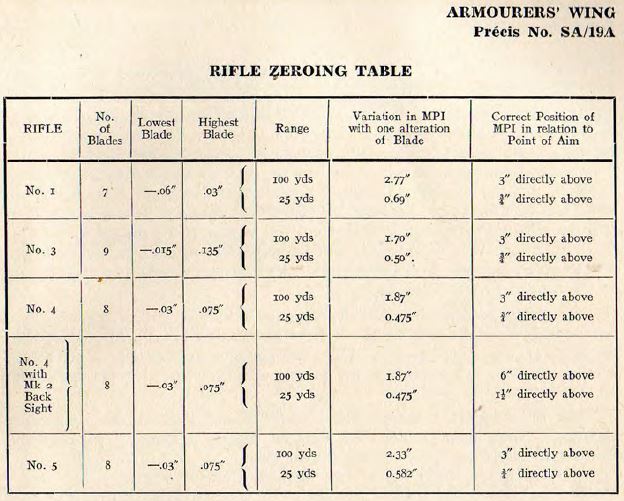
Depending on what Commonwealth country and rifle range, it could have been 25, 30, 100, or 200 yards. And if they did back then as they usually do now, confirmation of sight settings would have been fired at 300 yards prior to deployment (and perhaps in anticipation of major battles like the Normandy beach landings, Market Garden, etc). And then there's 4 (ARMT) TRG BN REME Precis No. 28, Rifles No. 4 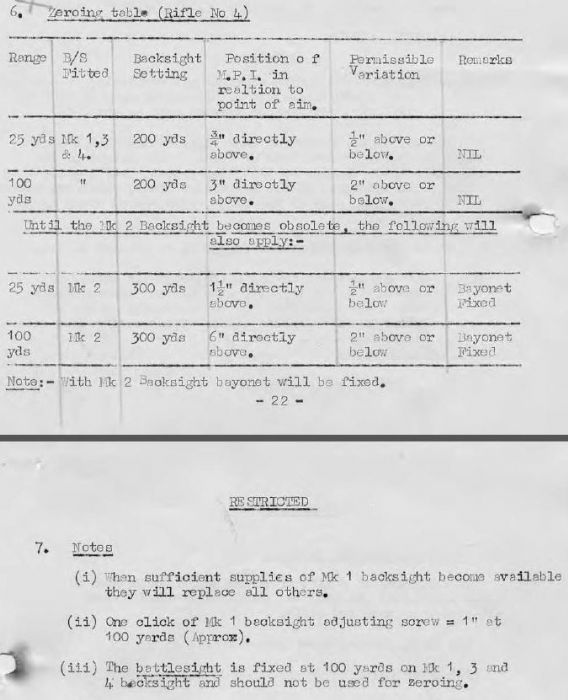 In some cases, the last known pam with zeroing instructions from the Canadians for the No. 4 rifle in particular, they couldn't agree on how much they should have POI over POA when zeroing for 300 yards. People who have sufficient rifles and back sights to play with (i.e. SAIs working with Canadian Rangers and some collectors) have discovered that the battle sight apertures often aren't correctly indexed with each other. And even more so with battle sight apertures and the adjustable sliding apertures. Not surprising, giving the exigencies of wartime manufacturing. Tooling got worn out, jigs got out of adjustment and that wasn't picked up by an inspector at the end of another long shift, etc. The only ones who probably care about that are competitive shooters seriously into competing in the events where the issue sights must be used. The Canadian instructions were that the rifle should be zeroed 2.5 MOA higher than the Brits. Same rifle, same ammunition: different zeroing instructions. Clear as mud? |
||
|
||
|
Rick
Groupie
Joined: April 24 2025 Location: NW MT/SE BC Status: Offline Points: 83 |
Post Options
Thanks(0)
Quote Reply
Posted: September 04 2025 at 4:19pm |
|
Do you have a reliable source of HXP for it to matter? And will you be shooting seriously at longer distances with your rifle and Mk VII ammunition? I think the vast majority have moved on from Mk VII due to its scarcity and obtaining quality Mk VII if they do have a source. I have about 500 rounds of some tight grouping (for Mk VII) 60's HXP, but these days I just hang onto it to use as reference ammunition; for serious and recreational shooting I reload, either commercial or cast bullets. You might consider doing some rough load development (or spend the time to develop the best load you can) to find a decent grouping load. Then forget about the Mk VII stuff: zero your rifle with that load at the distance of your choosing... say 400 yards. Dress down a higher front sight to obtain an exact POA=POI with your load at that distance on your rear sight setting for that range. You will have varying distances of higher/lower POI at ranges above or below that, but you will be very, very close from 200 - 600 yards. For the bigger differences, in your log book you can record the clicks of come-ups you have to move your sight (unless it's the later version without the click adjustment). If you're shooting with an A.J. Parker or Parker-Hale vernier rear sight, you're doing pretty much this anyways, except your logbook has the vernier settings for each range - and they're a starting point from which you fire your sighters.
|
||
|
||
|
Shamu
Admin Group
Logo Designer / Donating Member Joined: April 25 2007 Location: MD, USA. Status: Offline Points: 20510 |
Post Options
Thanks(0)
Quote Reply
Posted: September 04 2025 at 5:55pm |
|
|
There are a few recipes for reloading modem bullets to mimic MkVII ballaistics in the reloading section.
|
||
|
Don't shoot till you see the whites of their thighs. (Unofficial motto of the Royal Air Force)
|
||
|
||
|
britrifles
Senior Member
Joined: February 03 2018 Location: Georgia, USA Status: Offline Points: 8404 |
Post Options
Thanks(0)
Quote Reply
Posted: September 06 2025 at 12:07pm |
|
|
Rick is spot on with this.
You will have difficulty finding a quantity of reliable and accurate Mk 7z ball ammo, and I would stay away from the Mk 7 cordite. HXP does seem to run hot, and its accuracy is not all that great. Some lots may be better than others.
Reloading is the way to go, or buy PPU 174 gr FMJBT commercial ammunition, it should approximate Mk 7 trajectory fairly well (it’s loaded to 2400 fps). 40.0 to 40.3 grains of Varget behind a 174 SMK (2390-2400 fps) does well to replicate the Mk 7 trajectory out to 600 yds. Not likely you will be shooting a No. 4 with as issued sights beyond that. PPU Cases, Varget, and the Sierra 174 MatchKing are readily available in the US if you plan to reload. |
||
|
||
|
Post Reply
|
Page 12> |
| Tweet |
| Forum Jump | Forum Permissions You cannot post new topics in this forum You cannot reply to topics in this forum You cannot delete your posts in this forum You cannot edit your posts in this forum You cannot create polls in this forum You cannot vote in polls in this forum |


 Topic Options
 britrifles wrote: